
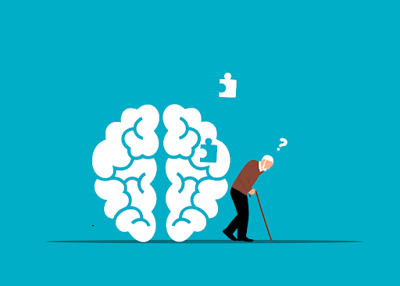

Brain diseases can develop at any age, but are more common in older age. While there is no cure to many of these diseases, spotting the signs early and getting a diagnosis can allow you to manage them better. Below are some of the common conditions that can affect the brain in older age.
Dementia
Dementia is a disease that affects the parts of our brain responsible for cognitive functions. The most common form of dementia is Alzheimer’s, which affects our memory, language and perception skills. Other forms of dementia may have a different impact such as frontotemporal dementia, which causes changes in personality and behaviour. The first signs of dementia include misplacing things, frequently getting lost, repeating oneself and forgetting familiar faces. People with dementia eventually need full-time care, but may be able to retain some independence in the early years.
Parkinsons
Parkinson’s affects the parts of the brain associated with movement. However, it can also cause other problems such as loss of smell, digestive issues and even dementia. Early signs of Parkinson’s include slow movement, uncontrollable tremors and stiffness. Someone with Parkinson’s may be able to remain independent at first with the help of a walking stick or wheelchair, but may eventually need full time care.
Multiple Sclerosis (MS)
MS is an autoimmune disorder in which the immune system attacks the nervous system. Like Parkinson’s, MS can cause mobility issues that get worse over time. However, it generally starts much earlier - often being noticeable before the age of 50. MS can also cause tingling, vision problems, hearing problems and fatigue. It does not usually lead to dementia. Those with MS may be able to remain independent for many years, but may eventually need regular help with tasks like getting washed and dressed.
Stroke
A stroke is caused by a disruption of blood flow to the brain. This can lead to parts of the brain getting damaged. The severity of a stroke can vary depending on how early it is caught and treated. Someone who has had a mild stroke may still be in control of most of their faculties, while severe strokes may render people unable to walk or talk. Assisted living is recommended for people who have mild to moderate strokes. What is assisted living? This is when you live in your own housing on a site with other residents, but have carers on call. Rehabilitative care may be possible to help those with a stroke return to normal. Those who have had a more severe stroke may need constant at-home care or may need to go into a care home.
Normal Pressure Hydrocephalus (NPH)
NPH is rarer than the other conditions listed above, but still affects many people. It is caused by a build-up of fluid in the brain. This can lead to mobility issues, trouble thinking and loss of bladder control. Fortunately, NPH can be treated - however treatment needs to sought out early to prevent permanent damage. Various scans and exams can test for this disease.


(0) comments
We welcome your comments
Log In
Post a comment as Guest
Keep it Clean. Please avoid obscene, vulgar, lewd, racist or sexually-oriented language.
PLEASE TURN OFF YOUR CAPS LOCK.
Don't Threaten. Threats of harming another person will not be tolerated.
Be Truthful. Don't knowingly lie about anyone or anything.
Be Nice. No racism, sexism or any sort of -ism that is degrading to another person.
Be Proactive. Use the 'Report' link on each comment to let us know of abusive posts.
Share with Us. We'd love to hear eyewitness accounts, the history behind an article.