
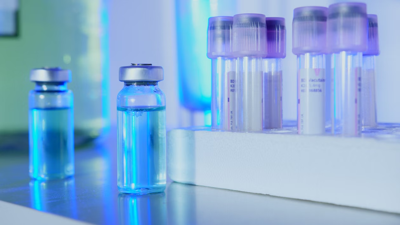
Particle and unknown substance identification analysis is the process of determining exactly what an unidentified material is: its chemical makeup, physical structure, and likely origin. It's the test manufacturers turn to when something shows up where it shouldn't. A speck on a finished product, a residue inside equipment, a discoloration on a surface, or a foreign object found during quality assurance testing. The goal isn't just naming the substance. It's answering the question that actually matters to the client: where did this come from, and how do we stop it from happening again.

How Do Labs Identify an Unknown Substance?
The process almost always starts the same way, regardless of industry: a visual inspection under magnification to assess the material's shape, texture, and consistency. From there, the analysis branches depending on what that inspection suggests.
If the material appears organic, Fourier Transform Infrared (FTIR) spectroscopy is typically the first tool used, since it identifies compounds based on how they absorb infrared light, making it well suited to plastics, polymers, fibers, and other carbon-based materials. If the material looks inorganic, metallic, or mineral in nature, Scanning Electron Microscopy with Energy Dispersive X-ray Spectroscopy (SEM-EDS) provides both high-resolution imaging of the particle's structure and its elemental composition in a single analysis. For crystalline materials, X-Ray Diffraction (XRD) can identify the specific compound based on its atomic structure. When a substance appears biological, microbiological and molecular methods take over instead.
Often, more than one technique is needed to reach a confident answer, and a well-equipped independent laboratory will move between them as the evidence points in a new direction, rather than being limited to a single method.
Who Needs This Kind of Testing?
Particle and unknown substance identification comes up across a wide range of industries, including general manufacturing, electronics and semiconductor production, food and beverage processing, cosmetics and personal care, chemical and materials production, and pharmaceutical manufacturing. ETR Labs offers specialized identification kits to help businesses investigate unexplained particles and contaminants. In most of these settings, an unexplained particle or contaminant isn't just a curiosity. It's a quality assurance issue that can hold up a production line, trigger a customer complaint, or in regulated industries, require formal documentation of the investigation.
Why This Kind of Work Often Needs an Independent Laboratory
Few companies keep this instrumentation and this specific expertise in-house, because the need for it is unpredictable by nature. Nobody schedules an unknown contamination event. That's exactly why independent laboratory testing exists for this purpose: a lab that already owns the FTIR, SEM-EDS, XRD, and elemental analysis capability, and already has chemists who do this kind of investigative work routinely, can move fast when a client can't.
This is also where R&D and chemical engineering consulting often intersects with identification work. Finding out what a substance is answers half the problem. Understanding why it's there, whether it points to a supplier issue, equipment wear, a process change, or contamination in a raw material, is the other half, and it's a question senior chemists are equipped to help think through alongside the client, not just hand off a report and move on.
How Industrial Analytical Services Approaches It
Industrial Analytical Services, Inc., an independent third-party laboratory, performs particle and unknown substance identification analysis using FTIR, SEM-EDS, and related micro-analytical techniques, and more, matched to what the visual inspection and preliminary results indicate. Samples can be submitted directly, without a long quoting process or an account requirement, and reviewed by the same chemists performing the analysis. That expertise is included and available to clients as consultation on what the findings likely mean and where to look next, drawing on ownership and senior chemists' hands-on experience rather than leaving a client to interpret a report alone.
For any company facing an unexplained contaminant, whether it's a one-time quality assurance flag or a recurring issue that's resisted explanation, having a lab that can run the full identification workflow start to finish is often the difference between a quick answer and a problem that lingers.


(0) comments
We welcome your comments
Log In
Post a comment as Guest
Keep it Clean. Please avoid obscene, vulgar, lewd, racist or sexually-oriented language.
PLEASE TURN OFF YOUR CAPS LOCK.
Don't Threaten. Threats of harming another person will not be tolerated.
Be Truthful. Don't knowingly lie about anyone or anything.
Be Nice. No racism, sexism or any sort of -ism that is degrading to another person.
Be Proactive. Use the 'Report' link on each comment to let us know of abusive posts.
Share with Us. We'd love to hear eyewitness accounts, the history behind an article.