

Traveling to the South Pole is one of the most ambitious ways to experience Antarctica, but the journey is very different from a conventional polar cruise.
Most visitors to Antarctica remain relatively close to the coast, particularly around the Antarctic Peninsula. The Geographic South Pole lies far beyond that familiar route, at 90° South, deep within the continent’s interior. Reaching it requires specialist logistics, flexible planning and an expedition structure designed around one of the most remote environments on Earth.
For luxury travelers, however, the experience can extend well beyond simply flying in, taking a photograph at the Pole and leaving again.
A bespoke itinerary might begin aboard a private expedition yacht along Antarctica’s coast before continuing inland, creating a journey that moves from icebergs, wildlife and remote anchorages to the vast emptiness of the polar plateau. Other trips focus entirely on the interior, combining private camps, skiing, overland exploration and time at the Geographic South Pole itself.
Expedition specialists, EYOS Expeditions work across both sides of that experience, organizing private Antarctic yacht journeys as well as expeditions into the continent’s interior. That makes it possible to treat 90° South not as an isolated destination, but as one part of a much broader exploration of Antarctica.
Here is what a luxury South Pole expedition with specialists can actually look like.
What does it mean to travel to the South Pole?
The Geographic South Pole is the point where Earth's lines of longitude converge at 90° South.
It lies on the Antarctic Plateau, far from the wildlife-rich coastline associated with many classic Antarctica trips. There are no hotels, roads or conventional tourism infrastructure, and itineraries remain heavily dependent on weather and ice conditions.
An expedition yacht can take travelers through the Antarctic Peninsula, the Ross Sea and other coastal regions, but a yacht does not sail to the Geographic South Pole. To reach 90° South, travelers must ultimately continue into the interior by specialist aircraft or, for certain expedition formats, by overland vehicle or ski.
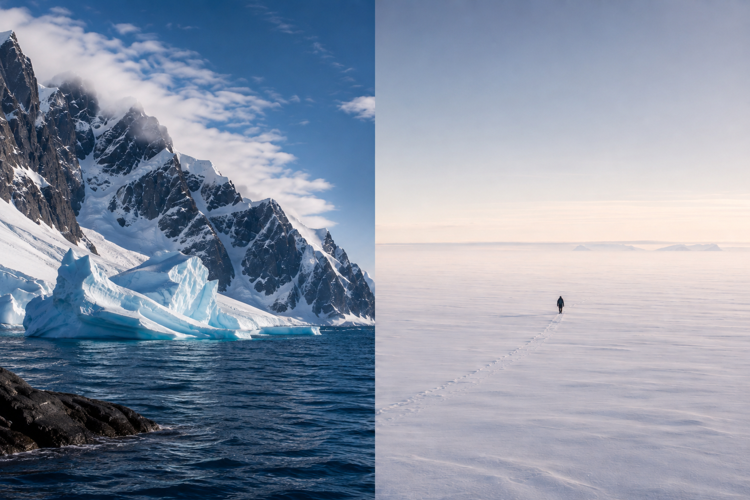
The appeal is therefore not simply arriving at a famous coordinate. It is experiencing the contrast between two very different Antarcticas: the dynamic coastline of icebergs, wildlife and fjords, and the immense stillness of the continental interior.
A South Pole expedition can begin at sea
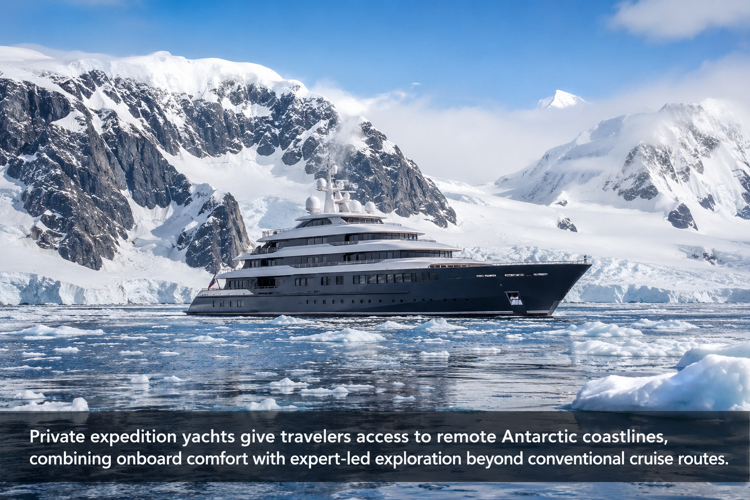
For travelers wanting a broader Antarctic experience, the journey can begin aboard a purpose-built expedition yacht.
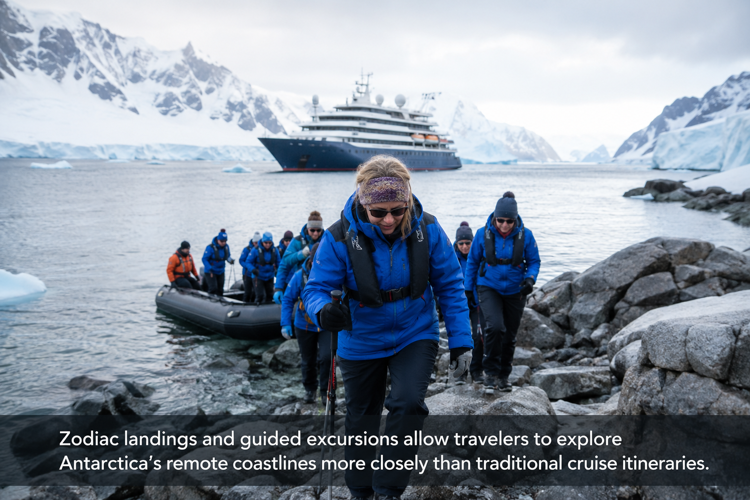
Private yachts offer a very different rhythm from large cruise ships. They can access smaller anchorages and remote landing sites, while expedition tenders such as Zodiacs make it possible to explore close to shore, kayak among icebergs or reach beaches and wildlife areas away from the ship. EYOS South Pole expedition yachts typically combine ice-strengthened hulls with specialized navigation, communication and landing equipment suited to polar conditions.
This coastal section may include destinations such as the Lemaire Channel, Weddell Sea, Danco Coast or Port Lockroy, depending on ice conditions and the particular itinerary.
The important point is that the yacht is not simply transportation. It becomes a private base for exploration, allowing the route to adapt day by day according to weather, wildlife and ice.
That flexibility is particularly important in Antarctica, where a rigid schedule can quickly become irrelevant.
From the Antarctic coast to 90° South
A coast-and-interior itinerary eventually changes character.
Travelers heading to the Geographic South Pole typically access the interior through specialized Antarctic logistics networks. One common route begins in Punta Arenas, Chile, before continuing to Union Glacier, a major private logistics hub in West Antarctica. Flights from Punta Arenas are weather dependent, making contingency days an essential part of any serious itinerary.
From Union Glacier, smaller ski-equipped aircraft can continue across the polar plateau toward the Geographic South Pole. EYOS describes this as the typical route for its private South Pole expeditions.
For travelers who began the journey aboard a yacht, the transition is dramatic. The coastline is filled with recognizable Antarctic life: penguins, seals, whales, rocky islands and enormous icebergs.
The interior strips much of that away.
What remains is scale.

Luxury at the South Pole does not mean a traditional resort
The word luxury means something different this far south.
There is no grand hotel lobby waiting at 90° South. Instead, luxury is expressed through the quality of the logistics: warm sleeping arrangements, carefully planned meals, private guiding, reliable communications and the ability to spend meaningful time in an environment where almost everything has to be brought in.
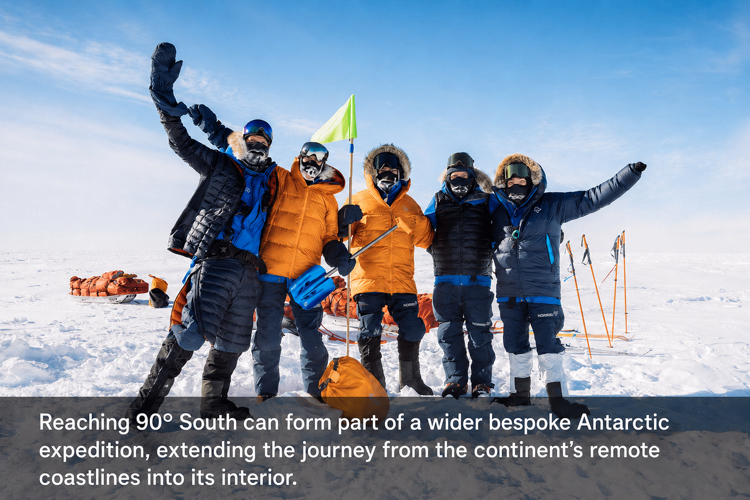
EYOS arranges overnight stays at a private South Pole camp with full-size heated sleeping tents and a heated dining tent.
Other Antarctic interior camps provide double-walled sleeping tents, mattresses, bedding and spaces designed specifically for polar conditions.
The South Pole's physical altitude is about 2,835 meters, while EYOS notes that its physiological effect can feel closer to approximately 3,300 meters, or 11,000 feet. Extreme cold and rapidly changing conditions remain part of the journey regardless of accommodation.
Reaching 90° South can be the beginning, not the whole trip

For some travelers, simply standing at 90° South is the objective.
For others, it is one stage of a much larger expedition.
EYOS offers access to activities across the Antarctic interior that can include hiking, cross-country skiing, downhill skiing, ice climbing, snowmobiling, fat-tire biking and overland exploration. The level of physical challenge can be tailored around the travelers involved.
More ambitious journeys can cover significant distances across the continent.
In one EYOS-documented expedition, photographer Stein Retzlaff joined a team traveling through Antarctica's interior in customized Toyota Hilux vehicles prepared by Arctic Trucks. The trip ultimately reached the Geographic South Pole after traversing vast sections of the continent.
Another option for physically prepared travelers is the Last Degree approach, which begins around 89° South and covers approximately 60 nautical miles on skis before reaching the Pole.
Luxury South Pole travel can therefore range from a relatively comfortable private visit to an expedition that still demands genuine physical effort.
Why the expedition team matters more than the itinerary
The defining feature of a serious polar expedition is not how detailed the itinerary looks on paper.
It is how well the team responds when the itinerary has to change.
Weather, visibility, runway conditions and ice can alter plans with little warning. South Pole itineraries must remain flexible because of weather and ice conditions.
That is where expedition experience becomes more important than conventional hospitality.
Polar guide Mark Sedon, part of the EYOS expedition team, has experienced just how quickly conditions can escalate in Antarctica. Recalling one expedition near the South Pole, he described being hit by a four-day storm shortly after arrival: “Temperatures dropped to below -60 C/F and we battered to keep the tents standing in 40 kt winds.”
The account is an unusually clear reminder that even highly organized polar travel remains exposed to the environment.
Guides and operational teams need to understand ice, terrain, weather, communication systems and contingency planning while still creating an experience that feels personal rather than procedural.
The most memorable luxury is access
What distinguishes a private South Pole expedition from a conventional luxury vacation is not necessarily what happens inside the accommodation.
It is what becomes possible outside it.
A private yacht may allow a small group to explore a secluded Antarctic bay after other vessels have departed. A Zodiac can reach a landing site that would otherwise remain inaccessible. An interior itinerary can be adjusted around skiing, photography, climbing or simply spending more time in a landscape that very few travelers ever see.
The planning by experienced expedition specialists are highly customizable, with activities and routes adapted around guests' interests and abilities.
That changes the definition of luxury.
The value is not a marble bathroom or a familiar hotel experience transplanted onto the ice.
It is privacy, expertise, flexibility and access.
When is the best time to visit the South Pole?
The Antarctic interior is accessible during the austral summer.
December and January are generally the strongest months for South Pole travel, when 24-hour daylight and comparatively favorable operating conditions make flights and exploration more practical.
The wider Antarctic yacht season runs roughly from November through March, with different months producing different conditions along the coast. December and January bring particularly long daylight hours, while wildlife activity changes throughout the season.
Travelers combining an expedition yacht with the South Pole therefore need to consider both the coastal and interior windows.
Even during peak season, however, Antarctic schedules remain provisional.
Weather decides when aircraft move.
Ice decides where yachts can navigate.
The itinerary follows.
How physically demanding is a luxury South Pole expedition?
It depends entirely on how the journey is designed.
Travelers do not need to undertake a multi-week ski traverse to visit the South Pole. The experiences can be adapted to different fitness levels and do not necessarily require previous polar experience.
A relatively accessible itinerary may involve flights, short excursions and comfortable camps.
A more demanding version might add ski touring, climbing, long overland sections or the Last Degree approach.
Whatever the itinerary, travelers should still be prepared for altitude, extreme cold and unpredictable weather.
Luxury reduces logistical friction.
It does not remove Antarctica.

What should travelers look for in a South Pole expedition?
For a destination this remote, the most important questions go beyond cabin size or menu choices.
A credible expedition plan should make clear who is responsible for aviation and ground logistics, what happens during weather delays, what medical support is available, how the operator manages Antarctic environmental requirements and how much genuine polar experience the expedition team has.
For yacht-based portions, the vessel also needs to be appropriate for polar conditions. EYOS highlights ice strengthening, redundant navigation and communication systems, specialized crews and suitable landing craft among the practical considerations for Antarctic expedition yachts.
Travelers should also understand exactly what the words South Pole expedition mean in the itinerary.
Does the trip include the Antarctic Peninsula?
Does it involve an expedition yacht?
Is the Pole a day visit or an overnight stay?
Will the journey include Union Glacier, overland travel or skiing?
Those details can produce completely different experiences even when the final coordinate is identical.
A South Pole journey is ultimately about perspective
Modern logistics have made the Geographic South Pole more accessible than it was during the age of Amundsen and Scott.
They have not made it ordinary.
Even aboard a private expedition yacht or inside a heated polar camp, Antarctica continues to operate on its own terms.
The coast changes with the ice. Weather rewrites schedules. The farther inland the journey travels, the more familiar reference points disappear until the landscape becomes almost entirely white, blue and horizon.
That is why the strongest luxury South Pole expeditions do not try to separate travelers from the reality of Antarctica. They use expertise and comfort to make deeper exploration possible.
For travelers working with specialists such as EYOS, the real privilege is not simply being able to say they reached 90° South.
It is having enough time, access and expert support to understand what reaching it actually means.


(0) comments
We welcome your comments
Log In
Post a comment as Guest
Keep it Clean. Please avoid obscene, vulgar, lewd, racist or sexually-oriented language.
PLEASE TURN OFF YOUR CAPS LOCK.
Don't Threaten. Threats of harming another person will not be tolerated.
Be Truthful. Don't knowingly lie about anyone or anything.
Be Nice. No racism, sexism or any sort of -ism that is degrading to another person.
Be Proactive. Use the 'Report' link on each comment to let us know of abusive posts.
Share with Us. We'd love to hear eyewitness accounts, the history behind an article.