

South Carolina’s fiber race has shifted from simple availability to 5- and 8-gig symmetrical speeds. Only a small share of South Carolina addresses still depend on BEAD funding for a wired build; glass already reaches almost everyone else. Yet Google’s generic “best internet” lists often bury true FTTH beneath cable and satellite results.
We cut through that noise by comparing four multi-gig, symmetrical FTTH plans you can order today, then flagging reliable runners-up if the big four skip your street.
A quick side-by-side look
Need the gist quickly? This table shows which multi-gig fiber plan offers the most bandwidth, the lowest lag, and the best standalone price, with no mobile bundles or teaser rates.
Provider | Why we picked it | Top symmetric tier | Typical latency* | Base price for fastest tier† |
WOW! Fiber | New-build FTTH in Greenville | 5 Gbps | 5 ms | $190 |
AT&T Fiber | Widest multi-gig reach statewide | 5 Gbps | ~10 ms | $135 |
GFiber | All-inclusive 8-gig plan | 8 Gbps | 13 ms | $150 |
Ripple Fiber | Fresh 8-gig option in the Upstate | 8 Gbps | Not reported | Not published |
*Provider-reported median multi-server latency.
†Full standalone monthly rate; hardware and installation included where the provider discloses them.
Why these numbers matter
All four tiers are truly symmetrical, so upload speed matches download, which is crucial for 4K livestreams, cloud backups, and large video pushes.
Latency separates the field. WOW! records a 5 millisecond median latency on its 5 Gig tier that nears esports grade, AT&T averages about 10 ms, and GFiber sits near 13 ms. Ripple hasn’t published comparable data yet, so gamers should double-check with real-world tests.
Keep this cheat sheet close as we explore each provider’s strengths, trade-offs, and fine print.
How we chose and scored these four
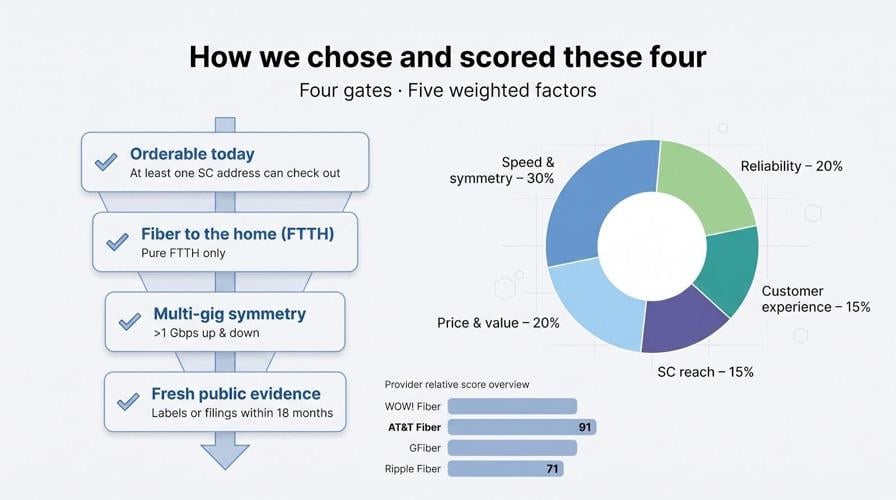
Every provider had to clear four non-negotiable hurdles:
Orderable today. At least one South Carolina address can check out the plan right now, with no “coming soon” banner.
Fiber to the home. Pure FTTH only; cable-fiber hybrids and fixed wireless didn’t qualify.
Multi-gig symmetry. The fastest tier must exceed 1 Gbps up and down.
Fresh, public evidence. A Broadband Facts label, FCC filing, or live checkout screen dated within the last 18 months.
After that gate, we graded contenders on five weighted factors
Speed and symmetry (30 percent): headline speed plus how closely typical speeds match.
Price and value (20 percent): full, non-promo monthly cost (equipment, installation) expressed as dollars per symmetrical gigabit.
Reliability (20 percent): published latency, any uptime guarantee, and documented outage history.
South Carolina reach (15 percent): unique fiber-serviceable locations, not ZIP-code claims.
Customer experience (15 percent): contract terms, data caps, and third-party satisfaction scores.
No provider hit a perfect 100. AT&T led with 91, thanks to broad reach and solid performance, while Ripple landed at 71 because its footprint and public data remain thin. The quick-look table above mirrors those ratings.
Why stop at four picks? Once we enforced the symmetry and evidence rules, familiar names such as Spectrum, Kinetic, and Frontier’s new 7-gig tier either lacked statewide transparency or topped out at 2 Gbps. We’ll call out the strongest near-misses later, but the muscle-tier debate starts here with WOW!, AT&T, GFiber, and Ripple.
WOW! Fiber: best for Greenville’s new-build fiber neighborhoods

Greenville is WOW!’s showcase market. The company’s residential fiber internet services tout 99.99% network reliability, unlimited data, and an optional Price Lock for Life; at qualifying addresses those FTTH lines replace the legacy cable network, so uploads match downloads and latency slips into esports territory.
Expansion continues. On May 19, 2026, the company announced fiber for 10,000 additional homes, businesses, and offices, targeting more than 20,000 passings by fall 2026. Inside that footprint, you can order up to 5 Gbps symmetrical service
Performance numbers support the promise. WOW!’s published performance data for the 5-gig tier lists 5,220 Mbps typical download, 4,650 Mbps typical upload, and 5 ms median latency, faster on ping than most multi-gig rivals. If you lean toward value, the 3-gig plan delivers about 3 Gbps in both directions at a lower monthly cost (label data appears at checkou
Pricing is direct: $190 per month for 5 Gig, equipment included, installation often waived, and an optional $5 per month rate freeze. There are no annual contracts, no data caps, and a 30-day money-back guarantee. (WOW! fiber plans start at $40 per month if you do not need multi-gig speed.)
Reach is the catch. Outside Greenville County, WOW! serves South Carolina with hybrid-cable lines that cap uploads below 200 Mbps. Always look for “Fiber to the home” and matching upload and download figures before celebrating multi-gig symmetr
AT&T Fiber: best overall availability
Need multi-gig fiber without moving? AT&T’s XGS-PON network now covers much of Columbia, Charleston, Greenville, and dozens of smaller towns, giving it South Carolina’s broadest 5 Gig footprint.
Performance is enterprise grade. AT&T’s Broadband Facts labels for the 5-Gig tier typically show download and upload speeds close to the 5 Gbps headline and median latency around 10 ms. Video calls, cloud backups, and large uploads stay stable even under heavy load. Pricing is competitive for the speed: $135 per month, equipment and standard installation included. Intro deals can trim the first-year bill, and AT&T’s month-to-month terms let you leave when a better offer shows up.
Mind one quirk: after a 2026 lineup refresh, new customers jump from 1 Gig straight to 5 Gig, with no 2-Gig option in between. Legacy 2-Gig accounts remain, but newcomers must choose between savings and headroom.
Most homes feel that 1 Gig is plenty, yet anyone uploading 4K footage or running VR sessions will welcome the 5-Gig cushion. Remember, a single wired device tops out around 4.7 Gbps after Ethernet overhead; spread the bandwidth across multiple PCs and consoles to feel the full benefit.
Bottom line: if your address shows “AT&T Fiber 5 Gig available,” you get statewide reach, proven speeds, and mid-pack pricing, with no contract required.
GFiber: best premium 8-gig package
GFiber’s footprint is tiny, mainly Fort Mill and Tega Cay, yet on those streets it feels more like a tech upgrade than a utility bill. The flagship 8 Gbps / 8 Gbps tier costs $150 per month, or about $18.75 per symmetrical gigabit, the strongest dollar-for-speed ratio in this roundup.
Value is only half the draw. The plan bundles Wi-Fi 7 equipment, mesh extenders, professional installation, and a battery backup for the optical network terminal at no extra charge. GFiber also pledges 99.9 percent uptime with a 25 percent bill credit if it falls short, and lists a typical 13 ms multi-server latency on its broadband label.
Your own hardware becomes the bottleneck. Wi-Fi 7 peaks around 3.4 Gbps per device; to max out the line you need a 10-gig Ethernet NIC and CAT6A cabling. Spread across several wired and wireless clients, though, the extra headroom makes large uploads and parallel 4K streams feel instant.
Coverage is the trade-off. GFiber serves only a slice of South Carolina and often overlaps Comporium. Check both providers at your exact address. If the green “Fiber is here” tag appears, you get contract-free, all-inclusive pricing and more bandwidth than most households can exhaust.
Ripple Fiber: best emerging Upstate 8-gig option
Ripple Fiber is the newcomer, yet it jumped into the deep end in early 2026 with new 5 and 8 Gig symmetric tiers and bundled Wi-Fi 7 hardware. All multi-gig packages include LTE fail-over and a three-year price lock, according to Ripple’s press materials.
Coverage stays hyper-local: Woodruff in Spartanburg County and Lexington in the Midlands are live, with the company saying more towns are coming. Address checks show 2, 5, and 8 Gig options where service is live; the on-screen Broadband Facts label remains your best source for price, latency, and install fees.
Public speed-test data on Ripple is still thin, so treat its performance as promising but unproven.
Ripple’s site shows plans starting at $40 with speeds up to 8 Gig, giving Upstate creators who have outgrown WOW!’s 5-Gig upload a fresh alternative. Even at a small premium, the baked-in LTE backup could appeal to remote workers who cannot risk downtime.
Ripple is not statewide, and it has not published latency data yet. If your exact street qualifies, read the label carefully and have a 10-Gig router ready to unlock the full speed.
Other fast fiber providers to consider
Our four picks cover most multi-gig choices, but South Carolina has several almost-there contenders. Each provider below advertises at least 2 Gbps symmetrical service somewhere in the state; most need newer broadband-label data before they can crack the main list.
Provider | Fastest advertised tier | Primary territories | Why it missed the top four |
Frontier (now Verizon) | 7 Gbps* | Horry, Lexington, York | A 7-Gig label exists, but no verified South Carolina address yet; 5 Gig is widely live. |
CarolinaConnect | 8 Gbps* | Electric-coop areas in the Midlands | Member-login label hides price and latency. |
WCTEL / WCFIBER | 8 Gbps* | Abbeville, Greenwood, McCormick | Publishes a $125 8 Gig price, but no current Broadband Facts label was captured. |
Comporium | 1 Gbps | Rock Hill, Fort Mill, Tega Cay | Tops out at 1 Gig on its public plan page; 24-month promo pricing. |
Brightspeed | 2 Gbps | Rural passings across the state | Tops out at 2 Gig today, though XGS-PON-ready. |
Kinetic | 2 Gbps | Dozens of small towns | Strong rural reach, but no tier above 2 Gig. |
Spectrum 100 Percent Fiber | 2 Gbps | Scattered streets inside cable markets | Limited address count; no 5-Gig plan yet. |
T-Mobile Fiber (Lumos network) | 2 Gbps | Columbia, Greenville, Spartanburg | Retail transition froze speeds at 2 Gig for now. |
*Speed documented on a corporate page or grant filing; we have not captured a current South Carolina Broadband Facts label or live checkout at that tier.
Why bother with these near-misses? Fiber footprints rarely overlap. If the big four do not serve your street, plug your address into Frontier, CarolinaConnect, or WCFIBER before you settle for cable; you might unlock a symmetric line that generic lookup tools miss. We will refresh this table as soon as any of these networks publish updated labels or expand their fastest tiers statewide.
Fiber availability by South Carolina region
(Use this map for orientation, then drill down to your exact address. Data sources: FCC BDC Q2 2026 and provider broadband labels.)
Charleston and the Lowcountry
AT&T Fiber: up to 5 Gig. Strong in North Charleston, Mount Pleasant, and Goose Creek.
Home Telecom offers fiber in Berkeley and Dorchester counties; check the label for current tiers.
Spectrum 100 Percent Fiber: 2 Gig pockets only; verify the label for a 2,000 Mbps upload.
PRTC tops out at 1 Gig today, but grant filings show 10-Gig-ready XGS-PON. Recheck every six months.
Historic-district permits slow aerial builds downtown, so incumbents with existing ducts, mainly AT&T, arrive first.
Columbia, Lexington, and the Midlands
AT&T Fiber: 5 Gig blanket west of I-77; the 2-Gig tier retired in 2026.
T-Mobile Fiber (Lumos network): 2 Gig in Lexington, Cayce, and West Columbia; conduit is XGS-PON, so higher tiers are firmware ready.
CarolinaConnect: 8 Gig on co-op poles; membership often required.
Spectrum 100 Percent Fiber: 2 Gig greenfield builds west of Lake Murray.
Greenville and Simpsonville
Competition is fierce: WOW! 5 Gig (5 ms latency) and AT&T 5 Gig often overlap in new subdivisions, and Ripple’s 8 Gig is live in nearby Woodruff. Downtown Simpsonville adds T-Mobile Fiber 2 Gig as a budget option. Confirm you are on WOW!’s FTTH tier; look for equal upload and download speeds.
Spartanburg and the Upstate
T-Mobile Fiber 2 Gig across Boiling Springs, Duncan, and Moore.
AT&T 5 Gig fills gaps east of I-26.
Brightspeed 2 Gig keeps adding rural passings across the Upstate.
Spectrum is piloting high-split cable upgrades; a 500 Mbps upload line signals the stopgap, not true fiber.
Rock Hill, Fort Mill, and Tega Cay

Three-way shoot-out: GFiber 8 Gig ($150), Comporium 1 Gig (24-month pricing), AT&T 5 Gig. Always enter the full street address; one side of a subdivision can be live while the other waits months.
Myrtle Beach, Conway, and Horry County
HTC 2 Gig dominates the Grand Strand.
AT&T 5 Gig appears west of Highway 17 and in new golf-course developments.
Frontier 5 Gig (Verizon) around Conway; a 7 Gig label exists, but no live South Carolina address yet.
Spectrum 100 Percent Fiber 2 Gig shows up inside select master-planned resorts; verify by checking for a 2,000 Mbps upload.
Rural and co-op territories
CarolinaConnect 8 Gig on Aiken, Mid-Carolina and Newberry co-op poles plus a few Midlands towns.
WCFIBER 8 Gig in Abbeville, Greenwood, and McCormick; often tops state speed-test consistency charts.
Upcountry Fiber (Blue Ridge Electric and WCFIBER) sits at 1 Gig today on 10-Gig-ready glass.
TriCoLink runs fiber in Calhoun and Kershaw counties; watch its plan page for tiers above 1 Gig.
Municipal FTTH: Orangeburg County Broadband and Chesnee Communications run 1-2 Gig links with quick local repair.
Takeaway: rural does not equal slow. If your power bill goes to a co-op, you may already qualify for 8 Gig symmetry, so check the label before assuming cable is your only choice.
Advertised speed versus real-world performance
Multi-gig banners look impressive, but provider labels reveal how those numbers translate at the wall jack.
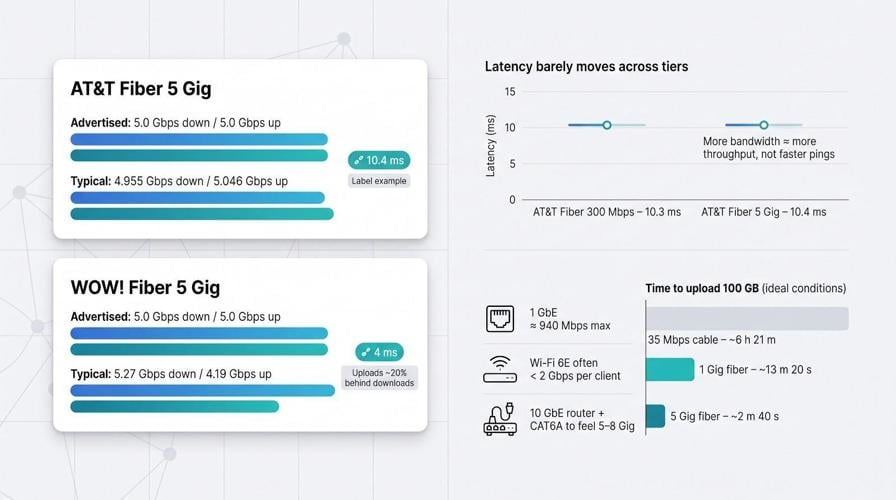
AT&T 5 Gig. Its labels typically show speeds at or near the 5 Gbps headline rate with median latency around 10 ms.
Provider guidance backs this up: WOW!’s network disclosure recommends a Cat6a or better Ethernet cable for speeds above 1 Gbps and cautions that Wi-Fi tests reflect lower speeds.
WOW! 5 Gig. Its published metrics show 5,220 Mbps down, 4,650 Mbps up, 5 ms latency; uploads run about 11 percent behind downloads but still crush any cable tier.
Latency barely moves across tiers. AT&T’s 300 Mbps fiber plan posts latency in the same 10 ms range as its 5 Gig tier, proving that more bandwidth mainly buys throughput, not faster pings.
Your hardware is the real choke point
1 GbE port → max ~940 Mbps
Wi-Fi 6E → often under 2 Gbps per client
To feel 5-8 Gig, you need a 10 GbE router, CAT6A cabling, and multi-gig NICs.
What faster uploads actually save
Upload rate | Time to push 100 GB* |
35 Mbps cable | ~6 h 21 m |
1 Gig fiber | ~13 m 20 s |
5 Gig fiber | ~2 m 40 s |
*Ideal conditions; excludes protocol overhead.
If you move raw 4K footage or nightly cloud backups, the hours shaved off justify the premium. For everyone else, a solid 1 Gig symmetric plan usually feels identical once the speed-test buzz wears off.
Bottom line: ignore the billboard, read the broadband label, and confirm your gear can keep up before paying for more zeros.
Is multi-gig fiber worth the money?
Bandwidth only matters when it shortens real tasks. Most households cruise through streaming, gaming, and video calls on 300-500 Mbps. Moving to 1 Gbps future-proofs a smart home full of cameras and consoles; anything higher needs a business case.
How much time do multi-gig uploads save?
Plan | Typical upload | 100 GB file* |
35 Mbps cable | 35 Mbps | ~6 h 21 m |
1 Gig fiber | 940 Mbps (1 GbE) | ~13 m |
5 Gig fiber | 4.7 Gbps (Ethernet overhead) | ~2 m 40 s |
*Ideal conditions; excludes protocol overhead.
Multi-gig shines when two remote workers, multiple 4K streams, and a 100 GB game patch hit the network at once. Shared capacity, not single-device speed, is the hidden win.
What it will not do: lower latency. Your game ping stays about the same on 1 or 5 Gbps. Nor will a 2×2 Wi-Fi client ever top 1.2 Gbps; you need wired 2.5 GbE or 10 GbE and Wi-Fi 7 to feel the extra headroom.
Quick rule of thumb
Stick to 1 Gig if you rarely upload huge files and manage fewer than 25 active devices.
Consider 2-3 Gig when multiple creators share the house and you already own 2.5 GbE gear.
Jump to 5-8 Gig only if nightly workflows punish slower tiers, and budget for a 10 GbE switch, NICs, and CAT6A along with the higher bill.
Run your own test: push a large cloud backup while streaming two 4K videos and downloading a game update. If Task Manager barely passes 900 Mbps, upgrade Wi-Fi before paying for more zeros. If the needle flat-lines at your current ceiling, you are the rare home that can use multi-gig fiber, and South Carolina finally has the networks to match.
Pricing, promotions, and extra costs
Headline prices rarely survive a full 24-month test. Use the checklist below to spot the fees that turn a “$XX per month” banner into a bigger bill.
Cost bucket | Typical treatment* | What to look for on the label |
Installation | $0 at AT&T and GFiber, $100 list price at WOW! (often waived); Ripple rolls it into the monthly rate during the initial build phase | The “One-time purchase fee” line |
Equipment | AT&T bundles All-Fi Pro; GFiber includes gateways and extenders; WOW! includes one Wi-Fi access point and charges $10 per month for a second; Frontier and Brightspeed sometimes add $10 per month after year 1 | The “Provider monthly fees” section |
Promo rate | AT&T 5 Gig shows $95 in year one → $135 in year two with AutoPay; WOW! takes up to $10 off the mobile bill when you bundle WOW! Mobile; offers disappear if you drop AutoPay or wireless | “Introductory rate” and sunset date |
Price lock | WOW! sells a $5 per month Price Lock for Life on Fiber 500 and higher that holds the base rate for as long as you stay a customer at the same speed; Frontier advertises four- or five-year guarantees tied to AutoPay and paperless billing | Fine print under “additional charges and terms” |
*Based on provider Broadband Facts labels accessed September 2026.
Build a two-year cost model
Total = (Base rate × 24) + (Equipment × 24) + Install - Promo savings
Run that number for every provider before you sign. The cheapest headline rate often loses once you add equipment or when a teaser expires.
Key reminders:
Taxes and government fees rise outside the price lock.
A waived install today can return tomorrow; screen-shot the offer.
Mobile or TV bundles lower the bill only while you keep the bundle.
Spend five minutes with the label and a spreadsheet now; it can save hundreds by month 18.
Reliability, latency, and staying online during an outage
Speed is fun, but downtime costs real money. We graded each provider on three things: typical latency, backup options, and any written uptime credit.
Provider | Median latency* | Backup path | Uptime credit |
WOW! 5 Gig | 5 ms | BYO UPS | None |
AT&T 5 Gig | ~10 ms | Optional 12-hour LTE kit (~$10 per month) | None |
GFiber 8 Gig | 13 ms | Battery plus auto-tether | 99.9 percent (25 percent credit) |
Ripple 8 Gig | NR | LTE fail-over included | NR |
*Provider Broadband Facts labels, September 2026.
GFiber leads on guarantees: 99.9 percent uptime and a 25 percent bill credit if it falls short. A bundled battery keeps the ONT alive during short blackouts, and the router can tether to cellular if the fiber drops.
WOW! offers no formal SLA, yet its 5 ms published latency makes it the latency champ, ideal for esports or real-time trading. Bring your own UPS; WOW! does not include one.
AT&T sits in the middle. Latency hovers around 10 ms, and the optional Internet Backup kit provides a 12-hour 4G link for roughly $10 per month, affordable insurance for tele-health or crypto traders.
Ripple bundles LTE fail-over on 5- and 8-Gig tiers, but public latency data are still missing. Public data are thin, so we tag its reliability as promising but unproven.
Fiber still breaks: regional outages hit every network from time to time, so keep offline copies of critical files and a phone hotspot handy.
Checklist
Latency under 15 ms.
A realistic backup path (battery, UPS, or LTE).
A written uptime credit if your work is mission-critical.
A line that stays lit beats one that merely tests fast.
South Carolina’s fiber expansion timeline: 2025-2026 at a glance
Fiber build-outs move quickly. Here is a two-year reel of milestones that pushed multi-gig service across the Palmetto State.
Spring 2025: GFiber launches in Fort Mill and Tega Cay.
April 1, 2025: T-Mobile closes its Lumos retail takeover.
January 20, 2026: Verizon completes its Frontier acquisition.
Early 2026: Brightspeed keeps expanding its rural South Carolina fiber build.
Early 2026: Ripple adds 5 and 8 Gig tiers.
May 19, 2026: WOW! announces 10,000 more Greenville passings.
Mid 2026: AT&T retires its 2 Gig plan.
Looking ahead to 2027: expect Spectrum, Brightspeed, and CarolinaConnect to climb above 2 Gbps, and watch whether AT&T follows Frontier past 5 Gig. Many rural co-ops already run 10-Gig-ready glass; once take rates climb, the throttle comes off.
How to confirm multi-gig fiber at your exact address
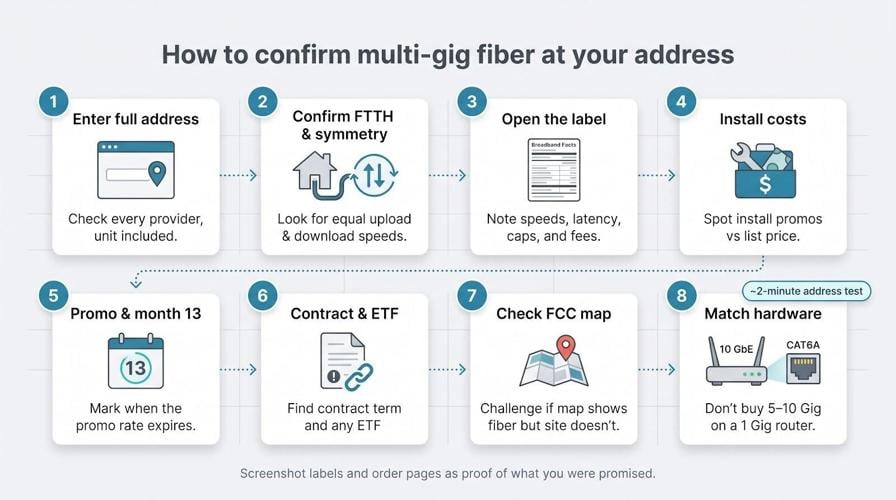
Provider splash maps look promising, but nothing beats a two-minute address test. Run this checklist before you cancel your old line or drill holes for new cable.
Enter your full street address, unit number included, on every provider site. One side of a rural road can be live while the other waits months.
Look for “fiber to the home” or matching upload and download speeds. If the page shows 5,000 / 35 Mbps, you are on upgraded cable, not true FTTH.
Open the FCC Broadband Facts label in the checkout flow. Scan advertised and typical speeds, latency, equipment fees, and any caps, then take a screenshot.
Note the installation price and whether it is waived. A $0 promo today can jump back to $99 tomorrow.
Check promotion length and mark the sunset date. Circle month 13 so a surprise bill never sneaks up.
Verify the contract term and early-termination fee. Most fiber is month-to-month, but some co-ops and legacy Frontier plans still carry an ETF.
Cross-check the FCC National Broadband Map. If the map shows fiber but the ISP does not, submit an availability challenge; providers often update records within weeks.
Match hardware to speed. Ordering 10 Gig on a 1 Gig router wastes money; budget for a 10 GbE WAN port, CAT6A cabling, and at least one wired client.
Five minutes of detective work now can save hours on hold later. Keep those screenshots; they are proof of what you bought and what you were promised.
FAQs
What is the fastest residential fiber in South Carolina right now?
GFiber’s 8 Gig tier is the raw-speed champ, but only in Fort Mill and Tega Cay. Ripple matches 8 Gig in Woodruff and Lexington, and Frontier (now Verizon) advertises 7 Gig, yet has not published a live South Carolina label.
Which providers actually sell 8 Gig service?
GFiber, Ripple, and two rural co-ops, CarolinaConnect and WCFIBER, list 8 Gig plans. Coverage is hyper-local, so check each street address.
Is 2 Gig internet worth it?
Yes, if you upload large files or run many simultaneous 4K streams. For most homes, 1 Gig symmetric feels identical in everyday use.
Will a higher tier lower my gaming ping?
No. Latency depends on network design and distance to the server, not bandwidth. WOW!’s 5 Gig tier is measured at 5 ms, while AT&T’s 300 Mbps fiber tier sits near 10 ms.
Can Wi-Fi hit 5 Gig or 8 Gig?
Not to one device. Even Wi-Fi 7 tops out around 3.4 Gbps per client. Use wired 10 GbE ports for true multi-gig transfers.
Do any South Carolina fiber plans have data caps?
None of the providers covered here enforce a residential data cap on fiber tiers.
Is WOW! Fiber live in Charleston?
No. WOW!’s fiber build and its 5 Gig tier are limited to Greenville County. Charleston remains on legacy cable.
Is Spectrum’s service fiber or cable?
Most addresses use upgraded cable. Look for the “100 Percent Fiber” badge and 2,000 Mbps upload on the label to confirm real FTTH.
Are Lumos and T-Mobile Fiber the same?
T-Mobile took over Lumos retail accounts in 2025. You order through T-Mobile, but the physical network remains Lumos-owned.
Will fiber stay up during a power outage?
The glass keeps working, but your equipment needs electricity. GFiber includes a battery; everyone else expects you to add a UPS.
When will BEAD-funded construction reach my home?
Only a small number of South Carolina addresses remain in the BEAD build queue. If your property is marked “BEAD” on the state map, construction should finish by 2030 at the latest.
Conclusion
Still puzzled? Drop your ZIP code in the comments, and we will update the guide as new fiber lines light up. Until then the rule is simple: in South Carolina, fastest means symmetrical, so judge the four picks on the upload figure and the region map, not the download number on the banner. AT&T Fiber covers the most ground, GFiber and Ripple Fiber carry the 8-gig tiers, and WOW! Fiber is the one to check in Greenville's new-build streets. Confirm at your address, read the promotion fine print, and buy the tier the speed section says you will actually use.


(0) comments
We welcome your comments
Log In
Post a comment as Guest
Keep it Clean. Please avoid obscene, vulgar, lewd, racist or sexually-oriented language.
PLEASE TURN OFF YOUR CAPS LOCK.
Don't Threaten. Threats of harming another person will not be tolerated.
Be Truthful. Don't knowingly lie about anyone or anything.
Be Nice. No racism, sexism or any sort of -ism that is degrading to another person.
Be Proactive. Use the 'Report' link on each comment to let us know of abusive posts.
Share with Us. We'd love to hear eyewitness accounts, the history behind an article.