
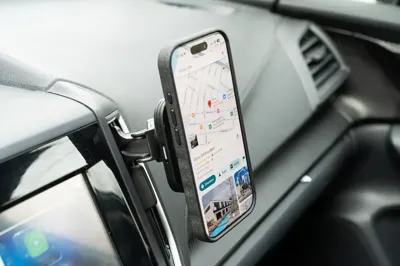

Most phone mounts fail at the worst possible moment. You hit a pothole. The arm swings. Your $1,000 phone slides across the dashboard while you're doing 65 mph on the freeway. If you've experienced the hunt for a mount that actually stays put through a full commute, you know how frustrating the selection becomes.
This guide covers what to look for, attachment type, phone grip, and everything in between, so you can pick a phone mount that stays secure during long daily trips without remounting your phone every other exit.
What Actually Makes a Phone Mount Stay Put
The right mount grips your dashboard or windshield with enough force to handle vibration, heat, and sudden braking. That's the baseline. In phone mounting systems, there are different full-contact approaches; options like a phone mount by STATIK and from other similar brands use a vacuum suction mechanism that creates a sealed hold on flat surfaces, while many other brands and models rely on adhesive pads that lose strength over time and under stress.
Suction vs. Adhesive vs. Vent Clip
Suction cup mounts attach directly to your windshield or a flat dashboard panel. A strong suction seal can hold several pounds of force, and you can reposition without damaging your car's interior. Adhesive mounts bond with a sticky pad that degrades in heat. Here's the thing: on a hot summer day in Phoenix, interior temps can reach 160°F (Automobile Club of Southern California heat data), and cheap adhesive fails fast. Vent clip mounts work when you're in a hurry, but they transfer vibration straight from the engine to your phone- not ideal for multi-hour trips.
Why Clamp Tension Matters More Than You Think
Your phone needs gripping at the sides, not just resting in a cradle. Spring-loaded clamps with 360-degree articulation keep the phone stable even on rough road surfaces; a clamp that loses tension after a few weeks is a common problem with low-cost mounts. Look for clamps rated to hold phones up to 3.5 inches wide, covering most modern flagship sizes.
Heat and Vibration: The Two Silent Mount Killers
Heat softens plastics and degrades adhesives; vibration loosens joints over time. The best mounts use reinforced polymer arms and metal locking joints instead of all-plastic construction. And if you see a mount advertised with a rubber-coated ball joint, that's worth paying attention to. The rubber absorbs micro-vibrations rather than letting them rattle the clamp loose.
How to Match the Mount to Your Car and Phone
Not every mount works on every dashboard. Some cars have curved windshields that reject flat suction cups. Others don't have any usable flat panel near the driver's line of sight.
Windshield vs. Dashboard Placement
Windshield mounts position your phone high, near your natural eye line, which reduces head movement and is generally safer. But some states restrict windshield mounting by law (California Vehicle Code Section 26708 restricts objects affixed to windshields in specific zones), so check your local rules first. Dashboard-mounted options work well if your dash has a flat section near the center console; many vacuum-style mounts attach there cleanly.
Phone Size and Case Compatibility
If you run a thick protective case, a mount with a narrow clamp range will fight you every morning. Check the mount's stated grip width before you buy; most modern mounts claim compatibility with phones up to 3.5 inches wide and 0.35 inches thick with a case. Your oversized battery case or rugged case might push past that, so measure first.
Arm Length and Viewing Angle
A short arm puts the phone too close to the vent or too low on the dashboard. That means more eye travel from the windshield. An arm in the 4-to-6-inch range gives you room to position the phone at eye level without blocking your view of the windshield. Adjustable gooseneck arms let you dial in the exact angle, but they wear out faster than rigid ball-joint arms on long trips because the flex point takes constant stress.
Picking a phone mount that stays secure during long daily trips comes down to three things: the attachment mechanism, the clamp build quality, and the fit for your specific car and phone. Vacuum suction beats adhesive for reliability. Metal joints outlast plastic ones. And getting the arm length right means you won't glance away from the windshield any longer than necessary. Buy once, mount once, and drive without the distraction of a phone that keeps sliding loose.

(0) comments
We welcome your comments
Log In
Post a comment as Guest
Keep it Clean. Please avoid obscene, vulgar, lewd, racist or sexually-oriented language.
PLEASE TURN OFF YOUR CAPS LOCK.
Don't Threaten. Threats of harming another person will not be tolerated.
Be Truthful. Don't knowingly lie about anyone or anything.
Be Nice. No racism, sexism or any sort of -ism that is degrading to another person.
Be Proactive. Use the 'Report' link on each comment to let us know of abusive posts.
Share with Us. We'd love to hear eyewitness accounts, the history behind an article.