

"Free AI API" sounds too good to be true, so it's worth explaining what's real and what's marketing. In 2026 there are genuinely legitimate ways to call powerful AI models at no cost — through starter credits, rotating $0 models, and program-based grants — provided you know where to look and what the limits are.
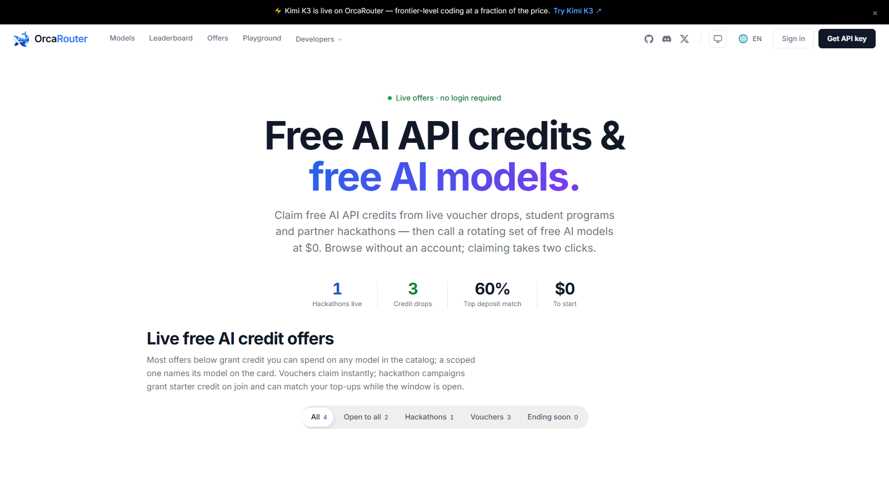
A concrete platform makes this easier to picture. OrcaRouter exposes many models through one OpenAI-compatible endpoint, and its free AI API offers — credit drops and a rotating set of $0 models — let you make real calls with no card. With that as a reference, here's how free AI API access actually works, so you can start building without spending anything.
The three flavors of "free"
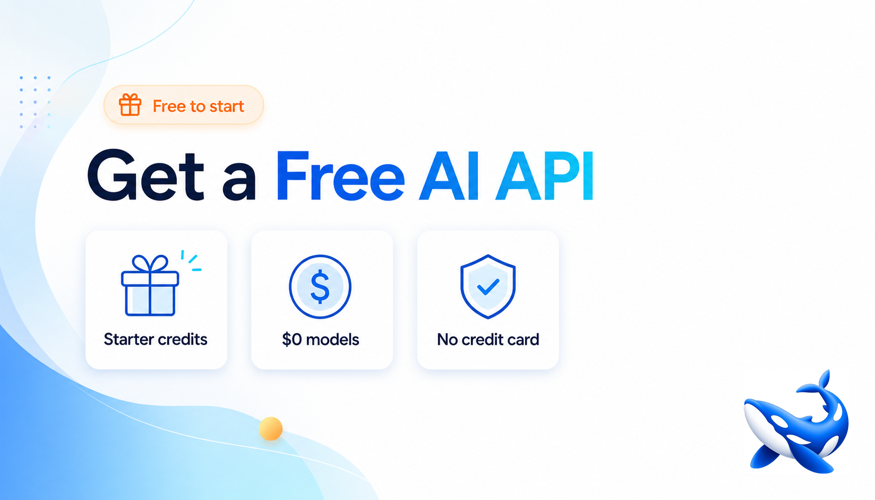
Free AI API access generally comes in three forms. First, starter credits: a balance you receive on sign-up (or by claiming a voucher) that you spend on real API calls. Second, $0 models: a rotating set of models a platform runs at no cost, callable like any other. Third, program grants: credits from student programs, hackathons, or partner campaigns, sometimes with a top-up match. Each has different limits, but all let you make real calls to real models for free.
What you can do with free access
More than you'd expect. Free credits and $0 models are enough to build and test a genuine prototype: wire up a chatbot, run a classification or extraction pipeline over sample data, compare several models on your task, or demo a feature to stakeholders. The free tier is designed for exactly this — learning, prototyping, and evaluating before you commit spend. It's not meant to run a high-traffic production app indefinitely, but it's more than enough to prove an idea.

No account, no card, no sales call
The best free AI API experiences remove the usual friction. On a well-designed platform you can browse available offers without even logging in, and claiming credit takes a couple of clicks. Getting an API key is a matter of seconds, with no credit card required and no sales conversation to sit through. That low friction matters: the whole point of a free tier is to let you make a real call in minutes and decide for yourself, rather than reading a pricing page and guessing.
A concrete example
To make this tangible: a good offers page lists credit drops and campaign-based grants, and exposes a rotating set of models you can call at $0 — with credits that are usually spendable on any model in the catalog. You browse the offers without an account, claim in two clicks, and get an API key in about thirty seconds without a card. Whatever platform you choose, that's the kind of low-friction free access to look for.
Reading the fine print
Free is real, but bounded — and the limits are the important part. Check how much credit an offer grants and roughly how many tokens that buys. Note whether a credit is general (spendable on any model) or scoped to a specific model. Watch expiry windows, since offers are often time-limited. And understand the step up to paid, so you're not surprised when free credit runs out mid-project. None of this makes free access less useful — it just helps you plan around it.
From free to production
The smart path is to use free access to learn and validate, then transition to paid once you know what you need. Because a good free AI API is the same platform as its paid tier, that transition is seamless — you keep your code and your model choices and simply start spending real balance. Build during the free phase on an OpenAI-compatible platform, and scaling up later is a billing change, not a migration.
Knowing when to switch from free to paid
The free tier is a phase, not a destination, and the skill is recognizing when you've outgrown it. A few clear signals: you're hitting rate limits or quotas that throttle your testing; you need guaranteed availability of a specific model rather than a rotating lineup; your prototype is becoming a product with real users; or your monthly usage would exceed what free credits realistically cover. When two or more of those are true, it's time to move to paid — and the move should be uneventful.
Plan the transition while you're still on free. Use the evaluation you did during the free phase to estimate your real volume and pick the model (or models) you'll run in production. Confirm your platform keeps free and paid on the same OpenAI-compatible endpoint, so switching is a billing action rather than a re-integration. Set a small budget and a usage alert so your first paid month has no surprises. Done this way, "graduating" from free is anticlimactic: your code doesn't change, your model choices carry over, and you simply start spending real balance. The value of the free phase is that you enter paid already knowing exactly what you need — which model, at what volume, for what cost — instead of guessing. That's a much stronger position than signing up for a paid plan cold.
Frequently asked questions
Is a free AI API actually free? Yes, within limits — via starter credits, rotating $0 models, and program grants. It's meant for prototyping and evaluation, not unlimited production use.
Do I need a credit card? On the best platforms, no — you can get a key and start calling without a card.
What can I build with it? Prototypes, demos, classification/extraction pipelines, chatbots, and model comparisons — real calls to real models.
Are the free models any good? Often surprisingly capable — free tiers frequently include strong recent models on a rotating basis.
What happens when credits run out? You transition to paid on the same platform, keeping your code and model choices; it's a billing change, not a rewrite.
How do I claim credits? Usually a couple of clicks on an offers page — some let you browse without even logging in first.
A free AI API in 2026 is a real, practical way to start building: starter credits, $0 models, and program grants let you make genuine calls to capable models with no card and almost no friction. Use it to learn, prototype, and compare models before spending; watch the credit amounts, model scoping, and expiry windows; and pick a platform where scaling to paid is seamless. Start free, prove your idea, then grow into paid on the same stack.
(0) comments
We welcome your comments
Log In
Post a comment as Guest
Keep it Clean. Please avoid obscene, vulgar, lewd, racist or sexually-oriented language.
PLEASE TURN OFF YOUR CAPS LOCK.
Don't Threaten. Threats of harming another person will not be tolerated.
Be Truthful. Don't knowingly lie about anyone or anything.
Be Nice. No racism, sexism or any sort of -ism that is degrading to another person.
Be Proactive. Use the 'Report' link on each comment to let us know of abusive posts.
Share with Us. We'd love to hear eyewitness accounts, the history behind an article.