
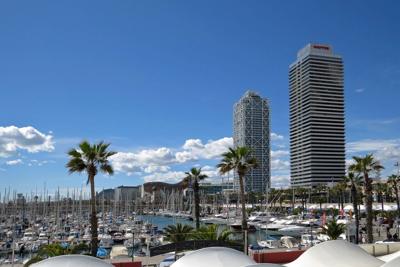

Barcelona's property now averages €4,719 per square meter, roughly $510 per square foot at current exchange rates, which for buyers from New York or Miami can look surprisingly accessible for a city with this kind of reputation. It's the third highest of any provincial capital in Spain (only San Sebastián and Madrid are more expensive). It's a number that gets quoted constantly as a proxy for "luxury", but why? That's the average, and by definition, average doesn't mean luxury just because it's expensive. Even the neighbourhoods that cost more than average aren't automatically luxury.
A price per square metre only tells you what a district costs, not what it's actually selling. It's better to divide properties for sale in Barcelona into regions and explore what separates expensive from luxury.
Eixample sells heritage
Eixample's premium is mostly a heritage one. And heritage doesn't get built twice. Two of its buildings, Casa Batlló and Casa Milà, belong to the seven-building "Works of Antoni Gaudí" UNESCO World Heritage Site, inscribed in 1984 and extended in 2005 to bring Casa Batlló into the listing.
Passeig de Gràcia is now Spain's single most expensive retail street. According to Cushman & Wakefield's annual Main Streets Across the World report, it ranks among the 20 most expensive retail locations on the planet. It's because you can't just build this tomorrow. Dubai cannot offer it, and nor can a recently built megacity like Chongqing in China.
Sarrià-Sant Gervasi was never trying to look wealthy
Not all luxury is the same. Eixample's rests on its landmarks and the old money that follows. Sarrià-Sant Gervasi's rests on the opposite: it has the highest per-capita income of any district in Barcelona, the largest share of residents with a university degree, and the lowest unemployment rate in the city.
The district absorbed the formerly independent village of Sarrià only in 1927, though the village itself dates to at least the 10th century. It kept its own layout rather than adopting Eixample's grid: narrow streets, modest scale, nothing like the storefronts on Passeig de Gràcia. It's also where the international schooling infrastructure is strongest, with both the Lycée Français de Barcelone and the Istituto Italiano Statale Comprensivo di Barcellona based there.
Low crime, high income, good schools. That's what makes Sarrià-Sant Gervasi luxury. For Diagonal Mar, it's the waterfront, the modern penthouses, the communal infinity pools. Luxury comes in different forms depending on what you're actually optimising for.
Buying into a district, not a price bracket
Any purchase in these neighbourhoods requires the same basics: an NIE number, a Spanish bank account, and usually a local agency like BCN Advisors that knows which streets within a district are actually worth a premium. Each neighbourhood has its own logic that a national portal won't elaborate on, and chasing a higher-cost area for its own sake can be a real mistake.
What separates a Barcelona neighbourhood that's simply expensive from one that's actually prestigious isn't the price tag. It's scarcity, institutions, and the kind of context that took centuries to accumulate. The property itself, modern or large, can be found almost anywhere. What surrounds it cannot.


(0) comments
We welcome your comments
Log In
Post a comment as Guest
Keep it Clean. Please avoid obscene, vulgar, lewd, racist or sexually-oriented language.
PLEASE TURN OFF YOUR CAPS LOCK.
Don't Threaten. Threats of harming another person will not be tolerated.
Be Truthful. Don't knowingly lie about anyone or anything.
Be Nice. No racism, sexism or any sort of -ism that is degrading to another person.
Be Proactive. Use the 'Report' link on each comment to let us know of abusive posts.
Share with Us. We'd love to hear eyewitness accounts, the history behind an article.