
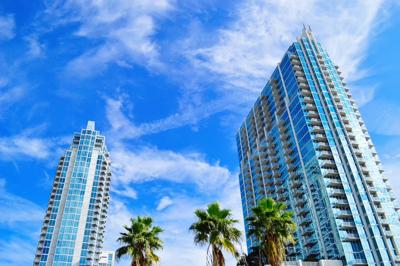
In Miami, luxury once announced itself through an ocean view, an expansive terrace or a recognizable designer name. Those details still matter, but the experience of living in the city’s newest residential developments increasingly begins much earlier—sometimes before a resident even steps out of the car.
Across South Florida, architects and developers are transforming entrances into carefully choreographed architectural experiences. Private guard houses, landscaped motor courts, sculptural porte cochères, attended valet areas and vehicle elevators now establish the personality of a property before residents reach the lobby.
For the latest generation of Miami luxury condominiums, arrival is no longer treated as a practical transition between the street and the residence. It has become part of the amenity package, combining privacy, security, hospitality and visual drama in one highly considered sequence.
Why the Luxury Experience Now Begins Outside
A successful residential entrance does more than create an attractive first impression. It separates the pace and exposure of the city from the privacy of home.
Landscaping can soften traffic noise and obscure vehicles from the street. A covered motor court can protect residents from South Florida’s intense sun and sudden rain. Guard houses, controlled elevators and discreet valet areas can limit unnecessary movement through the building while allowing residents and guests to arrive comfortably.
The strongest entrance designs also create a gradual transition. Instead of moving directly from a busy roadway into a lobby, residents pass through a sequence of gates, greenery, covered spaces and reception areas. That transition makes coming home feel deliberate rather than abrupt.
This approach reflects the increasing influence of resort and hotel design on private residential buildings. Buyers are not only purchasing square footage. They are purchasing an experience that includes how they are greeted, how their vehicles are handled, how deliveries are managed and how quickly they can move from the street into a private residence.
Bentley Residences Takes the Car Home
Few developments illustrate the connection between arrival and identity as clearly as Bentley Residences in Sunny Isles Beach.
The planned 62-story oceanfront tower incorporates automotive design into the residential journey. Its entrance is intended to reflect Bentley’s association with precision, materials and performance, but the defining feature appears beyond the porte cochère.
The development’s patented Dezervator is designed to transport residents and their vehicles directly to private garages connected to their condominiums. Rather than handing a car to a valet and entering through a shared parking structure, residents can remain with the vehicle as it moves vertically through the tower.
The result is part engineering solution and part private ritual. For collectors, the car is no longer separated from the home. It becomes visible from within the residence and functions almost like an architectural object.
The tower is planned to include 216 residences, with private heated pools on the terraces, outdoor living areas and a residents-only restaurant led by chef Todd English. Yet its most memorable amenity may be the way residents move between the roadway, elevator and home without passing through a conventional garage.
Bentley Residences demonstrates how new Miami luxury condominiums are using transportation itself as part of their architectural identity.
The Perigon Uses Privacy as Part of the Design
At The Perigon in Miami Beach, the arrival experience takes a quieter approach. Located at 5333 Collins Avenue between Indian Creek and the Atlantic Ocean, the development is planned as a collection of 72 oceanfront residences designed by architecture firm OMA, with interiors by Tara Bernerd.
A landscaped porte cochère and private guard house are intended to establish a controlled boundary between Collins Avenue and the residential environment. In a city where many oceanfront towers sit close to active streets, that separation can be as valuable as an elaborate lobby.
The design uses greenery, circulation and security to create privacy without making the property feel defensive. Residents move through a protected entrance before reaching the main building, allowing the experience to unfold gradually.
The Perigon’s proposed amenities include a private beach club, oceanfront pools, cabanas, a breakfast lounge and dining concepts from chef Shaun Hergatt. The guarded arrival complements those resort-style features by making the property feel private from its outer edge rather than only after residents enter the tower.
Fouquet’s Brings Hotel Ceremony to the Motor Court
Fouquet’s Hotel & Residences in the Miami Design District approaches arrival through the language of European hospitality.
The development is planned to include a 25-story residential tower with 143 condominium residences and a separate 12-story hotel managed by Fouquet’s. Architecture by Pritzker Prize-winning architect David Chipperfield gives the project an immediate design pedigree, but its landscaped motor court plays an important role in connecting that architecture to the resident experience.
Vehicles will enter a private exterior space designed to provide separation from the activity of the Design District. From there, residents will proceed into a soaring 28-foot lobby and lounge.
The contrast is intentional. The lower, landscaped motor court creates a sheltered moment before the interior opens vertically. Instead of revealing the entire building at once, the entrance establishes a sense of progression and ceremony.
The project also reflects the continued growth of hospitality-branded residential properties. Hotel service is no longer confined to room service or concierge assistance. It influences the handling of arrivals, luggage, vehicles, guests and everyday requests.
FINE readers interested in the area’s continuing evolution may also enjoy The Cloud One Hotel and Residences Brings European Elegance to Wynwood.
The Ritz-Carlton Residences Emphasizes Service
At The Ritz-Carlton Residences, South Beach, the entrance is designed around personal service rather than automotive spectacle.
The boutique oceanfront development is planned with only 30 custom residences, including two duplex penthouses. An attended porte cochère and 24-hour valet will introduce residents and guests to the property through the service standards associated with The Ritz-Carlton.
That may sound less dramatic than a private car elevator, but attentive arrival service can shape daily life more consistently than a purely visual amenity. Valets can coordinate vehicles, welcome guests, assist with packages and help prevent congestion near the entrance.
With architecture by Kobi Karp Architecture and interiors by Studio Munge, the property is also expected to include more than 50,000 square feet of amenities and culinary programming associated with chef José Andrés.
The restrained scale gives the entrance greater importance. In a 30-residence building, staff can become familiar with individual residents, their vehicles and their preferences. Luxury is expressed not only through finishes but through recognition, efficiency and discretion.
Ocean Terrace Creates a Layered Coastal Entrance
Ocean Terrace in Miami Beach’s North Beach neighborhood uses landscaping and architectural scale to create a more resort-oriented arrival.
Residents will approach by way of a cobblestone driveway leading to a lushly landscaped porte cochère and triple-height covered motor court. The height of the space allows the entrance to feel monumental, while the landscaping softens the structure and connects it to the surrounding coastal environment.
The development is planned around a 20-story tower with 52 residences, architecture by Revuelta Architecture International and interiors by Robert A.M. Stern Architects. It will also include a boutique hotel, resort residences and retail near a five-acre public park designed by landscape architect Raymond Jungles.
Here, arrival is not completely removed from the neighborhood. Instead, it is positioned between a public coastal setting and a private residential tower. The motor court acts as the architectural hinge between those environments.
Arrival Design Is Not Limited to New Towers
The principles appearing in new Miami luxury condominiums can also influence renovations within existing residences and older residential buildings.
Condominium owners may not be able to redesign a building’s porte cochère, but they can improve the private portion of the arrival. Elevator vestibules, entrance galleries and foyers can be reconsidered through better lighting, custom millwork, durable flooring, concealed storage and a clearer visual transition into the main living spaces.
In waterfront homes, the same thinking can be applied to gates, driveways, covered entries and the path between a garage and the interior. Owners undertaking major changes may work with experienced high end remodeling contractors in Miami to coordinate architectural planning, interior finishes and improvements that make the entrance feel connected to the rest of the home.
The goal should not be to reproduce a hotel lobby. A well-designed residential entrance should reflect the scale and personality of the home while making daily routines easier. A place for keys, packages, shoes and bags can be incorporated without allowing practical necessities to dominate the first view.
Privacy Has Become a Defining Luxury Amenity
These developments also reveal an important change in how luxury is being defined. Highly visible extravagance is giving way to controlled access and personal space.
A guarded oceanfront entrance, private elevator or concealed parking area may not photograph as dramatically as an infinity pool, but it can affect residents every day. It reduces unnecessary interactions, controls how guests enter and creates a buffer between public and private life.
That emphasis is particularly relevant in South Florida, where high-profile residents, seasonal homeowners and international buyers may value discretion as much as panoramic views.
Readers considering an upscale property should examine more than the residence itself. Our guide to planning the key costs of buying a luxury property explains additional financial and practical factors that deserve attention before a purchase.
The New Status Symbol Is the Journey Home
The next chapter of Miami residential design is not defined by a single architectural feature. Some properties rely on guarded entrances and landscape architecture. Others introduce hotel-level valet service, monumental motor courts or technology capable of carrying a car into the sky.
What connects them is a recognition that luxury does not begin at the front door of a condominium. It begins at the boundary between the city and the home.
As competition among Miami luxury condominiums continues, the entrance is becoming one of the clearest ways for a development to distinguish itself. The most successful designs will do more than impress visitors. They will make the daily journey home feel private, effortless and unmistakably connected to the architecture beyond it.

(0) comments
We welcome your comments
Log In
Post a comment as Guest
Keep it Clean. Please avoid obscene, vulgar, lewd, racist or sexually-oriented language.
PLEASE TURN OFF YOUR CAPS LOCK.
Don't Threaten. Threats of harming another person will not be tolerated.
Be Truthful. Don't knowingly lie about anyone or anything.
Be Nice. No racism, sexism or any sort of -ism that is degrading to another person.
Be Proactive. Use the 'Report' link on each comment to let us know of abusive posts.
Share with Us. We'd love to hear eyewitness accounts, the history behind an article.