




Luxury fashion has spent years becoming more visible, more accessible and considerably easier to buy. New collections arrive constantly. Coveted pieces can appear across dozens of stores and markets simultaneously. Even exclusivity has, in some corners of fashion, become something produced at scale.
Desislava Gilberte is betting on the opposite.
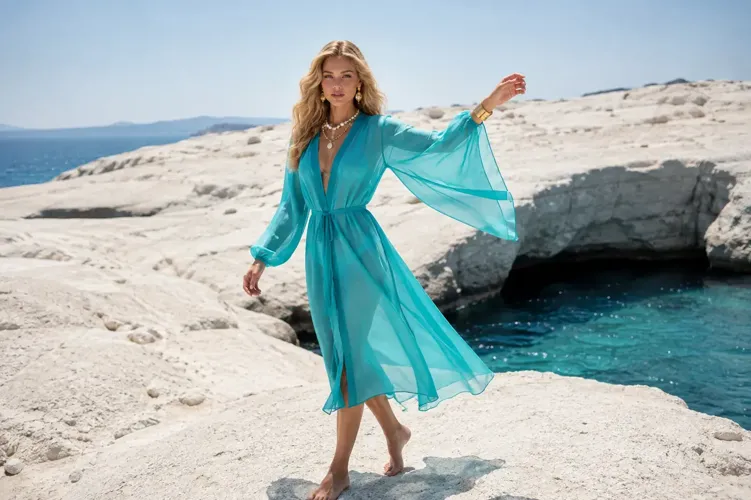
The newly launched luxury resortwear house is building its identity around Italian silk, Bulgarian craftsmanship and extraordinarily small production runs. Its debut Allure Founder’s Edition consists of 13 designs made to move from a sunlit terrace or yacht deck to dinner without feeling like conventional vacation clothing.
More interesting than the destination imagery, however, is the philosophy behind it. Founder Desislava Gilberte believes luxury may be entering a period in which having more matters less than owning something exceptional.
“I see women increasingly choosing fewer things that hold meaning over many things that do not,” she tells FINE Magazine.
From Silicon Valley to a Fashion House

Gilberte's path to fashion was not a traditional one. She grew up near Bulgaria's Black Sea and spent part of her early life ballroom dancing, an experience that would eventually influence her fascination with fabric in motion. But before starting a fashion house, she spent years working in boardrooms and startups in Silicon Valley.
There was no dramatic moment when one career suddenly gave way to another.
“There wasn’t a single dramatic moment so much as a quiet accumulation,” Gilberte says. “I spent years in boardrooms and startups in Silicon Valley, building other people’s visions, while the images of the Black Sea, the weight of silk, and the architecture of movement from ballroom never left me.”
Eventually, she says, those memories stopped feeling like something that should remain private.
“The real shift came when I finally allowed myself to admit that the life I had built in America had given me the freedom — and the responsibility — to create something of my own that carried both places.”
That combination now runs through the house: the sensuality of movement, European craftsmanship and the discipline of someone accustomed to thinking about how a business should be built.
Resortwear Gets More Serious
Gilberte launched with resortwear precisely because she felt much of the category had become too disposable.
“What I felt was missing was depth,” she says. “So much of what is labeled ‘resort’ is either purely decorative or purely practical — fast trends, light polyesters, designs intended for a single vacation.”
Her alternative is considerably more ambitious. The collection's flowing kaftans and silhouettes are intended to work over swimwear but retain enough presence for dinner and more formal surroundings.
That reflects a broader change in how many women travel. Packing a separate wardrobe for the pool, lunch, cocktails and dinner is less appealing when one exceptional piece can move among several of those settings.
“The old idea of a separate ‘resort wardrobe’ feels increasingly outdated,” Gilberte says. “Women want pieces that can travel with them through different parts of the day and different parts of the world without needing constant change.”
For her, versatility does not mean making clothing generic enough to work everywhere. It means creating something distinctive enough that it does not have to be changed simply because the setting does.
Why the Silk Matters

At the center of the collection is silk from Taroni, the historic Como textile maker whose silk-producing tradition extends back generations. Taroni describes its work as a combination of inherited weaving knowledge, careful yarn preparation and modern quality control, part of the textile heritage that has made Como synonymous with Italian silk.
Some Desislava Gilberte designs require five to six meters of continuous silk, which gives the garments their generous movement without relying on heavy structure.
“When the fabric itself has that kind of presence and cost, you cannot design lightly,” Gilberte explains. “You become more deliberate about proportion, about how the cloth falls and moves, about what is essential and what is excess.”
That restraint may be one of the more revealing aspects of the collection. More expensive material does not necessarily call for more embellishment. In Gilberte's view, it often demands less interference.
“You stop adding details for the sake of novelty and start listening to what the material wants to do.”
Behind the apparent simplicity are hand-rolled edges, internal French seams and careful attention to weight distribution so that large amounts of silk still feel light on the body.
As Gilberte puts it, “You don’t see the hours of discipline; you only feel the liberation.”
When Five Pieces Really Means Five Pieces
The other notable decision is how little the company intends to make.
Rather than treating scarcity as an advertising strategy while producing substantial quantities behind the scenes, Desislava Gilberte is releasing individual styles in unusually restricted numbers. For a luxury market accustomed to the phrase “limited edition,” the difference matters.
For Gilberte, the reasoning is partly exclusivity, partly craftsmanship and partly a refusal to overproduce.
“They are inseparable,” she says. “Limited production protects the level of craftsmanship we insist on. It also prevents the dilution that comes with scale.”
The resulting pieces fall roughly between $1,800 and $4,600, putting them firmly in investment-purchase territory. At that level, a kaftan has to offer something more enduring than a strong vacation photograph.
That is exactly where Gilberte believes luxury is heading.
“Accessibility has its place, but true luxury has always been about scarcity of attention and care as much as scarcity of product,” she says. “When everything is available everywhere, the pieces that still feel rare — because of how they were made, how few exist, and how thoughtfully they were considered — become more valuable, not less.”
Designing Outside the Trend Cycle

There is an obvious risk to investing thousands of dollars in a highly recognizable fashion piece: today's extraordinary purchase can become tomorrow's timestamp.
Gilberte's solution is straightforward. Do not design for the trend cycle in the first place.
“We design for the woman who already knows what she loves and is not waiting for permission from the season,” she says. “Relevance, for us, comes from proportion, material, and movement that do not date easily.”
That philosophy also determines what makes it into a collection. A design being attractive is not enough.
“Beauty is the minimum,” Gilberte says. A piece must also possess the architectural silhouette, movement and sense of “quiet confidence rather than spectacle” that she wants associated with the house.
It is an interesting distinction at a moment when luxury fashion competes aggressively for attention. Desislava Gilberte is attempting to create clothing that gets noticed without appearing to ask to be noticed.
A Different Definition of More
The Allure collection is only the first chapter, and a young luxury house ultimately has to prove that its philosophy can survive beyond an impressive debut.
Gilberte is clear about what she does not want growth to mean.
“I would like it to represent a certain standard of care — a house that never rushed, never diluted, and never forgot that clothing can be both deeply personal and rigorously made.”
That may ultimately be the more compelling idea behind Desislava Gilberte. The clothes evoke the Mediterranean, the Black Sea, grand hotels and long summer evenings, but the larger proposition has little to do with where someone vacations.
It is that luxury does not always have to mean more.
Sometimes it means making less, choosing better and keeping it long enough for the piece to become part of the life it was purchased to accompany.

(0) comments
We welcome your comments
Log In
Post a comment as Guest
Keep it Clean. Please avoid obscene, vulgar, lewd, racist or sexually-oriented language.
PLEASE TURN OFF YOUR CAPS LOCK.
Don't Threaten. Threats of harming another person will not be tolerated.
Be Truthful. Don't knowingly lie about anyone or anything.
Be Nice. No racism, sexism or any sort of -ism that is degrading to another person.
Be Proactive. Use the 'Report' link on each comment to let us know of abusive posts.
Share with Us. We'd love to hear eyewitness accounts, the history behind an article.