
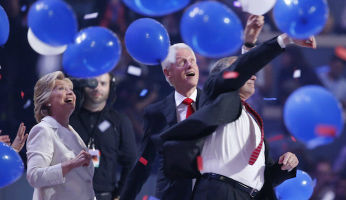
Following the Democratic National Convention and Republican National Conventions last week, Americans must be aware that they’re engaging in a political climate hotter than ever. Whether it be the public’s distrust of Hillary Clinton following her opting to use (and wipe clean) private email servers or Donald Trump’s lack of experience in elected office, the 2016 election is marked by negative sentiment all around. Add unrelenting Bernie Sanders supporters, Black Lives Matter Protests, and a clear lack of party support for Trump into the mix, and you get an election that is hard to predict. This election season is one of celebrity and of scandal, bringing more voters than ever to the ballots. Some things, however, never change, as each candidate is utilizing stances on sensitive current issues to bulk up their platforms, from foreign policy to gun laws to homeland security. This was seen at both conventions last week, as well as an unsurpassed amount of chaos and rhetoric from either side that, in many ways, broke traditional party norms.
The RNC: Some Notable Moments
This year’s Republican National Convention in Cleveland began with Trump walking on stage and introducing his wife Melania, who then delivered a speech. While some, like The Telegraph describe her speech as "delivered beautifully and with tremendous poise," others found the speech to be surprisingly close to Michelle Obama’s speech at the Democratic National Convention of 2008. As it turns out, Meredith Mclever, Melania’s speech writer, did admit to borrowing some of the current first lady’s phrasing. On the same day, African-American Milwaukee County Sheriff David Clarke Jr. opened his speech, largely a criticism of the Black Lives Matter movement, with the phrase "Blue Lives Matter," receiving hearty applause at the convention but serious criticism everywhere else. The protestors rampant during the RNC, as well as a lack of attendance of many Republican notables, spoke largely to the lack of unity within the Republican party as a result of Trump’s candidacy.
On day two of the convention, Trump officially accepted the presidential nomination, and Indiana governor Mike Pence accepted that for vice president. Various speakers followed to turn the night’s attention to Hillary’s alleged crimes, including speaker of the house Paul Ryan, who referred to Clinton as a "third Obama" and spoke of Republican Party unity. Finally, Donald Trump’s children took the stage to endorse the nominee.
Day three was filled with surprises, including the crowd booing Ted Cruz following his unwillingness to expressly endorse Trump and Cruz's tagline "vote your conscience." Newt Gingrich attempted to "paraphrase" Cruz and twist his words into the express endorsement that the Convention desired. Interestingly, the night seemed to be filled with not-quite there endorsements for Trump: right wing oriented rhetoric with no mention of the nominee’s name, potentially on purpose. The night was also filled with protests and arrests from the Cleveland police.
Most notable of the last day of the convention was Donald Trump’s speech, the longest acceptance speech in recent history, in which he called for an end to violent crimes, spoke of Hillary’s "bad judgment," and asked for the support of former Sanders supporters.
The DNC: Some Notable Moments
During Day 1 of the Democratic National Convention, Michelle Obama delivered an optimistic speech that changed the tone of the election entirely and fully endorsed Hillary. Elizabeth Warren and Bernie Sanders wholeheartedly gave the Democratic nominee their full backing, as well as a warm hug. Similar to the RNC, the DNC experienced interruptions from various protestors, including Sanders supporters and Black Lives Matter Protestors.
On the second day of the convention, Hillary made history and became the first female to accept a presidential nomination. Most notably, former president Bill Clinton endorsed his wife in a speech that didn't mention her Republican opponent, but described Hillary as the candidate most capable of making real changes.
The third night of the convention was heavy on themes of national security but carried a different tone than Trump’s plea for tighter national security. Speakers such as Senator and Vice Presidential Nominee Tim Kaine and Leon Panette celebrated America’s power through diversity. The convention sought to weaken Republican support of Trump by an endorsement from former Republican Mayor Michael Bloomberg as well as a statement by the current president himself that Trump’s convention "wasn’t particularly Republican––and it sure wasn’t conservative."
In her final chance to win voters, Clinton simply stated to Bernie Sanders supporters: "I hear you." She subtly bashed Trump by speaking to her own years of experience in the White House, by welcoming American Muslim Khizr Khan to speak against the Republican nominee, and by addressing matters of public safety that Trump has failed to note.
So Now What?
Clearly, while each convention rallied an immense amount of support for the now-official candidates, most deliveries last week were met with a certain amount of contempt. While Trump promises to "Make American Great Again," Clinton celebrates what America has accomplished and wishes to continue a tradition of tolerance. Both candidates evoke a patriotic sentiment but in different ways. Further, both candidates––due to extremism or scandal––could likely lose support from within their own party or gain it from independents. Because of the erratic nature of this election cycle, projections for November may be difficult to make. According to the New York Times’s constantly-updated election projector, Clinton has about a 74% chance of winning the November election as of August 3rd. This is about the same probability of an NBA player missing a free throw.
The takeaway? Both conventions were filled with celebrity, and complete authenticity is nearly impossible to find during the cutthroat campaign season. Amid the planning and the hubbub that is the campaign stage, keep your eye on the issues that mean most to you, and however you vote this November, as Ted Cruz so ambiguously suggested last Wednesday, "vote your conscience."
(0) comments
We welcome your comments
Log In
Post a comment as Guest
Keep it Clean. Please avoid obscene, vulgar, lewd, racist or sexually-oriented language.
PLEASE TURN OFF YOUR CAPS LOCK.
Don't Threaten. Threats of harming another person will not be tolerated.
Be Truthful. Don't knowingly lie about anyone or anything.
Be Nice. No racism, sexism or any sort of -ism that is degrading to another person.
Be Proactive. Use the 'Report' link on each comment to let us know of abusive posts.
Share with Us. We'd love to hear eyewitness accounts, the history behind an article.