

As parents with young children at home, your offspring’s safety is no doubt foremost in your mind when you decide on things like interior design, furniture, and other home improvement choices. Home should be the safest place for children, and yet, accidents can happen when you turn your attention away at the wrong moment or for a second too long.
In the U.S., 20% of electrical injuries happen to children out of the 3,000 cases admitted in hospitals, according to Johns Hopkins Medicine. It’s dreadful when these things do happen, so you need to exert every effort to make your home as safe as possible for toddlers and young kids.
Common Electrical Hazards to Children
Kids are curious creatures. They touch, taste, grab, and explore first and ask questions later — often after they’ve been hurt, scared, confused by what they just discovered. This probably explains their fascination with power outlets and cords.
Electric outlets are usually positioned low on the walls, which is the perfect height for children to see and touch. Kids also act on instinct: if they see an outlet with two holes and find power cords with two protruding metal prongs, they will plug the cable right in — a scene that will terrify any parent!
So when you’re reviewing measures on how to get rid of electrical hazards from your home, think beyond regular inspections and electrical services from residential electricians.
Here are some more electrical hazards that can put a toddler at risk of accidental electrocution at home:
- Exposed outlets
- Power plugs lying next to exposed outlets
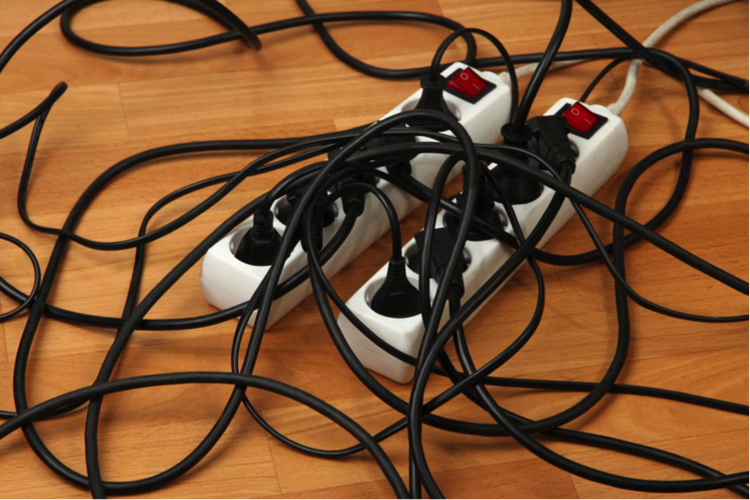
- Long appliance cable wires on the floor (used and unused)
- Overloaded extension cords
- Unused extension cords left on the floor
- Worn out power cables on appliances and gadgets
- Plugged cords that stand in the way of foot traffic
- Water spills next to electrical appliances and devices on the floor

All of these are avoidable, easily remedied, and within adults’ control. So to baby-proof your home, specifically against electric hazards, start by doing something about these common causes of accidental electrocution.
Tips for Removing Electrical Hazards Out of Your Children’s Way
- Cover all outlets -Cover the primary source of electric shocks. You can find outlet covers in many colors and designs. It might be counterproductive to buy the cute animal covers, though. The purpose of covering outlets is to make them fall under the radar. If you use attractive outlet covers, children will be drawn to them instead of staying away from them.
- Install GFCIs on all outlets —; Install ground fault circuit interrupters in all outlets, especially the ones that are near moisture-prone areas, like above the kitchen counters and in bathrooms.
- Place heavy furniture before power outlets- When kids grow old and smart enough to remove outlet covers on their own, place large, heavy furniture in front of the outlets so that they’ll have a hard time reaching them.
- Use metal raceways — Conceal electric cords along the walls or floor using metal raceways (also called wire mold or surface-mounted wiring). These will keep lines entirely out of kids’ way. More importantly, they won’t be able to pull out the electric cords.
- Keep all cables tidy — Don’t let electric cables dangle over counters, tables, or hanging within reach of toddlers. They like to yank on any object they get their hands on. It will be doubly dangerous if they pull on a plugged cable.
- Check all cables for wear and tear — Make a habit of checking electrical wiring and appliance cables for breaks or tears in the rubber coating, mostly if they’re not hidden under metal raceways. Toddlers, with their moist hands, might touch these problematic parts when they crawl all over the floor.
- Put away unused extension cords — Plugged extension cords are hazardous as children can play with them or trip over the loose coils. Moreover, long cables left on the floor are a strangulation risk for toddlers. Make it a rule that if unused, all extension cords must be put away.
- Buy extension cords with switches;—; Every precaution helps, and that’s what safety switches on extension cords are.
- Elevate extension cords- Sometimes, you can’t help but leave extension cords out because it’s a hassle to keep putting them away and then taking them out again when you need to use an appliance or gadget. If you must leave them out, keep them out of children’s reach. Better yet, mount them high up on the wall instead of on the floor or a low table. ;
- Teach children to avoid electrical hazards — As children grow, parents must teach them that electrical items are not toys they can play with anytime. Use simple words to explain, for example, that sticking things into an open outlet can be very bad for them. Make sure to also put up danger electrical hazard signs and make sure they recognize them every time. Knowledge and visual cues can help reinforce safety messages.
Accidents are sometimes out of our control, but if you’re careful enough, you can avoid them entirely. Use these tips to baby-proof your home and ensure your children’s safety against electrical hazards.
(0) comments
We welcome your comments
Log In
Post a comment as Guest
Keep it Clean. Please avoid obscene, vulgar, lewd, racist or sexually-oriented language.
PLEASE TURN OFF YOUR CAPS LOCK.
Don't Threaten. Threats of harming another person will not be tolerated.
Be Truthful. Don't knowingly lie about anyone or anything.
Be Nice. No racism, sexism or any sort of -ism that is degrading to another person.
Be Proactive. Use the 'Report' link on each comment to let us know of abusive posts.
Share with Us. We'd love to hear eyewitness accounts, the history behind an article.