
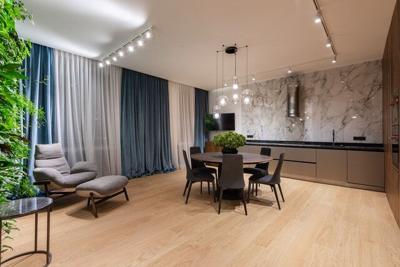

It can't be denied that the right kind of light always leaves soothing feelings on people's minds. Also, it is these lights that define the space well. It not only illuminates the room but sets the overall mood too. Therefore, it is always highly suggested to choose the right kind of light to enjoy maximum. In short, the correct type of lighting overall creates a substantial impact on the general feeling of the place. In the underlined piece of writing, we will specifically be talking about the LED Strip Lights. Let us begin with the introduction of these LED strip lights.
What are LED strip lights?
These lights are also referred to as LED Ribbon or LED Tape. These are some of the versatile solutions that enable the users to develop a professional lighting experience in an affordable manner and with minimum effort.
These are the self-adhesive and flexible strips of LEDs running at 12 volts. These can be cut at every 5 or 10 cm. It largely depends on the type of the LED strip that has been purchased. Since they make use of LEDs, they use much lesser electricity than the older fluorescent strip lights. Moreover, they last longer, and this is what makes these lights to be more cost-effective.
Variety of LED strip lights:
These are usually accessible in a couple of variations, i.e., color changing or a single color. Single color strips are the ones that are accessible in cool and warm white color and are considered ideal for hidden lighting or to create subtle lighting. Most of the time, people attach them to the underside of the kickboards and kitchen cabinets, where they amuse the users with practical and pleasing light. However, they can also be used to highlight, accent, or extra ambiance.
Color-changing strips are the particular type of LED, a blend of the green, red, and blue light as the source to come up with a spectrum of colors. These can be used similar to how single color lights are used but enable users to switch between the dynamic and static color options with different control units.
Advantages of LED Strip lights:
LED strip lights offer several advantages compared to traditional lights such as halogen, incandescent, and fluorescent. Some of these advantages are as follows:
Lesser electricity consumption:
Like the overall LED technology, LED strip lights to make significantly lesser use of the electricity while performing their operations. A standard strip of an LED uses around 7.2 watts of power which is about 90% more efficient than the other types of lighting.
Color:
LEDs are capable of creating a more comprehensive range of colors as compared to traditional lighting. It makes them more memorable. In addition to the standard cool white and warm white, these LEDs create a vast range of conventional colors.
Life expectancy:
The life expectancy of the LEDs exceeds the traditional lighting. A standard LED strip lasts up to almost 70,000 hours.
Flexible:
Traditional lights are housed inside the glass enclosures. These glass enclosures are inflexible and pretty much fragile. On the other hand, LED strip lights are usually mounted on a flexible ribbon capable of bending around 90 degrees corners and are fitted to the surfaces with changing and flexible gradients.
Lesser heat:
We all know that incandescent and halogen bulbs are notorious for getting hot when they are in use. On the contrary, the LED strips are known for producing less heat, and hence they are much safer to be used and less of a fire hazard.
Discrete:
These LED strips are generally considered to be the linear source of light. This is due to their thin and long design. This enables them to get fitted in the locations where other types of lighting can't be. Under alcoves, kitchen cabinets, shelves, bookcase, and you name it, and LED strips will serve the purpose well.
Easy installation:
Mounting lights are unexpectedly easy to be installed and do not require immense expertise in this regard. Most of these LED strip lights have a 3M self-adhesive, enabling them to get stuck straight onto the surface. They do not need any brackets or mounts. Even if there is no adhesive, bracket installation is much more straightforward and less hassle than the installation of fluorescent tubes.
Cutting:
These are one of the few types of lighting that can be cut. They have cutting points all along the length and can be used to separate or shorten the strips. These non-solder connections may be used for re-connection, or you may ask the retailer to do it for you.
In short, Lepro LED lights for homes are a perfect choice for everyone in every manner. It does not matter if it is about couch lighting, LED room lighting for decoration, or name it, and you will find them to serve the purpose best in every manner. These lights are not restricted to be used for specific places or rooms. Your name, and you will find these LED strip lights to serve the purpose best in every manner.
LED strip lights are perfect for all kinds of places and areas wherever you want to have cool or warm white light. If you want to add to the ambiance, you may get the changing color LED strip lights. All you need to ensure is that you are buying from a reliable name in this regard. One of the trustworthy names in this regard is the Lepro. Feel free to access their official site, i.e., https://www.lepro.com/led-strip-lights. You will be amused to see the variety of LED strip lights they have for you. You will not have to worry about the appropriate lighting in different areas of your place. Lepro will provide you with high-class yet reasonably priced lighting solutions at their best.


(0) comments
We welcome your comments
Log In
Post a comment as Guest
Keep it Clean. Please avoid obscene, vulgar, lewd, racist or sexually-oriented language.
PLEASE TURN OFF YOUR CAPS LOCK.
Don't Threaten. Threats of harming another person will not be tolerated.
Be Truthful. Don't knowingly lie about anyone or anything.
Be Nice. No racism, sexism or any sort of -ism that is degrading to another person.
Be Proactive. Use the 'Report' link on each comment to let us know of abusive posts.
Share with Us. We'd love to hear eyewitness accounts, the history behind an article.