
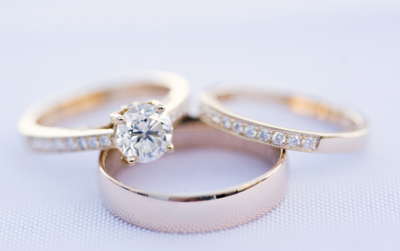

Jewellers use "wedding band" and "wedding ring" for the same products so freely that a plain gold ring can sit under either name depending on the website. The label tells you very little, because the metal, width, profile and finish underneath it decide how the ring looks, wears and sits beside whatever else is on your finger.
Is there a real difference between a wedding band and a wedding ring?
In everyday UK use, not really: a wedding band is a wedding ring, and shops apply both terms to the same products. Where a distinction exists, "band" usually describes a ring of even width all the way round with no shaping, plain or simply finished, while "ring" is the wider word that also covers patterned, shaped and diamond-set designs. A plain band is always a wedding ring, but a shaped or diamond-set ring usually isn't called a band.
A 2mm platinum court ring and a 6mm brushed yellow gold flat ring can both be sold as bands, and they have almost nothing in common on the finger. Metal, width, profile and finish are what to compare; the name only helps you search.
Which styles are usually called bands, and which are called rings?
Plain court and flat styles are the ones most often labelled bands. A court profile is rounded on the outside and the inside, which is why it feels comfortable through a full day, while a flat profile has a squared outer surface and a more modern look on the hand.
If you want to see how plain, shaped and diamond-set styles differ in person, browsing a full range of wedding bands makes the labels much easier to understand. The remaining styles are usually listed as rings:
- Shaped rings are curved or notched so they sit snugly against an engagement ring. With a high setting, a straight band leaves a visible gap beside the stone, and a shaped ring closes it.
- Patterned and textured finishes such as brushed, beaded edge or milgrain suit someone who wants a simple ring that isn't completely plain. Milgrain is a row of tiny beads along the edge.
- Diamond-set rings carry stones that can catch on fabric or loosen after knocks, so they need checking at routine services in a way a plain ring does not.
- Two-tone and coloured-stone rings suit a couple who want more than a single metal, such as a gold ring with a sapphire set into it.
How do you choose between them for your own situation?
If you will wear it next to an engagement ring
A high engagement ring setting leaves a gap under the stone, so a straight band sits slightly apart from it or tilts the engagement ring sideways, while a low setting often sits flush against a plain ring. Try both rings stacked on the same finger before deciding, because judging each one alone hides how they press, twist or gap.
Metal needs the same check. A yellow gold ring beside a platinum engagement ring shows a clear colour line, which some people like and others find disjointed. If you might add an eternity ring later, choose a wedding ring slim enough to leave room for it.
If you will wear it every day or work with your hands
For gym sessions, cooking or manual work, a plain even-width ring is the practical choice, since there are no stones or raised edges to catch. Diamond-set rings suit desk work and lighter use better: claw-set stones snag on towels and knitwear, while channel-set stones sit protected between walls of metal.
Comfort over a full day matters too. Fingers swell in hot weather, and a rounded inner edge is kinder than a flat one when they do. If scratches bother you, a brushed finish hides the fine marks a polished surface shows, and a polished ring can be repolished later.
If you and your partner want matching rings
Matching rings don't have to be identical. The same metal and finish in different widths or profiles still reads as a pair, which suits couples whose hands or daily routines differ. One partner might wear a plain band while the other wears a shaped or diamond-set ring that sits around an engagement ring.
Pick the metal first, since that is what makes two different rings look related. Browsing the men's and women's ranges together helps when you're choosing as a pair.
What should you check on the ring itself before you decide?
Platinum is naturally white, and a scratch in it moves metal around rather than removing it, which gives a soft, worn finish over the years. White gold is usually rhodium-plated for its bright white colour, and that plating can thin with wear, leaving a slightly warmer tone until it is replated. Yellow and rose gold have no plated layer to lose.
A wider ring usually fits tighter than a narrow one in the same size, so a size that works for a 2mm ring may feel snug at 5mm or more. Try your size in the width you intend to buy rather than relying on the number from a narrower ring.
Two rings of the same width can still feel very different. A court profile rounds both sides, while a flat one has a squarer inner edge that you notice more when you bend your finger.
In the UK, platinum and gold jewellery above small weight limits must carry a hallmark applied by an assay office, showing the maker's or sponsor's mark, the metal and its purity, and the assay office mark. Look for it before you buy. Very light rings can fall below the weight limit, so ask the jeweller if you can't find one.
How do you narrow down to one ring when two feel equally right?
When the choice is between a plain ring and a diamond-set one, ask which you would still be happy to wear every day in twenty years. The plain ring usually suits a life of gym, cooking and travel; the diamond-set ring suits lighter use and someone who wants the ring to catch the light.
Try both on your hand with your engagement ring, because photos hide how rings sit together. Ask the jeweller whether the ring comes in your size, which finishes are available and how it will wear over time. Resizing deserves its own question: a ring with stones all the way round is much harder to resize than a plain one.
If you and your partner disagree, use lifestyle fit as the tie-breaker rather than style.

(0) comments
We welcome your comments
Log In
Post a comment as Guest
Keep it Clean. Please avoid obscene, vulgar, lewd, racist or sexually-oriented language.
PLEASE TURN OFF YOUR CAPS LOCK.
Don't Threaten. Threats of harming another person will not be tolerated.
Be Truthful. Don't knowingly lie about anyone or anything.
Be Nice. No racism, sexism or any sort of -ism that is degrading to another person.
Be Proactive. Use the 'Report' link on each comment to let us know of abusive posts.
Share with Us. We'd love to hear eyewitness accounts, the history behind an article.