
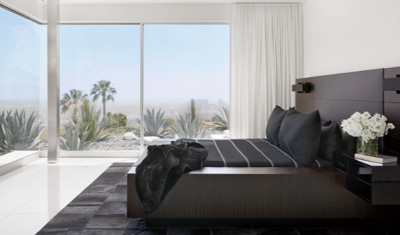

Walk through any newly finished luxury home and the primary suite tells the same story. Radiant-heated bathroom floors. A steam shower with programmable presets. Motorized blackout shades on a schedule. Whole-home climate zoning that holds the bedroom within a degree of its set point.
Then look at the bed, the one piece of furniture we use for a third of our lives. It's usually an excellent mattress with fine linens, and no control over temperature at all.
That's starting to change. Climate-controlled sleep is becoming the next standard feature of the high-end bedroom, and it fits into a well-designed space more easily than most homeowners expect.
Why room climate isn't the same as sleep climate
Sleep researchers generally put the ideal bedroom temperature at about 65°F. Most luxury HVAC systems can hit that easily. The problem is that the temperature that affects your sleep isn't the room's. It's the small pocket of air between your body and the mattress.
A premium mattress, especially one with dense foam layers, soaks up body heat over the night. Add a down duvet and a partner, and that pocket can get much warmer than the room around it. You can set the thermostat to 64°F and still wake up overheated at 3 a.m.
It's also the reason couples argue over the thermostat. One person runs warm, the other runs cold, and a single setting for the whole room can't satisfy both. Zoning the house solved this for different rooms. Nobody solved it for the two sides of one bed.
From passive to active: how the bed itself got smarter
The first answer was materials. A cooling mattress topper made with gel foam, latex or wool improves airflow and feels cooler to the touch. These toppers are a meaningful step up, but they're passive. They slow the build-up of heat without removing it.
The newer answer is a bed cooling system: a thin, temperature-controlled layer on top of the mattress, fed by a compact hub that circulates water to cool or warm the surface. In design terms, think of it as radiant climate control for the bed, the same principle as radiant floor heating.
For a design-led home, the appeal is that it's nearly invisible. The layer sits under the fitted sheet, and the bed keeps its look. The hub sits on the floor beside the bed, and in a finished suite it usually tucks out of sight under a nightstand or into custom millwork.
What separates a luxury-grade system
Not every system is equal. These are the details that matter in a high-end bedroom:
Independent zones. At minimum, each side of the bed should be controlled separately. The better systems go further and split each side into an upper and a lower zone, so cool shoulders and warm feet can coexist.
Silence. A primary suite should be the quietest room in the house. Look for operating noise in the mid-30-decibel range or lower, about as loud as a whisper.
Automation that disappears. The best systems adjust on their own through the night, cooling at bedtime and easing off toward morning, without anyone touching an app.
No surprise running costs. Some systems lock core features behind an annual subscription. For a fixture in the home, ownership should feel like ownership.
One system designed around these points is the temperature-controlled mattress cover from OVAL, called OVAL Adapt. It fits over an existing Queen or King mattress and divides the bed into four independently controlled zones. It covers a wide range, from 54°F to 118°F, and runs at 36 decibels or less. Built-in sensors let it adjust through the night, and its core features carry no subscription fee. It comes with a 100-night trial, which matters for a purchase you can only judge by sleeping on it.
Planning it into a renovation
If you're designing or renovating a primary suite, a few early decisions make a bed cooling system look built in rather than added on:
- Plan an outlet near the floor on at least one side of the bed, so the hub's power cord never crosses a walkway.
- Size the nightstands for it. A nightstand with an open lower shelf, or a closed cabinet with ventilation, hides the hub completely.
- Leave room in the plan for upholstered beds. A deep upholstered frame or platform base can hide the connection between the hub and the bed.
- Think about the whole sleep system. Pair the cooling layer with breathable linens, such as percale cotton or linen. Heavy sateen and polyester blends trap heat and work against it.
A quiet kind of luxury
The most valuable upgrades in a luxury home are often the ones guests never notice. Nobody sees the radiant floor heating, but everyone feels it. Climate-controlled sleep belongs in that category. It doesn't change how the bedroom looks. It changes how every morning feels.
As homeowners put more weight on health and recovery, from home gyms to cold plunges, the bed is the obvious next step. It's the one place where a small adjustment pays off every single night.

(0) comments
We welcome your comments
Log In
Post a comment as Guest
Keep it Clean. Please avoid obscene, vulgar, lewd, racist or sexually-oriented language.
PLEASE TURN OFF YOUR CAPS LOCK.
Don't Threaten. Threats of harming another person will not be tolerated.
Be Truthful. Don't knowingly lie about anyone or anything.
Be Nice. No racism, sexism or any sort of -ism that is degrading to another person.
Be Proactive. Use the 'Report' link on each comment to let us know of abusive posts.
Share with Us. We'd love to hear eyewitness accounts, the history behind an article.