
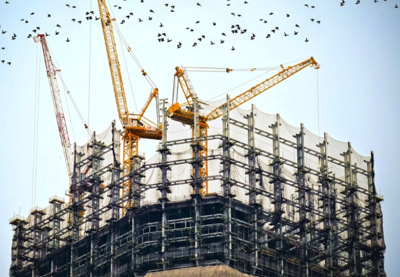

When most people picture a high-end commercial property, they imagine the finished surfaces: the glass curtain wall catching afternoon light, the polished concrete floors, the open showroom with nothing interrupting the sightlines. What they rarely think about is the skeleton holding all of it up. Yet that skeleton increasingly determines whether a project comes in on budget, opens on schedule, and holds its value over the next thirty years.
Across retail, logistics, automotive, and light industrial sectors, developers and business owners are quietly moving away from traditional masonry-and-timber construction toward engineered steel frames. The shift isn't about chasing a trend. It's about economics, speed, and the kind of design freedom that lets a building actually serve the business inside it.
The Open-Span Advantage
The single biggest reason architects reach for steel on commercial projects is the clear span. Because steel carries far more load per pound than wood or concrete, it can bridge wide distances without intermediate columns getting in the way.
For a car dealership, that means a showroom floor where every vehicle is visible from the entrance, with no posts breaking up the display. For a distribution center, it means aisles wide enough for forklifts and racking systems to run uninterrupted. For an aircraft hangar, it means clearances measured in tens of meters. Try to achieve any of that with load-bearing walls and you end up with a cramped, compartmentalized space that fights against its own purpose.
This is also why steel has become the default for modern warehouses and high-bay storage, where vertical clearance and column spacing directly affect how much usable volume a property actually delivers. The structure isn't just holding the roof up. It's defining the operational capacity of the entire facility.
Speed That Translates to Real Savings
Time is the cost that owners tend to underestimate. Every additional month on a construction timeline is another month of financing, another month before a tenant can move in, another month before the property generates revenue.
Steel construction compresses that timeline considerably. Modern steel-frame buildings are engineered and fabricated off-site to precise specifications, then delivered as components ready for assembly. The heavy work happens in a controlled factory environment while site preparation proceeds in parallel, rather than waiting for one phase to finish before the next begins. By the time the steel arrives, foundations are cured and crews can move straight into erection.
The companies that handle this well treat it as a complete process rather than a parts order. The more established manufacturers offer engineered building systems that cover design, fabrication, and on-site guidance as a single workflow, which removes a great deal of the coordination risk that drives traditional projects over budget. For owners managing a commercial build from a distance, that integration is often worth more than the line-item savings on materials.
Durability and the Long View
Premium materials only matter if they last, and this is another area where steel quietly outperforms. Engineered steel frames resist the warping, rot, and pest damage that plague timber over time. With proper corrosion-resistant coatings, the structure can stand for decades with minimal degradation, which is precisely what an owner wants from an asset they intend to hold.
There's a resilience dimension as well. In regions prone to seismic activity, heavy snow loads, or high winds, steel's strength-to-weight ratio and its ability to flex under stress rather than crack make it the structural choice engineers trust. For commercial owners in places like California, where buildings have to be designed around earthquake risk, that performance isn't a luxury feature. It's a baseline requirement.
Design Freedom Without the Compromise
A persistent myth holds that steel buildings all look like plain metal boxes. That hasn't been true for years. The frame is the structure, not the finish. Steel framing pairs with virtually any exterior treatment, including brick, stone, architectural panels, glass, and composite cladding, so the building can read as polished and intentional as any traditionally constructed property.
Insulation systems have advanced in step, keeping these buildings energy-efficient and comfortable, which matters as much for an office or showroom as it does for temperature-controlled cold storage. The result is a property that performs like an industrial-grade structure while presenting the refined exterior a high-end commercial tenant expects.
What This Means for Owners and Investors
For anyone weighing a commercial build, the calculus has changed. The conversation is no longer simply "steel or traditional." It's about matching the structural approach to what the property needs to do, and steel increasingly wins that comparison across commercial, retail, industrial, and specialty applications.
The smartest move at the planning stage is to look at the full range of available custom steel building solutions before committing to a structural direction, because the right system depends heavily on use case, climate, and timeline. A workshop has different demands than a showroom, and a cold-storage facility has different demands than an office. Understanding those options early is what separates a project that merely gets built from one that genuinely serves the business for the long term.
A building is one of the largest investments most businesses ever make. Getting the structure right, before the first panel goes up, is what protects that investment for decades to come.

(0) comments
We welcome your comments
Log In
Post a comment as Guest
Keep it Clean. Please avoid obscene, vulgar, lewd, racist or sexually-oriented language.
PLEASE TURN OFF YOUR CAPS LOCK.
Don't Threaten. Threats of harming another person will not be tolerated.
Be Truthful. Don't knowingly lie about anyone or anything.
Be Nice. No racism, sexism or any sort of -ism that is degrading to another person.
Be Proactive. Use the 'Report' link on each comment to let us know of abusive posts.
Share with Us. We'd love to hear eyewitness accounts, the history behind an article.