
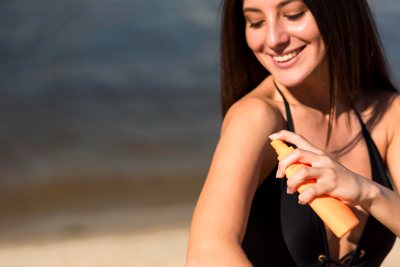

A good sunless tan should look smooth and believable, not patchy or orange. Getting there without UV exposure is easier than it used to be, but most of the result is decided before application.
This guide explains how to shop for sunless tanning products online with less guesswork. Focus on the details you can check before checkout: formula type, undertone, DHA level, rinse time, and the routine that helps color develop evenly.
Before You Buy: What Makes a Natural-Looking Tan
The color you see on your skin does not come from a dye that washes off right away. It comes from a reaction on the skin's surface, so timing, preparation, and product choice matter.
What DHA does, plus safety basics
Nearly every self-tanner uses DHA (dihydroxyacetone), a color additive used for external application to the skin. The FDA's safety guidance matters because DHA should not be inhaled or applied to the eyes, lips, or other mucous membranes. If you use a spray, protect those areas and follow directions.
A sunless tan is not sun protection. Only products with sunscreen and a listed SPF help protect against UV rays. Cleveland Clinic notes that SPF 30 blocks about 97 percent of UVB rays when used correctly, and the Skin Cancer Foundation has warned against Melanotan II because it is not FDA-approved. Stick with topical options and keep using broad-spectrum sunscreen outdoors.
Express, classic, or gradual
Product pages usually tell you how long color takes to develop, and that number shapes control. Express formulas can often be rinsed after about an hour, while classic formulas develop fully over roughly 6 to 8 hours. Bondi Sands explains this split clearly in its product FAQs. Rinsing an express tan early gives a softer result. Leaving it longer builds depth.
Choose Your Undertone and Depth
Two products with the same darkness level can finish very differently on your skin. The base color is often the reason.
A quick base-color cheat sheet
Green-based formulas lean cooler and can help counter orange or brassy tones, which many fair-to-medium skin tones appreciate. Violet-based formulas lean toward a richer, deeper finish. MoroccanTan makes both approaches easy to compare: its Exotics Instant Tanning Mousse is violet-based, while its Originals Instant Tanning Mousse is green-based and made with organic argan oil and aloe. Neither base is better for everyone. It comes down to the finish you want.
Match the DHA level to your skin
Higher DHA usually means a deeper result, so starting lighter is the safer way to avoid going too dark. A training chart from Aviva Labs maps DHA roughly by the Fitzpatrick skin type scale: I to II around 6 to 10 percent, III to IV around 8 to 12 percent, and V to VI around 12 to 16 percent. Treat those ranges as a starting point, not a rule, and build depth over a couple of applications.
Build Your Routine: Prep, Glow, Lock
A believable tan usually comes from three small habits working together: prep, glow, and lock.
Prep, the day before
The American Academy of Dermatology suggests exfoliating before you apply so color grips evenly. Shave earlier rather than right before application, and give dry areas a little extra moisture. Smooth, hydrated skin helps the color look more even. For a beach-day checklist, this sunless tan prep guide adds useful routine context.
Glow, on application day
Work in sections and blend outward. The AAD recommends diluting product over joints like knees, elbows, wrists, and ankles because those spots grab color fast. After applying, wait at least 10 minutes before dressing and wear loose clothing for about three hours while it develops. Once you rinse, you still need real SPF for sun exposure. For more everyday habits around staying protected outdoors, basic sun protection tips are a helpful companion to this routine.
Lock, to make it last
With good prep and daily moisturizing, many self-tans last about five to seven days. Keep showers shorter, moisturize daily, and use a gradual lotion for small top-ups. Chlorine and salt water can speed up fading, so rinse and rehydrate after a pool or beach day.
How to Shop Online With Confidence
Once you know what to look for, product pages get much easier to compare.
Read the label like a pro
Scan for the DHA percentage, the base color, whether it has a guide color or goes on clear, the recommended rinse window, and any professional-use-only notices. Some options are meant for trained applicators only. MoroccanTan's Accelerated professional solution, for example, contains 16 percent DHA and suggests 30 to 60 minutes for a natural result or 2 to 3 hours for a darker finish. It is intended for professional use, so at-home shoppers should choose a consumer formula instead.
Where to Buy Quality Formulas Online
If you would rather compare formulas and build a full routine in one place, you can shop tanning solutions online at MoroccanTan, where options are sorted into Prep, Glow, and Lock. That kind of layout makes it simpler to line up a base color, a DHA level, and a published rinse window without hopping between unrelated product pages.
When you browse, lean on the details each product page actually lists. MoroccanTan publishes rinse-time ranges for its mousses, for instance, so you can pick a depth on purpose rather than guessing. The Exotics mousse lists roughly 1 hour for natural, 4 to 5 hours for medium, and 6 or more hours for dark. The Originals mousse suggests about 3 to 4 hours for natural and 6 or more hours for dark. Reading those windows before you buy is the difference between a tan you controlled and one that surprised you.
Quick Comparisons You Will See Everywhere
You will run into a few familiar names while browsing. Here is a neutral, one-line snapshot to help you orient.
- Bondi Sands: known for express formulas, quick-drying foams, and hydrating lotions.
- St. Tropez: offers guide color across its core ranges and skincare-style textures.
- Loving Tan: markets a fast-rinse mask option for shoppers who want a shorter development window.
None of these are automatically better than another. The right pick depends on your undertone, the depth you want, and how much time you have.
Conclusion
The best results rarely come from the flashiest bottle. They come from matching the base color to your skin, choosing a DHA level that suits you, and respecting the timing on the label. If you are unsure, start lighter than you think you need and build over a couple of applications. It is much easier to add depth than to fix a shade that went too far. Shop slowly, read the details, and let the routine do the quiet work.
FAQ
Will self-tanner protect me from the sun?
No. A sunless tan only offers UV protection if the product includes sunscreen and shows an SPF. Products without SPF do not protect against sunburn, so keep applying a broad-spectrum sunscreen when you are outside.
How do I keep my hands and feet from going too dark?
Those areas grab color fast. Dermatology guidance suggests diluting product over joints like knees, elbows, wrists, and ankles, and using a lighter touch on hands and feet so the color fades out naturally instead of stopping in a hard line.
How long should I wait before rinsing an express formula?
Follow the product's listed rinse window. Rinsing earlier usually gives a softer result, while waiting longer can build more depth.
What if my color looks lighter after the first rinse?
That can be normal. Let the color finish developing as directed, then decide whether you want to add another light application later.




(0) comments
We welcome your comments
Log In
Post a comment as Guest
Keep it Clean. Please avoid obscene, vulgar, lewd, racist or sexually-oriented language.
PLEASE TURN OFF YOUR CAPS LOCK.
Don't Threaten. Threats of harming another person will not be tolerated.
Be Truthful. Don't knowingly lie about anyone or anything.
Be Nice. No racism, sexism or any sort of -ism that is degrading to another person.
Be Proactive. Use the 'Report' link on each comment to let us know of abusive posts.
Share with Us. We'd love to hear eyewitness accounts, the history behind an article.