
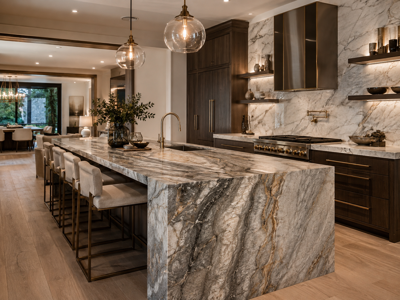

Luxury kitchens are expected to do two things at once: look exceptional and perform well under everyday use.
That combination makes countertop selection more important than simply choosing the most attractive slab in a showroom.
Marble and quartzite are two of the most desirable natural stones for high-end kitchens. Both can offer distinctive veining, large-format slabs, natural variation, and the ability to turn a kitchen island into an architectural focal point. Yet their appearance, practical characteristics, maintenance expectations, and suitability for different households are not identical.
For homeowners, designers, architects, and renovation professionals, the real decision is therefore not:
“Is marble or quartzite more luxurious?”
A more useful question is:
“Which natural stone better matches the way this kitchen will actually be used?”
If timeless softness, recognizable veining, and natural patina are priorities, marble may be the stronger choice.
If the kitchen needs dramatic natural character together with greater resistance to everyday countertop wear, quartzite often deserves closer consideration.
The right decision depends on lifestyle, design, maintenance expectations, slab selection, fabrication, and budget.
This guide compares those factors so buyers can make a more informed choice before committing to a material that may remain in the kitchen for decades.
Why Natural Stone Still Matters in Luxury Kitchen Design
Luxury kitchen design is increasingly moving away from unnecessary decoration.
Instead of adding more colors, finishes, and ornamental details, many sophisticated kitchens use a smaller number of materials with greater visual presence.
A large natural stone island can perform several roles simultaneously.
It can be:
- a food preparation surface;
- a breakfast area;
- an entertaining space;
- an architectural divider;
- a focal point visible from adjoining rooms.
This is particularly important in open-plan homes.
The kitchen may be visible from the living room, dining room, entrance, and outdoor entertaining area. As a result, the countertop material becomes part of the interior architecture rather than merely a functional work surface.
Natural stone is particularly effective because each slab carries geological variation.
The movement is not perfectly repeated.
Veins may change direction.
Mineral areas may become more concentrated in one part of a slab.
Colors can move from soft and subtle to dramatic within a single piece.
That individuality is difficult to reproduce exactly with manufactured surfaces.
Marble and Quartzite May Look Similar, but They Are Different Materials
Some quartzites can visually resemble marble, particularly varieties with light backgrounds and sweeping grey or gold veining.
This can cause confusion.
The two materials, however, have different geological origins and characteristics.
Marble
Marble is a metamorphic stone primarily associated with calcite-rich rock.
Its appearance may include:
- soft linear veins;
- cloudy movement;
- dramatic contrast;
- warm gold accents;
- green, brown, grey, black, or white backgrounds.
Marble has been used in architecture for centuries, which contributes to its strong association with timeless luxury.
Quartzite
Quartzite is a natural metamorphic stone created when quartz-rich sandstone undergoes intense geological heat and pressure.
Many quartzites contain a high concentration of quartz minerals, contributing to their hardness.
Visually, quartzite can range from very quiet to exceptionally dramatic.
Some varieties contain:
- broad grey movement;
- blue or green mineral areas;
- crystalline sections;
- gold veins;
- layered patterns;
- strong contrasting colors.
The important point is that both are natural stones.
Neither should be judged by appearance alone.
Quartzite: When the Kitchen Needs Natural Drama and Everyday Performance
Quartzite has become an increasingly attractive option for luxury kitchen islands and countertops.
One reason is visual impact.
Some slabs contain geological movement strong enough to become the centerpiece of an entire room.
A restrained kitchen with flat-panel cabinetry, warm wood, neutral flooring, and simple lighting can be completely transformed by one dramatic island.
For buyers who want genuine natural stone rather than a repeated manufactured pattern, carefully selected natural quartzite can provide the combination of individuality, visual depth, and countertop-focused performance that many high-end kitchens require.
Where Quartzite Works Particularly Well
Quartzite can be considered for:
- oversized kitchen islands;
- perimeter countertops;
- waterfall edges;
- bar areas;
- full-height backsplashes;
- integrated dining surfaces.
Its strongest role is often the island.
Because the island is usually one of the largest uninterrupted surfaces in a kitchen, it allows the complete slab pattern to remain visible.
Choose Quartzite When:
- genuine natural stone is important;
- the kitchen receives regular use;
- the island should become a visual focal point;
- unique geological movement is desirable;
- the homeowner wants something less visually predictable than manufactured stone.
However, the word “quartzite” alone should not be treated as a guarantee that every slab behaves identically.
Natural materials vary.
The specific stone should always be reviewed and properly identified before purchase and fabrication.
Durability: Why Lifestyle Matters
Countertops face more daily activity than many other interior surfaces.
A working kitchen can expose stone to:
- knives;
- cookware;
- dishes;
- food preparation;
- spills;
- cleaning;
- appliances;
- oils;
- acidic ingredients.
This is why lifestyle should influence material selection.
A kitchen designed primarily for entertaining may prioritize visual appearance differently from one used for cooking three meals every day.
Quartzite and Scratch Resistance
Quartzite is generally valued for its hardness, which contributes to its popularity for countertops.
That does not mean buyers should deliberately cut directly on the surface.
Cutting boards remain sensible because they protect both countertops and knives.
The practical advantage is that quartzite can suit households wanting natural stone without treating the kitchen like a showroom.
Marble and Everyday Wear
Marble requires a different mindset.
Its surface can develop signs of use over time.
Some homeowners consider this patina part of the beauty of natural stone.
Others find every small change frustrating.
Neither perspective is wrong.
The problem occurs when buyers choose marble for its appearance without accepting how the material may behave.
Maintenance Should Be Discussed Before Purchase
Maintenance is often treated as something to think about after the kitchen is installed.
That is backwards.
The homeowner should understand maintenance before approving the slab.
Questions should include:
- Does the stone require sealing?
- Which cleaning products are appropriate?
- How quickly should spills be cleaned?
- Is the surface sensitive to acids?
- How visible are fingerprints or water marks?
- Can the finish be professionally restored if necessary?
Maintenance tolerance is personal.
Some homeowners are happy to clean spills quickly and use stone-safe products.
Others want to wipe the countertop with almost anything without thinking about it.
The material should match those habits.
Marble: Why Designers Continue to Choose It
Despite requiring realistic maintenance expectations, marble remains one of the defining materials of luxury interiors.
There is a reason.
Its appearance is difficult to replace.
The natural veining can feel softer and more organic than many alternatives. White marble can brighten a kitchen, while darker or colored varieties can produce powerful contrast.
A carefully selected natural marble can work beautifully in luxury kitchens where timeless character and authentic geological variation matter more than maintaining a perfectly unchanged surface.
Marble Works Especially Well When:
- the kitchen has a classical or transitional design;
- the homeowner appreciates natural aging;
- the stone is part of a broader architectural concept;
- sophisticated veining is more important than perfect uniformity;
- appropriate maintenance is acceptable.
Marble May Be Less Suitable When:
- the homeowner is extremely concerned about etching;
- acidic ingredients are frequently used;
- maintenance must be minimal;
- a permanently flawless surface is expected.
This does not make marble impractical.
It simply makes expectation management important.
The Biggest Marble Issue: Etching
Etching is often confused with staining.
They are different.
Staining
A stain occurs when a substance penetrates the material and changes its color.
Depending on the stone, sealing can help reduce absorption.
Etching
Etching occurs when acidic substances react with calcite in marble and alter the surface finish.
Common kitchen substances may include:
- lemon juice;
- vinegar;
- wine;
- tomatoes;
- some household cleaners.
A sealed marble surface can still etch because sealing and acid resistance are not the same thing.
This is probably the single most important fact buyers should understand before installing marble in a working kitchen.
If visible patina will become part of the character → marble may still be an excellent choice.
If every etch mark will feel like damage → quartzite or another surface may be more appropriate.
Appearance: Marble Is Not Always Quiet, and Quartzite Is Not Always Dramatic
It is tempting to categorize marble as subtle and quartzite as dramatic.
Reality is more complicated.
Both materials offer a wide visual range.
Marble Can Be:
- soft;
- minimal;
- heavily veined;
- dark;
- colorful;
- strongly contrasted.
Quartzite Can Be:
- almost white;
- neutral;
- softly layered;
- strongly veined;
- blue;
- green;
- gold;
- highly expressive.
Therefore, buyers should select the actual slab rather than relying too heavily on the material category.
Review the Full Slab, Not Just a Small Sample
This is essential for natural stone.
A sample measuring a few inches cannot communicate the scale of a full slab.
Imagine selecting a small sample containing white background and one delicate vein.
The full slab may contain a large dark mineral section across one side.
Neither is necessarily a defect.
But the full pattern could completely change the kitchen design.
Before approving marble or quartzite, review:
- full slab photographs;
- current slab inventory;
- neighboring slabs if several are needed;
- color variation;
- vein direction;
- major mineral areas.
For expensive statement kitchens, slab selection should be treated as a design stage.
Several Slabs Must Be Selected Together
Large kitchens often require more than one slab.
This creates another challenge.
Natural stones do not repeat perfectly.
Three separately selected slabs may look individually attractive while failing to work together.
The design team should evaluate how the slabs will be distributed.
For example:
Slab A → island
Slab B → perimeter countertop
Slab C → backsplash
The most dramatic slab may be reserved for the island, while quieter slabs can be used around the perimeter.
This creates hierarchy.
Fabrication Can Matter as Much as Stone Selection
A beautiful slab can still produce a disappointing countertop if fabrication is poorly planned.
Before cutting, discuss:
- countertop dimensions;
- seam positions;
- vein direction;
- sink opening;
- cooktop opening;
- edge profile;
- backsplash;
- waterfall panels.
Highly directional materials demand particular attention.
A major vein running across an island can be one of the strongest design details in the kitchen.
If it suddenly stops at the waterfall edge and restarts in an unrelated direction, the finished result may look accidental.
Waterfall Edges: Beautiful but Not Automatic
Waterfall islands extend the countertop material vertically down one or both ends.
This creates visual mass and makes the island appear more architectural.
With natural stone, the goal is often to continue the vein through the corner.
That requires the fabricator to plan adjoining pieces carefully.
Waterfalls Work Best When:
- the island is large;
- the slab has attractive directional movement;
- cabinetry is simple;
- the island is visible from adjoining rooms.
Avoid Forcing a Waterfall When:
- usable slab area is limited;
- the pattern cannot be aligned successfully;
- the kitchen is small;
- the design already has too much visual weight.
Adding more stone does not automatically make the design more luxurious.
Full-Height Stone Backsplashes
Another popular high-end treatment is continuing slab material vertically from the countertop to the upper cabinetry or ceiling.
This can reduce grout lines and create visual continuity.
However, if the island already uses extremely expressive quartzite, repeating equally strong material across the backsplash can overwhelm the room.
One useful strategy is:
dramatic island + quiet perimeter
or
quiet island + dramatic backsplash
The kitchen needs a focal hierarchy.
Countertop Color Should Work With Cabinetry
Countertop selection should never happen independently of cabinets.
White or Cream Cabinets
Almost any stone color can work.
The decision is whether the goal is:
- subtle continuity;
- warm contrast;
- dramatic veining.
Light Oak
Pairs well with:
- white quartzite;
- cream marble;
- grey stone;
- green natural stone.
Walnut
Can work beautifully with:
- warm white;
- gold;
- brown;
- green;
- richly veined stone.
Dark Cabinets
Lighter stone can create contrast and prevent visual heaviness.
Dark-on-dark combinations can also work, but lighting becomes much more important.
Consider the Whole Countertop Package, Not Only Slab Price
Countertop budgeting becomes misleading when buyers compare only material prices.
The finished installation may also include:
- fabrication;
- templating;
- edge processing;
- sink cut-outs;
- cooktop cut-outs;
- reinforcement;
- transport;
- installation;
- slab waste;
- sealing where appropriate.
Different luxury stone countertops may require different fabrication strategies depending on slab dimensions, vein direction, island size, edge detail, and backsplash design, so the cheapest slab is not necessarily the lowest-cost finished solution.
A highly dramatic material may also require greater waste because the fabricator needs to preserve the most attractive parts of the pattern.
The correct comparison is therefore:
total installed value
rather than:
price per slab
Polished or Honed Finish?
Finish changes both appearance and user experience.
Polished
A polished surface usually makes the color and veins appear stronger.
It also reflects more light.
Polished stone can work well when:
- the kitchen needs stronger visual depth;
- the stone has attractive mineral movement;
- a formal luxury appearance is desired.
Honed
A honed surface has less reflection.
It can feel softer and more contemporary.
Honed stone often works particularly well with:
- oak cabinetry;
- lime-style plaster;
- matte metals;
- minimal architecture.
However, finish also affects how marks may appear.
Buyers should review an actual finished sample rather than making the decision from photographs alone.
Lighting Can Change Stone Color
Kitchen lighting has a major effect on natural stone.
Warm lighting may strengthen:
- cream;
- beige;
- brown;
- gold.
Cooler daylight may emphasize:
- white;
- blue;
- grey.
A slab selected under bright warehouse lighting may therefore appear different after installation.
Whenever possible, evaluate samples beside:
- cabinet doors;
- flooring;
- metal finishes;
under lighting similar to the final room.
Common Mistakes When Choosing Marble or Quartzite
1. Choosing Based Only on Social Media Photos
Photography, filters, and lighting can significantly alter stone colors.
Always review real material.
2. Assuming Every Quartzite Performs Identically
Natural stones vary.
Confirm the actual material.
3. Buying Marble Without Understanding Etching
Sealing does not eliminate acid sensitivity.
4. Selecting Several Slabs Separately
The slabs may not coordinate after installation.
5. Ignoring Vein Direction
Layout should be planned before cutting.
6. Choosing the Most Dramatic Stone for Every Surface
One focal point is often more sophisticated.
7. Comparing Only Material Price
Fabrication, waste, and installation affect total cost.
A Simple Buyer Decision Guide
Use this logic when narrowing the choice.
If Timeless Natural Elegance Is the Priority
→ Consider marble.
If Stronger Everyday Countertop Performance Is Important
→ Consider quartzite.
If Natural Patina Is Acceptable
→ Marble remains a strong option.
If Etching Would Cause Constant Concern
→ Quartzite may fit the household better.
If the Kitchen Needs One Dramatic Focal Point
→ Select a statement quartzite or expressive marble island.
If the Cabinets Already Have Strong Grain
→ Consider a calmer stone.
If Several Slabs Are Required
→ Select and review them together.
If Waterfall Edges Are Planned
→ Approve vein direction before fabrication.
Marble vs Quartzite: Which Gives Better Long-Term Value?
Value cannot be measured only by hardness or resale price.
A material has good long-term value when it continues to support the way the homeowner uses and experiences the kitchen.
Marble can provide exceptional value for someone who appreciates natural aging and timeless design.
Quartzite may provide greater value for someone wanting a dramatic natural stone countertop with fewer concerns about everyday surface wear.
The wrong choice occurs when expectations and material characteristics do not match.
Micro Summary
Marble and quartzite can both create exceptional luxury kitchens, but they satisfy different priorities.
Marble offers timeless veining and natural character, while quartzite is often selected when homeowners want natural geological movement together with stronger suitability for demanding kitchen surfaces.
If timeless beauty and patina matter most → consider marble.
If natural drama and everyday countertop performance matter more → consider quartzite.
Full slab selection, fabrication planning, vein direction, and realistic maintenance expectations are just as important as choosing the stone type.
Final Recommendation
Do not choose marble or quartzite because one material is currently more fashionable.
Choose according to the kitchen.
Start with lifestyle.
Then consider:
- natural appearance;
- daily use;
- maintenance;
- cabinet colors;
- slab dimensions;
- lighting;
- fabrication;
- budget.
If possible, review actual slabs rather than relying only on samples.
For multi-slab kitchens, inspect the complete group before fabrication.
For waterfall islands, full-height backsplashes, or strongly directional stone, approve a slab layout before cutting begins.
The strongest luxury kitchens do not necessarily use the most expensive material.
They use the material that feels appropriate every time someone enters the room—and still performs when dinner preparation begins.
That combination of design and practicality is what turns a beautiful kitchen into a successful one.
Frequently Asked Questions
1. Is quartzite better than marble for kitchen countertops?
Quartzite is often the better direction when homeowners want genuine natural stone with stronger scratch resistance and suitability for regular kitchen use.
Marble may be preferred when timeless veining, classical beauty, and natural patina are more important.
If durability is the priority → consider quartzite.
If timeless visual character is the priority → consider marble.
The specific slab and household expectations should still be evaluated before purchase.
2. Does quartzite stain easily?
Quartzite characteristics can vary from one stone to another. Some materials may benefit from sealing to reduce liquid absorption.
Spills should still be cleaned promptly, especially substances containing oils or strong pigments.
Buyers should confirm the characteristics and care requirements of the specific quartzite rather than assuming every material behaves identically.
3. Does marble need to be sealed for kitchen countertops?
Many marble countertops are sealed to help reduce liquid absorption and staining risk.
However, sealing does not prevent acid etching.
Lemon juice, vinegar, wine, and other acidic substances may still affect the finish.
Homeowners choosing marble should therefore understand both sealing and appropriate daily cleaning.
4. Is quartzite more expensive than marble?
Prices vary widely for both materials.
Cost depends on factors such as:
- stone variety;
- rarity;
- slab size;
- origin;
- visual quality;
- fabrication complexity;
- transportation.
Some exotic quartzites can cost significantly more than common marble varieties, while rare marbles can also be extremely expensive.
The better comparison is total installed cost rather than assuming one material category is always more expensive.
5. Which looks more luxurious, marble or quartzite?
Both can create luxurious kitchens.
Marble tends to communicate timeless, classical elegance.
Quartzite can provide more dramatic geological movement and unusual colors, making it particularly effective for contemporary statement islands.
If the goal is understated elegance → marble may fit better.
If the goal is an unforgettable natural focal point → dramatic quartzite may be stronger.
Luxury ultimately depends more on slab selection, layout, fabrication, and the relationship with the rest of the kitchen than on the material name alone.

(2) comments
This is a very informative breakdown between quartzite and marble. The tips on durability and maintenance are super helpful for anyone planning a kitchen remodel. Thanks for sharing such great insights!
This is a very informative breakdown between quartzite and marble. The tips on durability and maintenance are super helpful for anyone planning a kitchen remodel. Thanks for sharing such great insights!
We welcome your comments
Log In
Post a comment as Guest
Keep it Clean. Please avoid obscene, vulgar, lewd, racist or sexually-oriented language.
PLEASE TURN OFF YOUR CAPS LOCK.
Don't Threaten. Threats of harming another person will not be tolerated.
Be Truthful. Don't knowingly lie about anyone or anything.
Be Nice. No racism, sexism or any sort of -ism that is degrading to another person.
Be Proactive. Use the 'Report' link on each comment to let us know of abusive posts.
Share with Us. We'd love to hear eyewitness accounts, the history behind an article.