
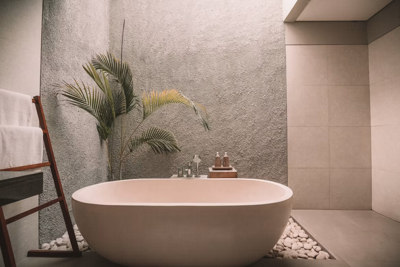

Want a bathroom that looks stunning AND actually lasts?
Guess how many homeowners nail their dream bathroom renovation? ZERO. Because most homeowners pick style OVER practicality. They go for that #PinterestFeel and all they get are invisible leaks, mouldy grout and a six-figure renovation you regret.
Here's the truth:
Day one, your bathroom can look amazing and be a complete disaster on pipes. This is because what makes a bathroom built well has almost nothing to do with tile selection.
Let's break it down.
In this guide:
- Why Looks Alone Won't Save Your Bathroom
- What Actually Lives Behind The Walls
- Why A Licensed Plumber Changes Everything
- The 4x Non-Negotiables Of A Well-Built Bathroom
- Warning Signs Your "Beautiful" Bathroom Is Failing
Why Looks Alone Won't Save Your Bathroom
A beautiful bathroom that fails is worse than an ugly bathroom that works.
After all, when a concealed leak rots through the subfloor... It's the cute finishes that are ripped out first. Leaking waterproofing costs homeowners anywhere from $2,000 to $12,000 to repair and leads to most insurance claims after bathroom renovations. Before you even consider the mould, destroyed framing and weeks your family goes without a functioning bathroom.
Here's why this happens so often:
Homeowners always go with the lowest priced contractor. They neglect the unsexy items (waterproof membranes, correct fixture spacing, proper pipe sizing). Then they spend way too much money on marble vanities and rainfall showerheads. If your rough-in layers aren't installed correctly by a Boris Mechanical licensed plumber, it won't matter how fancy that stuff is.
Because when water finds a way in... It always does.
What Actually Lives Behind The Walls
Ready for something most people never think about?
Behind every bathroom wall is a jungle of systems all fighting for space:
- Hot and cold supply lines
- Drain and vent stacks
- Electrical circuits & GFCI wiring
- Waterproof membranes
- Structural framing
All of these things relate to each other. Offset a drain and your slope is affected. Eliminate the vapour barrier and moisture traps in your studs. Size a pipe too small and water pressure decreases every time someone flushes a toilet.
A well-built bathroom respects all of this. A merely beautiful one hides it.
Little Known Fact: It doesn't show up on the walkthrough. It shows up 18 months later when the paint bubbles around the tub.
Why A Licensed Plumber Changes Everything
Getting a licensed plumber is not "nice to have" -- it's the biggest quality decision you make on the whole project.
DIY plumbing errors (or paying an unlicensed handyman to save some money) can lead to tens of thousands of dollars in unseen water damage and mould remediation. Compare that to the price of calling a pro originally... No contest.
Plumbers take care of what literally keeps your bathroom alive for years:
- Sizes pipes correctly: so there will be adequate water pressure when more than one fixture is used simultaneously.
- Slopes drains properly: meaning waste actually flows out (not back up into the shower).
- Follows code: meaning the work passes inspection and homeowners' insurance stays valid.
- Installs shut-off valves: the small stuff that saves thousands during an emergency.
- Pressure tests everything: before the walls close up and mistakes get buried.
An unlicensed installer skips one of these? Nobody notices until it's too late.
That's why every properly constructed bathroom has one thing in common: a licensed plumber inspected the pipes before they were hidden.
The 4x Non-Negotiables Of A Well-Built Bathroom
Alright onto the details. If a bathroom has these 4 things, it was built to stand the test of time. If not... Break out the chequebook.
1. Proper Waterproofing
This is your invisible layer. The boring stuff no one notices. But it's #1 reason why a bathroom looks professionally done versus just pretty.
Waterproof membranes are installed behind the tile in wet areas. Vapour barriers are installed in the surrounding walls. Each is important. Neglect one and water finds its way into the substrate, destroys the framing and you're back to demo in less than 5 years.
2. Correctly Sized & Routed Plumbing
Good bathroom plumbing will incorporate appropriate pipe diameters for the fixtures being served. It will also vent correctly (so that drains don't gurgle and traps don't dry out).
Don't skimp here. Plumbing accounts for 10% to 15% of total bathroom remodel costs -- it's this 10% to 15% that makes or breaks everything else.
3. Real Ventilation
Installing an undersized exhaust fan is one of the most deceptive errors in new bathroom construction. Too-small fans account for mould in 40% of renovated bathrooms in just 3 years.
Here's how to fix it. Get a fan rated for your bathroom's square footage. Make sure it vents to the outdoors (not the attic). Keep it running DURING and AFTER every steamy shower.
4. Quality Fixtures With Serviceable Parts
Cheap fixtures tend to break within 24 months. That's not a scare tactic — that's about how long the warranty lasts. Quality bathrooms have fixtures that:
- Solid brass valve bodies
- Ceramic disc cartridges
- Widely available replacement parts
Designer brands aren't the point. Serviceable ones are.
Warning Signs Your "Beautiful" Bathroom Is Failing
They say appearances can be deceiving, and bathrooms are no exception. Take a look under the surface on these common issues.
- Musty smell that won't quit: usually means moisture is trapped behind the walls.
- Grout that keeps cracking: the substrate is moving (not waterproofed properly).
- Higher water bills for no reason: hidden leak somewhere in the supply lines.
- Paint bubbling near the tub: vapour is getting into the wall cavity.
- Toilet that rocks slightly: toilet flange breaking down or subfloor beginning to rot.
Catch them early and it's minor remedial work. Miss them and you have demolition/remoulding experts, insurance claims adjusters and duplication of effort.
Bringing It All Together
A masterfully constructed bathroom is one where all of the unseen work equals the visible end result. Here's why:
- Waterproofing done right the first time
- Pipes sized, sloped, and vented properly
- Ventilation matched to the actual space
- Fixtures chosen for durability (not just looks)
- A licensed plumber signing off on every joint
The tile can wait. The vanity can wait. The gold-plated hardware can definitely wait.
But the plumbing and waterproofing? Those get exactly one shot.
Choose correctly and your bathroom will look good in 20 years. Choose incorrectly and no amount of tile countertops will save it from demolition.
The choice is simple. Build it right. Or build it twice.

(1) comment
Great article, really helpful
(Edited by staff.)We welcome your comments
Log In
Post a comment as Guest
Keep it Clean. Please avoid obscene, vulgar, lewd, racist or sexually-oriented language.
PLEASE TURN OFF YOUR CAPS LOCK.
Don't Threaten. Threats of harming another person will not be tolerated.
Be Truthful. Don't knowingly lie about anyone or anything.
Be Nice. No racism, sexism or any sort of -ism that is degrading to another person.
Be Proactive. Use the 'Report' link on each comment to let us know of abusive posts.
Share with Us. We'd love to hear eyewitness accounts, the history behind an article.