
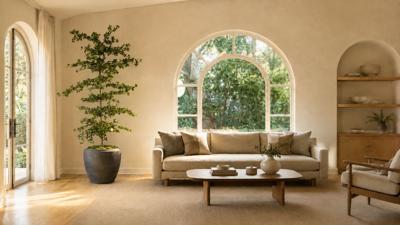
The most interesting object in a contemporary room may be the one that appears least designed.
A tree introduces none of the certainty associated with architecture. It does not present a clean edge, repeat a consistent interval, or resolve itself into an immediately readable silhouette. Its branches separate, overlap, disappear, and reappear. Light moves through it unevenly. Even when stationary, it suggests motion.
This makes the indoor tree more than a decorative gesture. Used with precision, it becomes a spatial device: one capable of interrupting architecture, obscuring overly obvious sightlines, altering the perceived dimensions of a room, and introducing ambiguity into interiors that might otherwise feel too completely composed.
That distinction matters. Much of the conversation around botanical décor remains preoccupied with whether artificial foliage looks sufficiently real. A more consequential question is whether the object does anything spatially interesting once it enters the room.
The strongest examples do.
The Value of an Unresolved Form
Contemporary interiors are often designed toward resolution. Walls meet cleanly. Furniture aligns with architectural grids. Lighting establishes hierarchy. Materials are selected to maintain continuity from one surface to the next.
An indoor tree works against that impulse.
Unlike a console, pedestal, or floor lamp, it cannot be understood from a single outline. Its form is porous. The eye moves through the canopy rather than stopping at its surface, catching portions of a wall, artwork, window, or adjoining room between the branches.
This partial visibility gives the interior something increasingly rare: an unresolved moment.
The tree does not divide space in the conventional sense. It produces a softer form of separation, allowing one area to remain perceptually connected to another while preventing the entire composition from being consumed at once. It edits the view without closing it.
This is why the most effective placement is not necessarily an empty corner. Corners often reduce trees to finishing touches, deployed after the consequential design decisions have already been made. A tree becomes more architecturally relevant when positioned where it can interfere with the room: at the edge of an opening, behind a seating group, adjacent to glazing, or between two zones that would otherwise transition too abruptly.
Its purpose is not simply to occupy unused floor area. It is to change how the space is read.
A Room Should Not Reveal Everything Immediately
Luxury interiors have long been associated with visual clarity, but complete visibility can flatten experience. When a room discloses its furniture, circulation, artwork, and architectural boundaries in a single glance, there is little reason for the eye to continue exploring.
Landscape design understands this instinctively. A path bends. A planting partially conceals what lies beyond it. A distant view is framed rather than exposed indiscriminately.
Interior greenery can perform a similar function.
Placed near the threshold of a living room, a branching tree can delay the full view of the seating arrangement. Positioned in front of a broad window, it can break a panoramic exterior into a series of smaller compositions. Used between living and dining areas, it can establish distinction without resorting to a screen, shelving unit, or change in flooring.
This quality relates to the biophilic principle of mystery: the promise of additional information that is only partially revealed. Biophilic design research extends well beyond the simple addition of plants and includes spatial conditions such as prospect, refuge, complexity, and partial concealment.
The relevance here is not that every interior tree must be justified as biophilic design. It is that organic form can influence perception as meaningfully as material or architecture.
The Tree as Counter-Composition
A room does not always need another harmonious object. Sometimes it needs resistance.
In a rigorously symmetrical interior, a tree can introduce imbalance without making the space feel careless. In a room dominated by horizontal furniture, it can establish vertical movement. Against repetitive wall paneling or a strict glazing grid, an irregular canopy prevents the architecture from becoming visually monotonous.
The effect depends on contrast rather than coordination.
A tree selected because its foliage precisely matches the upholstery or because its planter repeats the coffee table finish may make the room more cohesive, but not necessarily more compelling. Excessive coordination turns greenery into another component of the decorating scheme.
A stronger approach allows the botanical form to retain a degree of independence. Its silhouette should challenge the surrounding geometry. Its branches should extend beyond the narrow visual territory allotted to conventional accessories. Its presence should appear considered without appearing obedient.
This tension is particularly valuable in neutral interiors, where the problem is rarely a lack of tasteful objects. The problem is often that every object speaks with the same volume, texture, and level of restraint.
A tree introduces a different syntax.
Artificiality Is Not the Central Problem
The debate surrounding faux greenery is frequently reduced to authenticity: Does it look real?
That standard is useful but incomplete. A convincing trunk and varied foliage matter, particularly in interiors where materials are experienced at close range. Yet even a remarkably accurate tree will fail if its proportions are weak, its canopy is compressed against a wall, or its placement has no effect on the composition.
Conversely, artificiality can offer a specific design advantage. A living tree is responsive to light, climate, irrigation, growth, and seasonal change. Those qualities are desirable, but they also determine where the plant can survive and how its form will evolve.
A faux tree allows the designer to treat botanical form with greater permanence. The height, spread, and directional emphasis can be selected for a particular architectural condition and maintained there.
This places artificial greenery in an unusual category: visually organic but compositionally controlled.
Vert House’s Shady Lady Faux Olive Tree is useful within this discussion because it has been conceived as an architectural presence rather than a conventional decorative plant. Available in approximately seven- and eight-foot heights, it uses a natural camellia-wood trunk, hand-painted foliage, internal wire, and individually adjustable branches., it uses a natural camellia-wood trunk, hand-painted foliage, internal wire, and individually adjustable branches.
Those details support realism, but the more important attribute is adjustability. A branch that can be directed toward an opening, pulled away from a wall, or extended across a sightline is not merely being styled. It is being used to calibrate the space.
The Canopy Creates a Second Ceiling
Large rooms are frequently discussed in terms of floor plans, yet their emotional character is often determined overhead.
A high ceiling can provide grandeur, but it can also leave furniture visually stranded at floor level. Pendants and chandeliers address this by lowering the perceived ceiling plane, although they do so from a fixed central point.
A tree works differently.
Its canopy establishes an irregular intermediate layer between furniture and architecture. It occupies the otherwise vacant volume above a chair, beside a sofa, or near the edge of a dining table. Because the foliage does not form a solid plane, the room retains its height while gaining a more intimate human scale.
This can be particularly effective in double-height rooms, open stair halls, and residences with expansive glazing, where natural light has already become an organizing element of the architecture. The tree does not compete with the volume. It gives the volume something against which to register.
Scale is therefore not simply a matter of selecting a tall enough object. The canopy must enter into dialogue with the upper portion of the room. A narrow vertical tree may emphasize ceiling height, while a broader branching form can compress it perceptually. One stretches the architecture; the other moderates it.
The decision should be intentional.
The Planter Determines How the Tree Meets the Room
Once a tree is treated as a spatial object, its planter can no longer be regarded as packaging.
The vessel determines how the tree meets the floor. It can make the composition feel rooted, elevated, monolithic, delicate, provisional, or overly ornamental. It also mediates between the irregularity of the canopy and the geometry of the room.
A low, broad planter emphasizes the spread of the branches and gives the arrangement a grounded profile. A tall pedestal-like vessel elevates the canopy and may be useful where furniture would otherwise obscure the trunk. A planter with a narrow base and substantial upper volume can make the tree appear less stable, introducing tension that may or may not benefit the room.
Vert House offers fiber-composite planters in different proportions, including the low Flint and taller Stele forms. Their differing heights illustrate how significantly the base can change the reading of the same tree.
The planter should not be selected only by matching finishes. It should be chosen according to what the room needs the tree to do.
Designed Interruption
The contemporary interior does not need more objects selected merely because they are attractive. It needs elements capable of altering experience.
An indoor tree can conceal without dividing, fill volume without creating mass, and introduce complexity without clutter. It can make symmetry less rigid, transitions less abrupt, and large rooms less immediately comprehensible.
This is the more compelling context for Vert House and the Shady Lady Faux Olive Tree. Its relevance lies not simply in producing a realistic substitute for living greenery, but in recognizing that botanical form can be designed and deployed with architectural intent.
The tree should not be asked merely to make the room feel warmer or more natural. Those are predictable outcomes and increasingly empty design language.
It should be asked to interrupt something.
That is where it begins to matter.


(0) comments
We welcome your comments
Log In
Post a comment as Guest
Keep it Clean. Please avoid obscene, vulgar, lewd, racist or sexually-oriented language.
PLEASE TURN OFF YOUR CAPS LOCK.
Don't Threaten. Threats of harming another person will not be tolerated.
Be Truthful. Don't knowingly lie about anyone or anything.
Be Nice. No racism, sexism or any sort of -ism that is degrading to another person.
Be Proactive. Use the 'Report' link on each comment to let us know of abusive posts.
Share with Us. We'd love to hear eyewitness accounts, the history behind an article.