
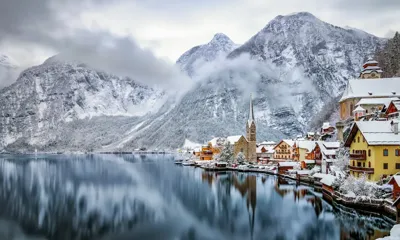

Genuine exclusivity in winter travel has less to do with price tags or hotel ratings than with how difficult a place is to reach. Geographic isolation, narrow seasonal windows, and limited transport can keep visitor numbers naturally low. When snow closes mountain roads or winter conditions cut off remote valleys, getting there depends as much on timing and logistics as it does on making a reservation.
Some destinations owe their exclusivity to location, season, and limited access. A car-free alpine village high in the mountains, a hotel rebuilt from ice each winter, or a remote valley reached only by helicopter offers a level of privacy that conventional resorts cannot easily match. The five retreats below stand apart because their rarity begins with the landscape, the season, and the journey required to reach them.
Oberlech, Austria: Car-Free for the Entire Ski Season
At around 1,750 meters above sea level, Oberlech becomes completely car-free from December to April. Guests leave their vehicles in Lech and continue uphill by cable car, while a 3.2-kilometer underground tunnel system handles much of the movement of luggage and supplies beneath the village. The system has operated since 1997 and allows Oberlech to remain free of normal road traffic throughout the winter season.
That infrastructure changes the feel of the resort in a very practical way. Hotels and chalets sit directly among the ski slopes without the usual road traffic running between them, while goods are transported through the tunnels by electric vehicles. What sets Oberlech apart is its high-altitude setting and the way winter access is kept largely separate from road traffic.
For those considering Chalet 1551 in Lech, the property sits in Oberlech with ski-in, ski-out access and wide views across the surrounding Alps. Guests can move directly between the chalet and the slopes, making the location itself a large part of what sets the stay apart.
Kyoto, Japan: Home to Just Over 40,000 Historic Machiya
Kyoto still has tens of thousands of kyomachiya, the traditional wooden townhouses that have shaped the city’s streets for generations. Under Kyoto’s current ordinance, a kyomachiya is defined as a traditional wooden building constructed before 1950. Many have narrow street-facing facades opening into deep interior layouts with features such as latticework, earthen passageways, and small courtyard gardens known as tsuboniwa.
Their numbers are falling quickly. Kyoto’s 2024 survey found that around 800 kyomachiya are still being lost each year, which makes intact examples increasingly significant. Districts such as Gion, Kamigyo, and Higashiyama still contain surviving townhouses where timber posts, tatami rooms, lattice screens, and interior gardens preserve elements of traditional urban architecture.
Restoring these buildings requires work suited to their traditional construction methods, and Kyoto provides specialist guidance and support for their preservation and renovation. When adapted for modern stays, some retain their original timber framework and courtyard layouts while adding discreet heating and other contemporary comforts. The rarity here is measurable: each surviving kyomachiya belongs to a building type that continues to disappear from the city every year.
Saint Martin: The World's Smallest Island Split Between Two Nations
At roughly 34 square miles, Saint Martin is the smallest inhabited island shared by two nations. The Treaty of Concordia divided the island between French and Dutch control in 1648, creating today’s French collectivity of Saint-Martin in the north and Sint Maarten, a constituent country of the Kingdom of the Netherlands, in the south. The border remains open, making it possible to move freely between the two sides.
On the French side, development gives way in places to protected coastline and quieter residential enclaves. The National Nature Reserve covers more than 3,000 hectares in the northeast, protecting coral reefs, mangroves, salt ponds, and stretches of shoreline. Winter sea temperatures remain around 79 to 82°F, while easterly winds are common through the season.
At the western end of the French side, Terres Basses is a gated residential area close to Baie Longue and Baie aux Prunes, two relatively quiet beaches with little commercial development. Terres Basses is one of the main areas to consider for those exploring Saint Martin vacation rentals, particularly for private villas across the peninsula. The island’s open border also makes it easy to move between Grand Case on the French side and the marinas and services of Dutch Sint Maarten.
Swedish Lapland: An Ice Palace Rebuilt Every Single Year
Around 200 kilometers north of the Arctic Circle in Jukkasjärvi, ICEHOTEL creates a new winter hotel from snow and ice every year. Roughly 5,000 tons of natural ice are harvested from the Torne River during spring and stored until construction begins for the following winter. The seasonal hotel welcomes guests from December to April before melting back into the river as temperatures rise.
Inside, temperatures remain around 23°F even when conditions outdoors fall far below zero. Artists from around the world create individually designed rooms and suites from ice and snow, with each winter bringing a new collection. Beds are fitted with mattresses, reindeer hides, and insulated sleeping bags designed for the sub-zero setting.
Jukkasjärvi also lies within the Aurora Oval and has limited light pollution, creating favorable conditions for seeing the Northern Lights when skies are clear. What makes the winter hotel genuinely rare is its temporary nature: the rooms and sculptures exist for only one season before disappearing, with an entirely new version built the following year.
New Zealand: High-Country Lodges Reachable Only by Helicopter
Minaret Station Alpine Lodge sits at 3,000 feet in a remote glacial valley near Lake Wanaka, with no road leading to the property. Guests, staff and supplies all arrive by helicopter, with flights taking around 15 to 20 minutes from Wanaka or 25 to 30 minutes from Queenstown. The lodge has just four private chalets on a 50,000-acre high-country station, where limited access is central to the experience.
New Zealand’s summer also coincides with winter in the Northern Hemisphere, opening the surrounding high country to hiking, fishing, and helicopter excursions during the warmer months. Guided trips can reach remote ridgelines, valleys, and backcountry fishing areas that would be difficult to access overland.
The lodge’s isolation also shapes how it operates. Its primary source of electricity comes from hydro power generated by a nearby waterfall, which also supplies water fed by snow and rain. With no road connection and only four chalets, Minaret Station offers a particularly clear example of exclusivity created by geography and restricted access.
Which of these could you actually reach?
What sets these retreats apart is not a star rating or a price tag, but the limits built into each destination. Oberlech removes cars from the equation in winter, Kyoto’s historic machiya are disappearing each year, ICEHOTEL exists in a new form for only one season, and Minaret Station can be reached only by helicopter.
Choosing between them comes down to the kind of remoteness that appeals most. Some require careful timing; others depend on specialist transport or limited seasonal access. In each case, the landscape and logistics shape the experience long before you arrive, which is precisely what makes these retreats difficult to replicate elsewhere.

(0) comments
We welcome your comments
Log In
Post a comment as Guest
Keep it Clean. Please avoid obscene, vulgar, lewd, racist or sexually-oriented language.
PLEASE TURN OFF YOUR CAPS LOCK.
Don't Threaten. Threats of harming another person will not be tolerated.
Be Truthful. Don't knowingly lie about anyone or anything.
Be Nice. No racism, sexism or any sort of -ism that is degrading to another person.
Be Proactive. Use the 'Report' link on each comment to let us know of abusive posts.
Share with Us. We'd love to hear eyewitness accounts, the history behind an article.