
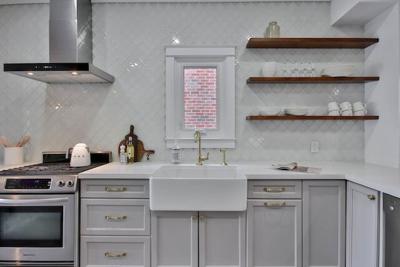

On average, Americans spend around 400 hours per year in their kitchen. As one of the most important parts of your house, its primary purpose, of course, is function. But many homeowners don't think about their sink could be upgraded to better serve their needs.
If you're one of those who do and are in the market for a new sink, a farmhouse model might just do the trick. Here's what you need to know about this type of sink and how to determine if they're the right fit for your kitchen.
What Exactly Is a Farmhouse Sink?
The standout feature of a farmhouse sink is the apron front. Rather than being hidden inside the cabinets, the front is exposed, which adds a flair to an otherwise regular kitchen. They also don’t have any rounded edges from the basin to the counter, which creates a stylized look.
What Should I Know About Buying One?
A sink is one of the main focal points of your kitchen, and it needs to be as functional as possible, especially if you find yourself cooking large meals fairly often. You may think that there's not much that goes into buying a sink, but there are plenty of factors to consider.
Materials
Farmhouse sinks come in a variety of materials. Many homeowners opt for stainless steel, copper, or enamel, depending on their needs.
These sinks combine the utility of a deep basin with the benefits of those building materials to create beautiful and durable sinks. A copper farmhouse sink can be especially advantageous due to copper’s antimicrobial properties and gorgeous patina effect as it ages.
Though your primary concern will likely be the size and material, the style of the apron front is another way to customize the look of your sink. Some materials, like fireclay, stone, and copper, can have decorative fronts that can range from simple, such as an unpolished or ‘natural’ stone, to incredibly detailed with copper.
Sizing
Since they were born out of the need to hold an incredible amount of water for an entire day’s work of cleaning, washing, and rinsing, there’s a wide range of sizes they come in. They're most commonly built as 30 and 33-inch basins, but you can even get them in 60 inches. But the size you need will depend on your desire for function or style and whether you need a single basin or double.
You should also measure the width that you’ll need, as this determines how far back you’ll need to install the sink and similarly, how far forward the sink will hang over the edge of the counter.
Fixtures
The faucet and other fixtures you'll pair with it should enter the equation as well. Regarding the faucet, these will have to be mounted behind or above the sink rather than as part of it. Wall-mount faucets, those that are mounted to the wall above the sink, can be useful if you don’t have much countertop space to spare behind the sink or just prefer the look.
Countertops
If you’re replacing or modifying your countertops, you might think about your drainage options. Using a counter with drainer grooves can help water flow into the sink from the countertop, which is useful not only for any unfortunate spills but can be used in tandem with a drying rack as well.
Other Benefits of Buying a Farmhouse Sink
The biggest advantage of farmhouse sinks is that they're designed to be much deeper than the average basin of today. So if you have large pots and pans that are hard to fit in a normal basin, a farmhouse sink can be a great solution.
And because the front is exposed, they’re more comfortable to spend an extended amount of time in front of, and this is aided by the lack of edges or overhang from the counters to the sink.
Drawbacks
Though that’s not to say that farmhouse sinks come without their fair share of downsides. If you're stepping out and choosing a material like cast iron or porcelain, you should know that they’re more prone to chipping, and dropping glass dishware into a porcelain sink is a recipe for disaster.
Another thing to note is that you’ll need to modify your countertops to fit. Since they’re deeper and have an exposed front, any cabinets below the sink will need to be adjusted, as well as the countertop itself to remain flush with the sink. But there is the option for retrofitting, which cuts down the full height of the apron from 10 inches to 3 to fit your cabinets in case you don’t plan on customizing or replacing your cabinets to fit.
Maximize Your Kitchen
Buying a new sink can be a bit overwhelming with how many options are on the market. But a farmhouse sink may be just the addition to complete your kitchen upgrade. If you value function, style, and a unique kitchen feature like an apron front, you can't go wrong spending time in front of a farmhouse-style sink.

(0) comments
We welcome your comments
Log In
Post a comment as Guest
Keep it Clean. Please avoid obscene, vulgar, lewd, racist or sexually-oriented language.
PLEASE TURN OFF YOUR CAPS LOCK.
Don't Threaten. Threats of harming another person will not be tolerated.
Be Truthful. Don't knowingly lie about anyone or anything.
Be Nice. No racism, sexism or any sort of -ism that is degrading to another person.
Be Proactive. Use the 'Report' link on each comment to let us know of abusive posts.
Share with Us. We'd love to hear eyewitness accounts, the history behind an article.