
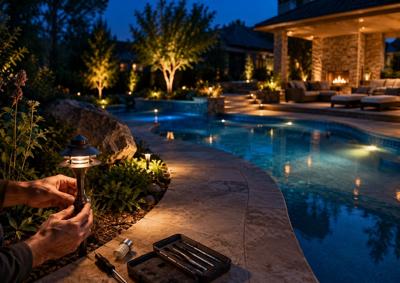

Outdoor lighting is one of those home features people notice most when it stops working. A glowing path, softly lit garden, illuminated pool, and warm patio can make a backyard feel elegant and easy after sunset. But one flickering fixture, a dark step, or a pool light that suddenly goes quiet can change the mood quickly. Nothing says “luxury outdoor living” quite like guests using phone flashlights to find the patio stairs.
That is why outdoor lighting repairs should not be treated as an afterthought. Lighting affects beauty, safety, security, and the way a home functions after dark. Around pools, spas, wet patios, and landscaped pathways, repairs are even more important because water and electricity are not a casual pairing. The right maintenance approach helps homeowners know what to check, what to avoid, and when to bring in a qualified professional.
Start With The Lights That Affect Safety
Not every lighting issue is equally urgent. A decorative garden light that has shifted slightly may be annoying, but a dark step, broken pathway light, flickering pool light, or damaged fixture near water deserves faster attention. Safety lighting helps people see where they are walking, where the pool begins, where stairs change level, and where outdoor surfaces may be wet.
Homeowners should walk the property at night and notice the dark spots. Look at pool edges, steps, gates, walkways, outdoor kitchens, dining areas, driveways, side yards, and any route guests use to move through the property. If an area feels awkward, shadowy, or easy to trip through, it belongs on the repair list.
Do Not Ignore Pool Light Problems
Pool lights are beautiful when they work properly, but they need to be treated seriously when they fail. Flickering, dimming, water inside the fixture, a tripped breaker, visible corrosion, or a light that works intermittently can all point to a problem that should be inspected before anyone keeps using the pool casually.
The U.S. Consumer Product Safety Commission warns that wet skin and wet surfaces, including grass and pool decks, can increase the risk of electrocution. That makes pool lighting repairs different from changing a decorative bulb on the patio. Electrical work around pools should be handled by qualified professionals.
Watch For Flickering Or Dimming Fixtures
A flickering light might be a loose bulb, but it can also point to wiring, moisture, transformer, voltage, or fixture problems. Dimming can happen when fixtures are aging, connections are weak, lamps are failing, or the system is not getting consistent power.
If one fixture flickers, the issue may be local. If several lights flicker or dim at once, the problem may be with the transformer, controls, circuit, or wiring. Either way, repeated flickering should not be ignored. Outdoor lights live with rain, irrigation, humidity, heat, pests, and landscaping tools. Eventually, something will complain.
Look For Moisture Inside Fixtures
Outdoor fixtures are built for exterior conditions, but they are not invincible. Moisture inside a fixture can signal a failed seal, cracked lens, poor installation, aging gasket, or fixture damage. Around pools and irrigation zones, moisture problems can show up faster because fixtures are exposed to splash, spray, and damp surfaces.
If water appears inside a pool light, landscape fixture, path light, or wall light, turn the light off and have it inspected. Do not keep resetting breakers or hoping the fixture dries itself into better behavior. Moisture and electrical components are a repair issue, not a personality quirk.
Check For Corrosion And Rust
Corrosion can appear on fixtures, screws, connections, mounting hardware, and metal housings. Pool chemicals, coastal air, irrigation overspray, and general outdoor exposure can all speed up wear. A little discoloration may be cosmetic, but heavy corrosion can affect performance and safety.
Inspect fixtures near pools, spas, fountains, outdoor showers, and planting beds more often. These areas are harder on materials. If a fixture is rusting, loose, cracked, or no longer sealed properly, replacing it may be smarter than repeatedly repairing it.
Make Sure GFCI Protection Is Working
Ground fault circuit interrupter protection is one of the most important safety features for outdoor electrical systems, especially near water. The Electrical Safety Foundation International recommends GFCI protection for electrical devices used outside to help prevent electrocution and electric shock injuries. ESFI also notes that outdoor receptacles should be covered to keep them dry and that swimming pool electrical equipment should be grounded.
Homeowners should know where outdoor GFCI outlets and breakers are located and should test them according to manufacturer instructions. If a GFCI trips repeatedly, that is not something to bypass. It is a sign that the system needs professional attention.
Check Timers, Sensors, And Smart Controls
Sometimes the fixture is not the problem. Timers, photocells, motion sensors, transformers, app controls, and smart-home settings can all make outdoor lights behave strangely. A light that does not turn on may be fine electrically but controlled by a timer that lost its settings after an outage.
Check basic settings before assuming a fixture has failed. Confirm schedules, daylight sensors, dimmer settings, smart-home scenes, and manual overrides. If the system still behaves inconsistently, the issue may be wiring, a failing control, or a transformer problem.
Understand Transformer Problems
Many landscape lighting systems use low-voltage transformers. When a transformer is overloaded, aging, improperly sized, or exposed to weather damage, lights may dim, flicker, fail in groups, or operate inconsistently.
A transformer problem is especially likely if several fixtures on the same run stop working together. Homeowners can check whether the transformer is powered, whether the timer is set correctly, and whether the system has an obvious tripped breaker. Beyond that, a lighting professional should inspect the system. The backyard is not improved by experimental electrical work.
Inspect Pathway And Step Lights
Pathway and step lights are easy to overlook because they are often low, subtle, and designed to disappear into the landscape. But when they fail, the effect is immediate. Walkways feel darker, steps become less obvious, and guests may have to guess where the safe route is.
Look for fixtures that have been knocked over, buried by mulch, blocked by plants, damaged by foot traffic, or shifted by irrigation and soil movement. Clean lenses, trim overgrown landscaping, and make sure lights still aim where they are needed. A path light hidden inside a shrub is no longer lighting the path. It has chosen a new career.
Watch For Landscaping Damage
Outdoor lighting systems often share space with mowers, trimmers, rakes, irrigation lines, roots, mulch, and seasonal plantings. Wiring can be nicked, fixtures can be knocked loose, and lights can slowly disappear under landscaping that was not part of the original plan.
After major yard work, walk the property and check the lighting system. Look for exposed wires, tilted fixtures, cracked housings, or lights that no longer work. Landscape crews are not always aware of hidden lighting lines, and outdoor systems can take damage quietly.
Know When A Bulb Replacement Is Enough
Not every repair requires a major service call. Some fixtures only need a replacement lamp, a cleaned lens, a tightened housing, a reset timer, or debris cleared away. Solar lights may need cleaned panels, better sun exposure, or rechargeable battery replacement.
Still, homeowners should be cautious. If the fixture is near water, shows signs of moisture, trips a breaker, smells hot, sparks, flickers repeatedly, or has visible wiring damage, stop treating it like a simple bulb issue. The repair has moved into professional territory.
Upgrade Aging Lights When Repair No Longer Makes Sense
At some point, repeated repairs are not worth it. Older fixtures may be inefficient, poorly sealed, mismatched, corroded, or incompatible with newer controls. Upgrading can improve safety, appearance, reliability, and energy use.
ENERGY STAR notes that certified exterior light fixtures can use energy-efficient technologies, including LEDs, motion sensors, and daylight sensors. Modern outdoor lighting can offer better performance with less energy use, especially when paired with thoughtful controls.
Use Repairs To Improve The Lighting Plan
A broken fixture is annoying, but it can also be useful. Repairs are a chance to notice whether the lighting plan still fits the way the backyard is used. Maybe the path to the outdoor kitchen needs more light. Maybe the old pool area lighting is too harsh. Maybe the seating area needs a warmer glow. Maybe one lonely fixture has been trying to do the work of six.
This connects naturally with broader pool lighting ideas. Repairs do not have to be purely practical. They can be the moment when a backyard becomes safer, more flattering, and much more enjoyable after dark.
Keep Lighting Maintenance On A Seasonal Schedule
Outdoor lighting should be checked seasonally, especially before heavy entertaining seasons and after storms. Walk the property at night, then again during the day. At night, you can see where light is missing. During the day, you can see damage, corrosion, blocked fixtures, or exposed wiring more clearly.
This routine pairs well with broader pool maintenance tips and pool-area cleanup. A clean, well-lit backyard is easier to maintain and safer to use.
Know When To Call A Professional
Call a licensed electrician or qualified outdoor lighting professional if pool lights fail, a breaker trips repeatedly, fixtures show moisture or corrosion, wiring is damaged, several lights fail at once, a transformer seems overloaded, or any lighting problem appears near water.
For pool-specific electrical issues, do not improvise. Underwater lighting, bonding, grounding, GFCI protection, and electrical equipment near pools require the right expertise. A beautiful backyard should never depend on “probably fine” wiring.
How Lighting Repairs Fit Into Outdoor Maintenance
Lighting repairs are part of outdoor maintenance because they affect how the space looks, feels, and functions. Broken lights can make a pool area feel neglected. Dark paths can create safety issues. Damaged fixtures can become electrical concerns. Poorly aimed lights can create glare instead of ambiance.
For homeowners already working through pool care, this article connects naturally with guides on how to keep your pool area clean, how to spot pool leak problems, and when to hire a swimming pool service company for water and equipment care.
The Bottom Line On Outdoor Lighting Repairs
The most important outdoor lighting repairs are the ones that affect safety, visibility, moisture protection, electrical performance, and how the space functions after dark. Flickering pool lights, dark steps, damaged pathway lights, corroded fixtures, tripping breakers, moisture inside housings, and failing transformers should not be ignored.
A well-lit backyard feels polished, comfortable, and cared for. It also helps people move safely around pools, patios, gardens, and outdoor living spaces. Repair the lights that matter, upgrade the ones that no longer make sense, and call a professional whenever water and electricity are sharing the same sentence.
(0) comments
We welcome your comments
Log In
Post a comment as Guest
Keep it Clean. Please avoid obscene, vulgar, lewd, racist or sexually-oriented language.
PLEASE TURN OFF YOUR CAPS LOCK.
Don't Threaten. Threats of harming another person will not be tolerated.
Be Truthful. Don't knowingly lie about anyone or anything.
Be Nice. No racism, sexism or any sort of -ism that is degrading to another person.
Be Proactive. Use the 'Report' link on each comment to let us know of abusive posts.
Share with Us. We'd love to hear eyewitness accounts, the history behind an article.