
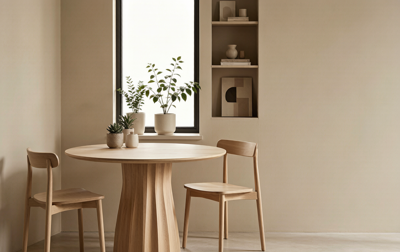

If you have ever squeezed past the corner of a rectangular dining table to get to your seat, knocked your hip on a sharp edge while carrying plates, or watched guests awkwardly move around chair legs during dinner, you know that table shape is not just about aesthetics. It affects how your room functions every single day.
I spent three years in an apartment where the dining area was barely nine feet square. I started with a narrow rectangular table because it looked good in catalog photos. After six months of bruised thighs and cramped movement, I switched to a round table and the difference was immediate. The room felt larger. People moved freely. Dinner became less about logistics and more about conversation. Since then, I have become a convert to round dining tables for any space under roughly one hundred twenty square feet.
This article covers why round tables improve traffic flow, how to pick the right diameter for your room and seating needs, what materials make sense in compact spaces, and one measurement most buyers forget to check before they buy.
Why Table Shape Matters More Than You Think
Most people choose a dining table based on how it looks or how many people it seats. Those matter, but there is a third factor that determines whether you actually enjoy using the table day after day: how easily you can move around it.
Rectangular tables create dead zones at the corners. Those four corners take up floor space but contribute almost nothing to usable surface area. In a small room, every square foot counts. A round table eliminates those corners entirely. The footprint becomes more efficient because the entire perimeter is usable for seating and access.
The psychological effect is real too. Round tables have no head position. Everyone sits equidistant from the center. This encourages eye contact and balanced conversation in a way that rectangular tables do not. It sounds minor until you host a dinner party and notice the difference.
Round vs Rectangle: The Traffic Flow Difference
Here is a direct comparison based on real dimensions and everyday use. I have included clearance numbers because that is where most sizing mistakes happen:
Factor | Round Table (42") | Rectangle (48x30") |
Seats comfortably | 4 adults | 4 adults |
Min. room width needed | 9 ft (with 36" clearance) | 8.5 ft (long sides) |
Corner obstacles | None | 4 sharp corners |
Traffic flow around it | Excellent, smooth path | Good, corners slow you down |
Flexible seating | Yes, squeeze in a 5th easily | No, positions are fixed |
Best room shape | Square (8x8 to 10x10 ft) | Rectangular (10x12+ ft) |
The clearance number deserves emphasis. You need at least thirty-six inches between the table edge and any wall or piece of furniture so people can pull out chairs and walk behind seated diners comfortably. If your space only allows twenty-four inches, everyone will be bumping into things regardless of table shape.
Sizing Your Round Table for Real Life
Diameter is the main spec you need to get right. Here is a practical breakdown by household size:
28 to 36 inches. Seats two to three people. Works well in breakfast nooks, studio apartments, or as a secondary table in a kitchen. This size feels intimate and cozy. It is too small for a full dinner service with platters and serving dishes.
42 inches. The sweet spot for most small homes. Seats four adults with enough elbow room for comfortable meals without feeling crowded. Fits in a nine-by-nine-foot room with adequate clearance on all sides. If you are unsure what size to buy, start here.
48 to 54 inches. Seats six people. Requires a room at least ten by ten feet, ideally twelve feet in one direction. This is a genuine family dining table, not just a casual spot. Make sure you measure the fully cleared space, not just the open floor area.
One detail that catches people off guard: pedestal bases save more legroom than four-legged designs. With four legs, the corner legs interfere with chair placement. A single central column gives you unrestricted knee room and lets you tuck chairs completely under the edge when not in use.
Measuring Your Room the Right Way (Most Buyers Skip This)
Almost every buying guide tells you to measure your room. Very few tell you how to measure it correctly for a dining table. Here is the method that prevents buyer's remorse.
First, measure wall to wall in both directions at table height, not floor level. Baseboards, radiators, and built-in features can eat up two or three inches that you do not notice until the table arrives. Second, mark where chairs will go when pulled out. A standard dining chair adds about eighteen inches of depth when someone is seated. Add another twenty-four inches behind that for walkway clearance. That means your table needs roughly forty-two inches of clear space from the wall on each side where people sit.
Third, account for door swings, cabinet doors that open into the dining area, and any fixed elements like a heating vent or window sill that protrudes. I once measured a room that seemed perfect for a forty-two-inch round table, then realized the patio door swung inward directly through where the fourth chair would sit. Measure the full arc of anything that moves.
Finally, use painter's tape to outline the table footprint and chair pull-out zone on your floor. Walk around it for a day. Open nearby doors. Carry a plate from the kitchen to the taped outline. This low-tech test reveals problems that numbers alone will not show you.
Materials That Work Best in Small Dining Spaces
Material choice affects how large or small your table feels visually, not just physically. In a compact room, this matters more than you might expect.
Light oak or ash wood. Light-colored timber reflects more ambient light and makes the table feel smaller than dark walnut or mahogany. A natural oak finish can make a forty-two-inch table look like it takes up less visual weight than a darker piece of the same size.
Glass tops. These practically disappear visually. You see through them to the floor, which doubles the perceived openness of the room. Glass works especially well with slim metal bases. Look for tempered glass at least half an inch thick for durability.
White or light-painted finishes. Painted MDF or engineered wood with a white or off-white finish is budget-friendly and keeps the visual footprint minimal. Just avoid placing hot dishes directly on painted surfaces. Use trivets or placemats.
What to avoid in small spaces: heavy dark stone tops like thick marble or concrete. They look stunning in large dining rooms but visually dominate a compact area. If you love the stone look, consider a thinner veneer or a lighter quartz option.
Seating Flexibility: The Hidden Advantage of Round Tables
One benefit of round tables that rarely gets mentioned is seating flexibility. With a rectangular table, each seat has a fixed position. The person at the head has more space. The person squeezed into the short side has less. When an extra guest shows up, there is nowhere natural to put them unless you drag over a separate chair that blocks the walkway.
With a round table, all positions are equal. You can usually squeeze in a fifth person at a four-seat round table without anyone feeling cramped. The circular shape distributes the crowding evenly. For households that host informally, this flexibility matters more than the maximum stated capacity suggests.
Armless chairs give you even more wiggle room. They tuck completely under the table edge when not in use, which makes the dining area feel larger when nobody is sitting. They also make it easier to slide in and out in tight spaces. If you choose upholstered armless chairs, pick a fabric that hides stains if you have children or frequent dinner parties.
Making Your Small Dining Area Work Harder
A round dining table is one of the few furniture choices that genuinely improves how a small room functions. It removes corner obstacles, smooths out traffic flow, creates flexible seating, and makes meals feel more social. The key is picking the right diameter for your actual clearance, choosing a material that does not overwhelm the space visually, and measuring your room with chairs and door swings in mind before you order.
Ready to find the right fit? Browse a curated selection of space-saving round dining tables designed specifically for compact homes and apartments. Look for the clearance specs in each listing, and when in doubt, go one size smaller rather than one size bigger. You will never regret having a little extra room to breathe.


(0) comments
We welcome your comments
Log In
Post a comment as Guest
Keep it Clean. Please avoid obscene, vulgar, lewd, racist or sexually-oriented language.
PLEASE TURN OFF YOUR CAPS LOCK.
Don't Threaten. Threats of harming another person will not be tolerated.
Be Truthful. Don't knowingly lie about anyone or anything.
Be Nice. No racism, sexism or any sort of -ism that is degrading to another person.
Be Proactive. Use the 'Report' link on each comment to let us know of abusive posts.
Share with Us. We'd love to hear eyewitness accounts, the history behind an article.