
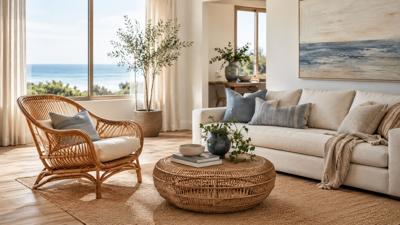
Rattan has spent decades drifting in and out of fashion, often returning with the same familiar associations: tropical resorts, sunrooms, vintage conservatories, and relaxed vacation homes. In the modern beach house, however, the material is taking on a more sophisticated role.
Today’s most compelling rattan furniture is sculptural rather than novelty-driven. It appears in curved lounge chairs, architectural headboards, tailored dining seating, handwoven cabinetry, and oversized lighting that can hold its own in a carefully designed room. Instead of announcing a coastal theme, rattan now contributes warmth, texture, craftsmanship, and a sense of ease.
That distinction matters. The modern beach house is moving beyond predictable white interiors, blue stripes, and rooms filled with matching woven furniture. It is becoming richer, more collected, and more closely connected to the landscape surrounding it.
Rattan fits naturally into that evolution.
Rattan Has Moved Beyond the Sunroom
Rattan furniture was never limited to beach houses, but its lightness and flexibility made it particularly suitable for warm climates, conservatories, verandas, and informal gathering spaces.
Its design history is far more substantial than its casual reputation suggests. Rattan has appeared in European interiors since the Victorian era and later became part of modern furniture movements that favored lighter forms, expressive curves, and handcrafted construction. Italy’s Bonacina, for example, has built an extensive design legacy around rattan, with work spanning more than a century.
That history is helping designers view the material differently.
Rather than treating a rattan chair as a decorative beach accessory, they are considering its silhouette, joinery, scale, and relationship to the architecture. A well-designed woven chair can have the visual presence of sculpture while still feeling less imposing than a fully upholstered piece.
In a modern beach house, where light and views often play leading roles, that openness is valuable.
The New Coastal Interior Feels Warmer
For years, coastal design was dominated by bright white walls, bleached woods, pale upholstery, and carefully placed navy accents. The effect could be crisp and attractive, but it also became easy to reproduce—and just as easy to overdo.
The newer coastal palette is warmer and less formulaic.
Cream, parchment, sand, clay, tobacco, olive, weathered blue, and muted terracotta are replacing stark white as the only acceptable foundation. Natural wood is deeper. Stone is more expressive. Textiles have visible weave and weight.
This shift is part of a broader move toward interiors that feel personal, regionally grounded, and assembled over time rather than styled around one recognizable trend. Current design coverage also points toward warmer materials, richer textures, and less reliance on rigidly themed rooms.
Rattan works especially well within that palette because it sits between color and texture. Its honeyed tone warms pale rooms, while its woven surface creates depth without requiring a bold pattern.
It can make a minimalist room feel less sterile and a traditional room feel less formal.
Sculptural Shapes Are Changing the Conversation
The most interesting rattan furniture does not disappear into the background.
It curves, arches, wraps, and frames the body. Generous lounge chairs may feature sweeping arms and rounded backs. Headboards rise above the bed in rhythmic woven patterns. Dining chairs use controlled geometry rather than resort-style bulk.
These pieces are effective because rattan can bend into forms that would be difficult to achieve with many heavier materials. It offers visual movement while maintaining an airy structure.
In a large living room, a pair of curved rattan chairs can create an intimate conversation area without blocking sightlines toward the ocean. In a bedroom, an oversized woven headboard can provide architectural presence without the weight of dark wood or deeply upholstered panels.
The goal is not to fill the house with rattan. It is to allow a few exceptional pieces to shape the room.
Rattan Looks Most Luxurious Beside Contrasting Materials
Rattan becomes more refined when it is placed beside materials that are smoother, heavier, or more polished.
A woven chair against limewashed walls feels relaxed. The same chair beside veined stone, lacquered cabinetry, bronze lighting, and tailored linen becomes more sophisticated.
Strong pairings include:
Rattan and honed marble
Rattan and travertine
Rattan and dark walnut
Rattan and brushed brass
Rattan and bouclé
Rattan and handwoven wool
Rattan and plaster
Rattan and richly grained oak
The contrast keeps a coastal room from drifting too far into informality.
This material tension is also what makes rattan relevant beyond vacation properties. It can soften contemporary architecture, bring lightness to formal furniture, and add a handmade quality to rooms dominated by stone, glass, and metal.
FINE’s guide to interior color and style trends for homes in 2026 explores the same movement toward nature-driven tones and more tactile interiors.
Vintage Rattan Adds Character
One reason rattan is appearing in more polished interiors is that it rarely looks better when everything matches.
Vintage pieces bring variation in color, patina, weave, and scale. A 1970s lounge chair, an older Italian side table, or a well-made bamboo-and-rattan cabinet can introduce the kind of individuality that newly purchased furniture sets often lack.
The best vintage rattan pieces do not necessarily need to look pristine. Slight tonal variation and signs of age can make a beach house feel established rather than newly decorated.
Condition still matters. Loose bindings, cracked cane, weakened joints, and brittle fibers may require professional repair. But when the structure is sound, an older rattan piece can serve as the room’s most distinctive element.
Mixing vintage and contemporary furniture also helps prevent coastal interiors from looking like a hotel showroom. A modern sofa becomes more interesting beside an older woven chair. A restrained bedroom gains personality from a rattan bench with an unusual silhouette.
The room begins to tell a story rather than merely follow a style.
Lighting May Be Rattan’s Most Dramatic Role
Furniture is not the only place where rattan is changing beach-house design.
Oversized woven pendants and sculptural sconces are becoming architectural elements in their own right. Their scale can define a dining area, emphasize a vaulted ceiling, or bring warmth to an otherwise minimal kitchen.
Because woven shades filter light rather than containing it completely, they also create patterned shadows and a softer evening atmosphere.
In a modern beach house, this is particularly effective. Large windows and open floor plans can feel luminous during the day but exposed or flat after sunset. Layered woven lighting helps shift the mood without relying on overtly decorative fixtures.
The most elegant approach is usually one strong fixture rather than several competing woven designs. An oversized pendant over a dining table, for example, can provide sufficient texture without requiring rattan stools, baskets, chairs, and accessories in the same space.
Bedrooms Benefit From Rattan’s Visual Lightness
A beach-house bedroom should feel restful, but it does not need to be visually empty.
Rattan introduces detail without creating heaviness. A woven headboard can anchor the bed while allowing the surrounding wall to remain visible. Cane-front nightstands provide storage but feel lighter than solid cabinetry. A bench or occasional chair can bring warmth to an otherwise pale room.
The material is especially effective in bedrooms with linen bedding, plaster walls, natural oak, or handwoven rugs.
However, scale should guide the choice. Small decorative headboards can look insignificant in rooms with high ceilings. A larger, more architectural design will usually feel better proportioned and more intentional.
The same principle applies throughout the modern beach house. Rattan should not be used merely because it appears coastal. It should earn its place through shape, craftsmanship, or function.
Dining Rooms Are Becoming Less Formal and More Layered
Beach-house dining rooms often need to perform several roles. They may host relaxed breakfasts, family dinners, long weekends with guests, and more formal evening gatherings.
Rattan dining chairs help bridge those settings.
They feel less rigid than traditional upholstered chairs but more considered than basic outdoor-style seating. When paired with a substantial dining table in oak, walnut, stone, or plaster, woven chairs create a balance between ease and permanence.
The strongest combinations avoid excessive coordination. Host chairs may differ from side chairs. Upholstered seating can be mixed with woven designs. A contemporary table can sit beneath a handcrafted rattan pendant.
This layered approach connects with the broader shift away from interiors that look purchased all at once.
FINE’s feature on Hamptons-style interiors also demonstrates how natural materials can create warmth without sacrificing balance or refinement.
Indoor and Outdoor Rattan Are Not the Same
The visual continuity between indoor and outdoor living is one of the defining features of a modern beach house. Large openings, terraces, covered loggias, and pool areas often function as extensions of the interior.
That does not mean the same material should be used everywhere.
Natural rattan is best protected from prolonged moisture, direct rain, and severe weather. It can work in enclosed rooms and carefully sheltered spaces, but exposed patios usually require synthetic woven materials, outdoor rope, teak, powder-coated metal, or other weather-resistant alternatives.
Modern synthetic wicker can reproduce the visual softness of rattan while offering better resistance to moisture and ultraviolet exposure. Marine-grade rope is another increasingly popular option for coastal outdoor furniture because it provides an open woven effect with greater durability in exposed settings.
The design connection should come from color, scale, and silhouette—not necessarily from using identical materials.
An indoor rattan lounge chair might relate to an outdoor rope chair through its curved frame and open weave. The spaces feel connected without asking natural fibers to perform in conditions they were not designed to withstand.
Craftsmanship Matters More Than Quantity
Rattan’s renewed relevance also reflects a growing interest in materials that show evidence of the hand.
The beauty of a woven piece lies in its repeated bindings, controlled bends, natural variations, and structural rhythm. These details become more noticeable when the furniture is used sparingly.
Quality rattan furniture should feel stable, balanced, and thoughtfully finished. Joints should be secure. Wrappings should be tight. The weave should appear consistent without looking mechanically perfect.
A single beautifully made chair may contribute more to a room than several inexpensive woven pieces scattered throughout it.
That is especially true in a luxury home, where the distinction between natural texture and decorative filler is immediately visible.
The Modern Beach House No Longer Needs a Theme
Perhaps rattan’s greatest contribution is that it allows a coastal home to feel relaxed without becoming literal.
The modern beach house does not require anchors, coral sculptures, rope knots, or a prescribed collection of blue-and-white accessories. Its connection to the coast can be expressed through light, ventilation, natural materials, framed views, and furniture that encourages slower living.
Rattan supports that atmosphere quietly.
It can reference craft traditions, tropical climates, Italian modernism, vintage California interiors, or contemporary organic design depending on how it is used. That range is why the material feels relevant again.
The most successful rooms allow rattan to participate in the design rather than dominate it. One sculptural chair, an expressive headboard, or a beautifully scaled pendant can provide enough warmth and movement to transform the space.
Rattan Is Becoming a Modern Classic
Rattan may be trending again, but its appeal is not dependent on one decorating season.
Its durability as a design material comes from contradiction. It is strong but visually light, relaxed but capable of refinement, traditional yet easily shaped into modern forms.
In the modern beach house, those qualities feel particularly appropriate.
The material allows rooms to remain open and comfortable while adding depth, craftsmanship, and character. Used with restraint, it creates a home that feels connected to the coast without becoming trapped in a coastal theme.
That is not simply a return to rattan.
It is a more intelligent way of seeing it.
(0) comments
We welcome your comments
Log In
Post a comment as Guest
Keep it Clean. Please avoid obscene, vulgar, lewd, racist or sexually-oriented language.
PLEASE TURN OFF YOUR CAPS LOCK.
Don't Threaten. Threats of harming another person will not be tolerated.
Be Truthful. Don't knowingly lie about anyone or anything.
Be Nice. No racism, sexism or any sort of -ism that is degrading to another person.
Be Proactive. Use the 'Report' link on each comment to let us know of abusive posts.
Share with Us. We'd love to hear eyewitness accounts, the history behind an article.