
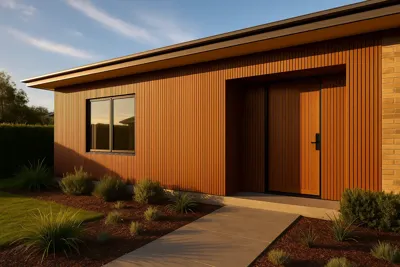

The exterior of a fine home is one of its most significant assets — and one of its most consequential specification decisions. The right cladding choice defines the property's architectural character for decades, contributes meaningfully to its market value, and determines the maintenance commitment that the owner makes from the day the building is completed.
For homeowners at the premium end of the market, three questions dominate the cladding conversation: does the material deliver the visual quality and longevity that a fine home demands? Does it comply with the fire performance requirements that increasingly apply to residential projects of all scales? And does it add genuine, measurable value to the property? This article addresses all three.
Fire Compliance for Residential Projects in 2026
Fire rated cladding is no longer a concern exclusive to tall residential towers. The post-Grenfell regulatory environment has extended fire performance requirements to a wider range of residential projects, and homeowners undertaking extensions, garden buildings, and new homes are increasingly encountering requirements they had not previously needed to consider.
The key trigger for fire rated cladding on residential projects is building height and boundary proximity. For homes above two storeys — including many fine homes and country properties with significant footprints — fire performance requirements may apply to external wall materials depending on the distance from the nearest site boundary. Extensions built close to a boundary face similar requirements, as do any projects where local planning conditions specify enhanced fire performance.
The practical implication is straightforward: confirm the fire performance requirement with building control or a fire engineer before specifying cladding, not after. The cost and disruption of changing a cladding specification at procurement stage are significant. The cost of confirming requirements at RIBA Stage 2 is negligible. Factory pressure-impregnated fire retardant treatment — the only method that reliably achieves and certifies Euroclass B-s1,d0 compliance — is available across all main premium timber species and profiles, so there is no trade-off between fire compliance and the quality of the finished facade.
For fine home projects where fire rated cladding is required, a specialist fire rated cladding service UK can supply factory-treated boards across Siberian larch, ThermoWood, Nordic spruce, and Douglas fir — all with full EN 13501-1 certification documentation ready for building control submission. The service includes system assembly guidance to ensure the complete wall build-up achieves the required classification, not just the individual boards.
Does Timber Cladding Add Value to a Fine Home?
The question of whether exterior timber cladding adds value to a property has become more relevant as natural timber facades have moved from architectural niche to mainstream premium residential choice. The evidence from the UK property market over the past decade is broadly positive, though the relationship between cladding specification and property value is more nuanced than simple before-and-after valuations suggest.
Premium natural timber cladding — Siberian larch, ThermoWood, charred timber — contributes to property value through two mechanisms. The first is direct visual differentiation: a well-clad home stands out in the local market, attracts more viewing interest, and commands a premium from buyers who respond to the quality of the exterior finish. The second is implied quality signalling: premium timber cladding, when correctly specified and installed, communicates to informed buyers that the rest of the property has been specified to the same standard. It functions as a quality indicator for the build as a whole.
The caveats are important. The value contribution depends on the quality of specification and installation, the appropriateness of the material choice for the property's context, and the maintenance condition of the cladding at the point of sale. Poorly maintained timber cladding — boards that have greyed unevenly, joints that have opened, surface coatings that have failed — can work against value rather than for it. The case for low maintenance premium species is therefore not only about owner convenience but about protecting the value contribution the cladding makes over the property's ownership cycle.
For a detailed assessment of how different timber cladding species and treatments affect property value in the UK — including survey data on buyer responses to different exterior finishes and guidance on which choices deliver the strongest value contribution in different property types and locations — the does timber cladding add value to a house UK guide examines the evidence honestly and practically for homeowners considering cladding as part of a renovation or extension project.
Making the Right Choice for a Fine Home
The cladding specification for a fine home should be driven by three aligned priorities: architectural appropriateness, material performance, and long-term value contribution. The material that best serves all three simultaneously is typically a naturally durable or thermally modified timber in a profile that suits the building's architectural language — specified correctly, installed in a ventilated rainscreen system, and maintained to a standard consistent with the quality of the rest of the property.
For homeowners working with architects and contractors on premium residential projects, the most important single piece of advice is to make the cladding specification decision early. The choice of species, profile, and treatment affects cavity design, fixing specification, and window and door reveal detailing in ways that cannot be efficiently resolved at Stage 4. Early engagement with a specialist supplier produces better architecture, more efficient construction, and a finished facade that delivers on its promise for decades.
(0) comments
We welcome your comments
Log In
Post a comment as Guest
Keep it Clean. Please avoid obscene, vulgar, lewd, racist or sexually-oriented language.
PLEASE TURN OFF YOUR CAPS LOCK.
Don't Threaten. Threats of harming another person will not be tolerated.
Be Truthful. Don't knowingly lie about anyone or anything.
Be Nice. No racism, sexism or any sort of -ism that is degrading to another person.
Be Proactive. Use the 'Report' link on each comment to let us know of abusive posts.
Share with Us. We'd love to hear eyewitness accounts, the history behind an article.