
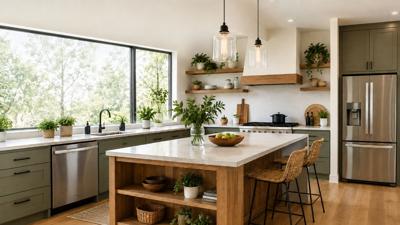
How to Design a More Sustainable Kitchen Without Sacrificing StyleA sustainable kitchen does not have to look like an earnest collection of bamboo utensils, mismatched recycling bins, and appliances chosen solely for their efficiency labels.
The most environmentally responsible kitchens are often the ones that look the most considered. They use durable materials, avoid unnecessary demolition, reduce everyday energy and water consumption, and remain attractive long after a passing design trend has disappeared.
That longevity matters. A kitchen that must be remodeled again in five years because the layout is impractical or the finishes have already dated is rarely sustainable, regardless of how many recycled materials went into it.
The goal is not to create a perfectly “green” kitchen. It is to make better decisions at every stage—from deciding what can remain to selecting cabinetry, appliances, lighting, plumbing fixtures, and surfaces that will perform well for years.
Begin With What You Can Keep
The most sustainable material is often the one already inside the house.
Before removing every cabinet, appliance, floorboard, and light fixture, evaluate what can realistically be repaired, refinished, repurposed, or relocated. Structurally sound cabinet boxes may only need new doors, hardware, or paint. Existing hardwood flooring might be refinished instead of replaced. A functional island could be resized or given a new countertop rather than sent to a landfill.
This does not mean preserving elements that are damaged, inefficient, or poorly placed simply for the sake of keeping them. It means distinguishing between something that is genuinely unusable and something that merely looks dated.
Selective renovation can also leave more of the budget available for improvements that meaningfully affect daily life, such as better ventilation, efficient appliances, durable counters, improved lighting, or a more functional layout.
Design the Layout for the Way You Actually Cook
A beautiful kitchen becomes wasteful when its layout is frustrating enough to inspire another remodel.
Start by considering how food moves through the room. Groceries arrive, ingredients are stored, food is prepared, meals are cooked, dishes are served, and everything eventually returns to a cabinet, drawer, refrigerator, or dishwasher.
The refrigerator, primary prep surface, sink, cooktop, pantry, and waste stations should support that sequence without forcing people to cross the kitchen repeatedly.
This is particularly important in larger kitchens. An expansive room may look luxurious, but placing the refrigerator twelve feet from the prep sink is not sophisticated planning. It is simply a long walk with a carton of eggs.
Think about who uses the room and when. A second person making coffee should not need to enter the main cooking zone. Children should be able to reach snacks and water without standing beside a hot range. Recycling, compost, and household waste should be easy to separate rather than treated as an afterthought.
Good planning reduces friction, prevents unnecessary future alterations, and makes the kitchen easier to live with over time.
Choose Cabinetry for Longevity
Cabinetry represents a substantial portion of most kitchen-renovation budgets, as well as a significant amount of material. It deserves more attention than whichever door color currently dominates social media.
Look for solid construction, repairable components, durable hinges and drawer glides, and finishes that can withstand repeated cleaning. A cabinet that can be repainted, refaced, adjusted, or repaired has a much longer useful life than one designed to be replaced as a complete unit.
Homeowners concerned about indoor air quality can also ask about low-emitting composite wood products, adhesives, paints, and finishes. The Environmental Protection Agency notes that certain pressed-wood products can release formaldehyde, making product composition and emissions relevant considerations during material selection.
Wood certification can provide additional information about sourcing. The Forest Stewardship Council, for example, operates a certification system intended to support responsibly managed forests and traceable forest-based products.
Style should be considered through the same long-term lens. Restrained cabinetry does not have to be dull. It simply allows personality to come from lighting, stools, hardware, art, and smaller details that can change without requiring another construction project.
Select Countertops for the Household, Not the Showroom
Every countertop material involves trade-offs.
Natural stone can last for decades but may require sealing and careful maintenance. Engineered surfaces are often consistent and practical, although their composition and repairability vary. Stainless steel is exceptionally durable and recyclable but can feel more commercial. Solid-surface materials may be repairable, while recycled-glass and terrazzo-style counters can bring visual character but differ significantly by manufacturer.
The most sustainable choice is not automatically the material with the strongest environmental marketing. It is the surface that suits the way the household cooks and cleans and that will not be replaced prematurely.
Before choosing, ask:
Can the surface be repaired if chipped, scratched, or stained?
Does it require regular sealing or specialized cleaning?
Is the appearance likely to age well?
Where was it manufactured, and how far must it travel?
Can remnants be used for a smaller island, pantry counter, or backsplash?
Will the fabricator be able to use the slab efficiently?
A dramatic stone with extensive veining may be irresistible, but careful templating and layout can reduce waste while ensuring that its most beautiful portions appear where they will actually be seen.
Invest in Efficient Appliances—but Buy Only What You Need
Appliances are one of the most obvious places to improve a kitchen’s energy performance.
ENERGY STAR-certified products must meet energy-efficiency criteria established by the U.S. Environmental Protection Agency or Department of Energy. Depending on the appliance category, efficient models can reduce electricity or water use without sacrificing normal performance. The label is a useful comparison tool, but it should not replace evaluating capacity, features, expected use, and long-term serviceability.
Larger is not always better. An oversized refrigerator consumes kitchen space and may encourage overbuying. A second dishwasher can be worthwhile for a household that entertains constantly but excessive for one that rarely fills the first. A commercial-style range may look impressive while using more energy than the homeowner’s cooking habits justify.
Purchase for the life you live rather than the culinary life suggested by an appliance showroom.
Induction cooking is also gaining attention because it transfers heat directly to compatible cookware rather than heating the surrounding surface in the same way as conventional electric or gas cooking. It offers rapid temperature response, a cooler cooking surface, and no combustion inside the kitchen, although electrical upgrades and cookware compatibility should be evaluated before installation.
Reduce Water Use at the Sink
Kitchen water consumption is shaped by dozens of small daily habits: rinsing produce, filling pots, washing hands, cleaning counters, and pre-rinsing dishes that may not require it.
A thoughtfully selected faucet can reduce water use without making ordinary tasks inconvenient. Look for a model with easy temperature control, a practical spray pattern, replaceable components, and a flow rate appropriate for kitchen work.
Touchless and touch-activated controls may also reduce the amount of time the water runs while hands are occupied, although convenience features should be judged by durability and ease of repair rather than novelty alone.
A high-efficiency dishwasher can often use less water than repeatedly washing full loads by hand. Run it when adequately filled, use the appropriate cycle, and avoid unnecessary heated drying when the model provides an effective alternative.
Treat Lighting as a System
One decorative pendant cannot illuminate an entire kitchen, no matter how beautiful it looks above the island.
Sustainable kitchen lighting begins with layers. Ambient lighting provides general visibility, task lighting illuminates counters and cooking areas, and accent lighting adds atmosphere or highlights architectural details.
LED lighting uses substantially less electricity than traditional incandescent lighting and generally lasts much longer. Its success, however, depends on choosing the right color temperature, brightness, placement, and controls.
Poorly positioned lighting often leads homeowners to turn on every fixture at once. A better plan places light exactly where it is needed and divides fixtures into separate zones. Dimmers allow brighter task lighting during food preparation and softer illumination once dinner is served.
Natural light should also be used intelligently. Enlarging a window may improve daytime illumination, but orientation, heat gain, privacy, and the loss of storage space must be considered before sacrificing an entire wall of cabinetry.
Use Salvaged and Recycled Materials Selectively
Reclaimed wood, antique hardware, vintage lighting, recycled tile, architectural salvage, and repurposed furniture can add depth to a kitchen that might otherwise feel newly installed in the least interesting sense of the phrase.
The key is selectivity.
An old worktable may make a compelling island if its height, structure, and surface are appropriate. Reclaimed timber can bring warmth to shelving or a hood surround. Vintage pendants may provide character after being professionally rewired.
Not every salvaged object needs to become a design feature. Materials should be safe, cleanable, structurally appropriate, and compatible with local building requirements. Older painted pieces may also require testing or professional evaluation before being sanded or refinished.
Used thoughtfully, reclaimed elements give the kitchen a sense of history while reducing demand for newly manufactured decorative materials.
Plan for Construction Waste Before Demolition Begins
Renovation waste is easier to manage when a plan exists before the first cabinet is removed.
Ask the contractor which materials can be donated, recycled, reused on-site, or separated from general debris. Cabinets, appliances, sinks, fixtures, hardware, and building materials in usable condition may be accepted by architectural-salvage organizations or nonprofit reuse centers.
Donation requirements vary, so arrangements should be made before demolition. A cabinet set that could have been reused may quickly become unusable if it is removed carelessly or left exposed to weather.
Discuss packaging waste as well. Appliances, cabinetry, tile, plumbing fixtures, and lighting can arrive surrounded by cardboard, foam, plastic, and pallets. Determine how those materials will be sorted and handled rather than assuming everything will be diverted automatically.
Avoid Trends That Require Structural Commitment
Trends are not inherently irresponsible. They keep interiors lively and reflect changing tastes. Problems arise when a highly specific trend is built into the most expensive and difficult-to-replace parts of the kitchen.
A daring paint color is relatively easy to change. A sculptural pendant can be replaced. Bar stools, hardware, rugs, and art allow experimentation without demolition.
A permanent layout based on a fleeting lifestyle trend is another matter.
Build the room’s architecture around proportion, circulation, storage, natural light, and durable materials. Use less permanent layers to express the moment. This approach produces a kitchen that can evolve rather than one destined for a complete redesign when tastes shift.
A Sustainable Kitchen Should Still Feel Luxurious
Sustainability is sometimes presented as a series of sacrifices: fewer materials, fewer appliances, smaller rooms, and a stern rejection of anything beautiful.
A better sustainable kitchen is not defined by deprivation. It is defined by discernment.
It invests in craftsmanship instead of disposable upgrades. It favors materials that can age gracefully, appliances that match the household’s needs, and a layout that will remain functional through different stages of life. It avoids replacing useful components merely because they are no longer fashionable.
Most importantly, it creates a room worth keeping.
That may be the most luxurious and environmentally responsible kitchen decision of all.
(0) comments
We welcome your comments
Log In
Post a comment as Guest
Keep it Clean. Please avoid obscene, vulgar, lewd, racist or sexually-oriented language.
PLEASE TURN OFF YOUR CAPS LOCK.
Don't Threaten. Threats of harming another person will not be tolerated.
Be Truthful. Don't knowingly lie about anyone or anything.
Be Nice. No racism, sexism or any sort of -ism that is degrading to another person.
Be Proactive. Use the 'Report' link on each comment to let us know of abusive posts.
Share with Us. We'd love to hear eyewitness accounts, the history behind an article.