

For millions of people, home isn't just a sanctuary; it is the front line of a daily battle against invisible enemies. Pollen, dust mites, pet dander, and mold spores are the silent occupants of our living spaces. For allergy sufferers, these microscopic particles turn a comfortable afternoon into a haze of sneezing, itchy eyes, and congestion.
Many homeowners attempt to combat this by "cleaning harder"—dusting more often or vacuuming daily. However, standard cleaning methods can sometimes exacerbate the problem rather than solve it. The act of dry dusting or sweeping often kicks allergens up into the air, where they linger for hours before settling back down.
To truly allergy-proof a home, one must shift from "moving dirt around" to "trapping and removing" it. This requires a hygiene routine that prioritizes filtration and wet cleaning over simple suction.
The Science of Settling: Why Daily Maintenance Matters
Allergens are governed by gravity. Eventually, everything in the air settles on the floor. This makes your floor the largest "allergen trap" in your house. If you walk across a dusty floor, you act as a bellows, pumping those particles back into the breathing zone.
The key to controlling this is frequency. You must remove the settled particles before they have a chance to become airborne again. However, for a busy family, vacuuming every single day is impractical.
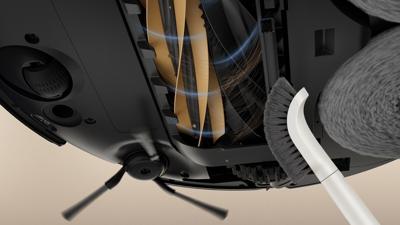
This is where the vacuum and mop robot becomes a medical necessity rather than just a convenience. By scheduling a robot to run daily (perhaps while the family is out of the house), you keep the "allergen load" of the home consistently low.
The "mop" function is particularly critical for allergy sufferers. While suction removes the hair and large dust bunnies, the damp mopping pad captures the microscopic particulate that suction misses. It traps the fine dust and pollen against the pad, effectively locking it away until it is washed off. This dual-action approach prevents the "puff" of dust that often occurs with traditional sweeping.
The Deep Clean: Washing the Air by Washing the Floor
While daily maintenance keeps the surface levels down, deeper reservoirs of allergens can hide in rugs, grout lines, and corners. Furthermore, sometimes the allergens are sticky—pollen that has tracked in on muddy shoes, or dried saliva on pet toys.
Dry vacuuming cannot remove sticky allergens. You need water. However, traditional mopping is flawed; as you dip a dirty mop back into a bucket, you are often just spreading a "pollen soup" back onto your floors.
To truly sanitize the floor and remove allergens, you need a system that constantly extracts the dirty water. A wet and dry vacuum is the superior tool for this task. These devices spray clean water onto the floor to bind with the dust and dander, scrub the surface to lift it, and then immediately suck the contaminated water into a sealed dirty tank.
This process ensures that the allergens are physically removed from the environment and flushed down the drain, rather than wiped around. For those sensitive to chemicals, this mechanical cleaning power often reduces the need for harsh sprays, as the friction and water alone do a tremendous amount of the work.
Filtration: The Final Barrier
When selecting these tools for an allergy-prone home, the internal filtration is as important as the cleaning power.
HEPA Standards: High-quality vacuums (both robotic and handheld) often utilize HEPA (High-Efficiency Particulate Air) or similar high-grade filters. These filters are designed to trap 99.97% of particles as small as 0.3 microns. This ensures that the air coming out of the vacuum is cleaner than the air going in.
Sealed Systems: A good allergy vacuum has a sealed system, meaning dirty air cannot leak out through cracks in the casing before passing through the filter.
Building the Anti-Allergy Protocol
To maximize your defense against sneezing, implement this routine:
The "No-Fly Zone" (Daily): set your robot to vacuum and mop high-traffic areas (entryways, living rooms) every morning. This captures the pollen tracked in from the day before.
The "Wash Out" (Weekly): Use the wet-dry vacuum to deep clean the entire hard floor surface. Pay special attention to the areas near doors and windows where pollen ingress is highest.
The "Filter Check" (Monthly): Rinse or replace the filters in your devices. A clogged filter loses suction and filtration efficiency, compromising your defense.
By combining the consistent, passive removal of dust via automation with the deep, extractive power of wet-dry cleaning, you transform your home from a source of symptoms into a true safe haven. You breathe easier, sleep better, and stop worrying about what is hiding in your carpets.

(0) comments
We welcome your comments
Log In
Post a comment as Guest
Keep it Clean. Please avoid obscene, vulgar, lewd, racist or sexually-oriented language.
PLEASE TURN OFF YOUR CAPS LOCK.
Don't Threaten. Threats of harming another person will not be tolerated.
Be Truthful. Don't knowingly lie about anyone or anything.
Be Nice. No racism, sexism or any sort of -ism that is degrading to another person.
Be Proactive. Use the 'Report' link on each comment to let us know of abusive posts.
Share with Us. We'd love to hear eyewitness accounts, the history behind an article.