
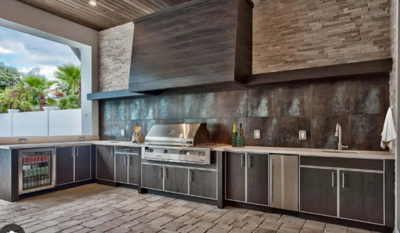

An outdoor kitchen is more than a backyard flex—it’s an everyday lifestyle upgrade. But the cabinetry material you choose determines whether your setup stays sleek for years… or starts peeling, swelling, and regretting its life choices after the first wet season.
If you’re comparing particle board vs. stainless steel for outdoor kitchen cabinets, here’s the clear headline: particle board is built for controlled indoor conditions, while stainless steel is built to take weather, heat, grease, and real use.
Quick comparison of particle board vs stainless steel
- Best for outdoors: Stainless steel (especially in humid or coastal areas)
- Most vulnerable to moisture: Particle board
- Safest near grills and high heat: Stainless steel
- Lowest maintenance: Stainless steel
- Lowest upfront cost: Particle board (often higher cost long-term)
What particle board is and why it struggles outdoors
Particle board is an engineered wood product made from compressed wood particles and resin binders. It can look finished and polished at first, but it’s highly sensitive to the outdoor realities of moisture swings, humidity, and temperature changes.
It’s also worth noting that particleboard is one of the composite wood products covered under U.S. formaldehyde emission rules (TSCA Title VI). For details, see the EPA overview here: Formaldehyde Emission Standards for Composite Wood Products (EPA).
What stainless steel is and why it wins for outdoor kitchens
Stainless steel is a corrosion-resistant metal alloy designed to handle harsh environments. For outdoor kitchens, the common conversation is 304 vs. 316 stainless: both are durable, but 316 generally performs better in chloride-heavy environments (think coastal salt air). One technical reference many engineers rely on is the Nickel Institute’s design guidance: Nickel Institute: Design guidelines for selecting stainless steels (PDF).
The real-world differences that matter
Weather resistance and moisture exposure
Particle board: Absorbs moisture and can swell, warp, and break down—especially at edges, seams, and screw holes. Even “sealed” surfaces can fail once water finds a path in.
Stainless steel: Doesn’t absorb water and holds its shape through rain, humidity, and temperature swings.
Durability for daily use
Particle board: More likely to sag under weight, chip at corners, and loosen at hinges over time.
Stainless steel: Handles heavy cookware, frequent opening/closing, and outdoor wear with far less drama.
Heat and fire safety near grills
Particle board: Not a smart pairing near high heat. Over time it can degrade, and it’s inherently combustible compared to metal.
Stainless steel: A safer choice around grills, side burners, and pizza ovens because it’s non-combustible and stable at typical outdoor cooking temps.
Maintenance and cleaning
Particle board: Needs more babysitting—protective finishes, careful cleaning, and repair when veneers peel or panels swell.
Stainless steel: Wipes down easily and stays more hygienic thanks to a non-porous surface.
Long-term appearance
Particle board: Can look great initially, but outdoor exposure often shows up as peeling, fading, bubbling laminate, and softening edges.
Stainless steel: Keeps a clean, professional look longer and pairs well with stone, concrete, and tile finishes.
Verdict: stainless steel is the smarter outdoor cabinet material
If your outdoor kitchen is meant to last, stainless steel is the better material—especially where humidity, rain, or salt air are part of the deal. Particle board may look like a budget win on day one, but outdoors it often turns into a replacement project you didn’t ask for.
For more outdoor-kitchen planning (including keeping the space clean and pest-free), you may also want to read: Outdoor Kitchens That Stay Clean & Pest-Free: Design Trends You Need.


(0) comments
We welcome your comments
Log In
Post a comment as Guest
Keep it Clean. Please avoid obscene, vulgar, lewd, racist or sexually-oriented language.
PLEASE TURN OFF YOUR CAPS LOCK.
Don't Threaten. Threats of harming another person will not be tolerated.
Be Truthful. Don't knowingly lie about anyone or anything.
Be Nice. No racism, sexism or any sort of -ism that is degrading to another person.
Be Proactive. Use the 'Report' link on each comment to let us know of abusive posts.
Share with Us. We'd love to hear eyewitness accounts, the history behind an article.