

How to Integrate Concrete Into a Well-Designed Home
When I walk onto a beautifully designed property, my first thought is rarely, “How do we make the concrete stand out?”
Usually, it is the opposite.
The home is the hero.
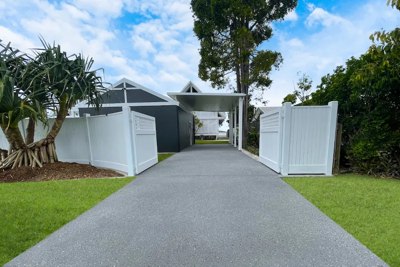
The architecture, the proportions, the materials, the landscape and the way the property sits within its surroundings have already begun telling a story. The role of the driveway, pathways, stairs, pool surrounds and other hardscape elements is to continue that story, not interrupt it.
After years of working around people's homes, I have come to believe that some of the best concrete design is the concrete you don't consciously notice.
It simply feels like it belongs.
Start With the Home, Not the Concrete
One of the easiest mistakes to make when designing or constructing a concrete driveway or outdoor area is to treat it as a separate project.
Choose a concrete colour. Pick a finish. Select an aggregate. Decide where it starts and stops.
Done.
But that misses the bigger picture.
Before thinking about the concrete, I am looking at the home.
What colour are the window frames? Is there white stone that we can subtly reference with a lighter aggregate or fleck? Are there creams in the brickwork? Gunmetal in the gutters? Timber, render or natural stone that already establishes a material palette?
I don't necessarily want the concrete to match these things. I want it to have a relationship with them.
There is a difference.
When materials are considered together, your eye can move across a property without constantly stopping at the boundary between one decision and the next.
The driveway feels connected to the façade. The pathway makes sense beside the landscaping. The stairs feel as though they were designed with the house rather than added afterwards.
That continuity is what makes a property feel resolved.
Restraint Can Be More Powerful Than Decoration
Having more budget does not mean you need more design.
In fact, I often think the opposite is true.
One of my favourite driveway combinations is beautifully poured plain concrete with carefully positioned cobblestone feature areas: perhaps at the driveway entrance, again at the entry to the home, and as a band through the middle.
Cover the entire driveway in cobblestone and some of its impact can be lost.
Use plain concrete everywhere and, depending on the architecture, it can feel unfinished or purely utilitarian.
Put the two together thoughtfully and both materials become better.
The concrete gives the cobblestone room to be appreciated. The cobblestone elevates the concrete. Neither is trying too hard.
That is an important principle in exterior design because driveways are often enormous visual surfaces.
A bold colour, elaborate stencil, contrasting border or highly decorative finish may look impressive on a sample board. Across 200 square metres in front of a beautiful home, however, it can become the first thing you see.
I don't believe that should automatically be the objective.
Sometimes the best question isn't, “How can we make this driveway more interesting?”
It is, “How little do we need to do to make this entire property feel better?”
Sometimes Better Concrete Design Means Less Concrete
Recently, we were working on a large property north of Brisbane.
Behind the home was an area of roughly 250 to 300 square metres separating the house from a custom-built swimming pool. The rear of the home featured French doors and large sections of glass looking directly onto this space.
The original request was simple: concrete the whole thing.
We could have.
In fact, as concrete contractors, pouring the entire area would arguably have been the obvious commercial answer.
Instead, I asked the owners whether I could suggest something different.
Rather than creating one enormous hard surface, we broke the area into large concrete steppers, leaving approximately 300mm spaces between sections. Those breaks created opportunities for greenery, planting and a water feature. They also helped create places for water to move rather than treating the entire area as one uninterrupted surface.
We used less concrete.
The result was better.
Looking through those large glass sections from inside the house, your eye now travels through the space. There are changes in texture. Greenery interrupts the hardscape. The water feature creates a destination and a moment of interest.
It became somewhere you wanted to look at and walk through, rather than simply 300 square metres of concrete between a house and a pool.
That project reinforced something I have believed for a long time:
Our job isn't to find somewhere to put as much of our product as possible.
It is to work out how much of it the design actually needs.
Landscaping Changes Everything
The longer I work with concrete, the more I find myself falling back in love with landscaping.
Concrete provides structure. Landscaping gives that structure life.
A driveway on its own is a driveway.
But place it within a broader landscape idea, whether that is tropical, native, Mediterranean, contemporary or something entirely different, and the way you think about the hardscape begins to change.
Where should the edges be softened?
Where should planting interrupt the concrete?
What will these plants look like in five years rather than five months?
Where does lawn make sense?
Where do we actually want negative space?
And what do we want someone to feel when they arrive?
Suddenly, we aren't talking about pouring a driveway anymore.
We're talking about a home.
This is where I think exterior design can sometimes become disconnected from the extraordinary amount of thought that goes into the house itself.
People will spend months choosing cabinetry, stone benchtops, tapware, flooring, lighting, paint colours and door handles.
Then construction finishes, everyone is exhausted, the budget has been stretched and we arrive outside.
A small driveway goes in. Pebble fills the empty areas. Cheap turf covers another section. A hundred young plants are squeezed into whatever remains.
It looks finished.
Five years later, the plants that started as puppies have become big dogs. Everything is competing for space. The driveway isn't large enough. Materials haven't aged well. Areas that seemed inexpensive at the time now need to be removed and rebuilt.
The money that was “saved” at the end of the build can easily become considerably more money spent later.
Design for the Life You Are Going to Live
This is perhaps the biggest change in how I think about residential design.
Don't only design for what your family needs today.
Think about what your life might look like five or ten years from now.
A family with two young children might build a driveway perfectly suited to two cars.
But those children eventually become teenagers.
Then come licences.
Then cars.
Suddenly a driveway that worked perfectly when the home was built no longer works at all. Cars end up parked on lawns, everyone is shuffling vehicles every morning, or another section of concrete needs to be added.
Technically, that problem can be solved.
Visually, it can be much harder to make an addition look as though it was always meant to be there.
The same thinking applies throughout an outdoor space.
Is entertaining important?
Do children need somewhere to play?
Do you want gardens or as little maintenance as possible?
Do you have dogs?
A caravan or boat?
Will older parents regularly visit?
How do you move from the car to the house with groceries in the rain?
Where do the bins go?
How do you get from the entertaining area to the pool?
Even small inconveniences become surprisingly important when you experience them every day.
Grass right beside a swimming pool might look beautiful in a photograph. If every time you mow it you spend the next hour getting clippings out of the pool, you may eventually feel differently about the decision.
Good design should create beauty, but it should also create flow and convenience.
The best outdoor spaces tend to do both.
Spend Money Where It Changes the Outcome
Another misconception I regularly encounter is the assumption that spending more automatically buys a better result.
Homeowners will sometimes ask us to make a residential driveway substantially thicker and install heavier reinforcement because they want to prevent cracking.
We are happy to build it that way.
But my first question is usually: what are we trying to achieve?
If the answer is simply “I don't want it to crack,” then increasing a driveway toward commercial specifications may mean spending considerably more money without solving the problem the homeowner thinks it solves.
Concrete can crack for numerous reasons, and simply adding thickness and steel does not make it immune.
In situations like that, I would rather understand the concern and put the budget somewhere it creates meaningful value. Sometimes that might mean increasing the concrete strength. Elsewhere it could mean better preparation, drainage, landscaping or another part of the property entirely.
More isn't always better.
Better is better.
Build Tomorrow's Home Today
Concrete is relatively permanent.
That should change the way we think about it.
Plants grow. Cars change. Children grow up. Homes get repainted. Families entertain differently. Landscaping matures.
But once a driveway, pathway or large entertaining area has been constructed, changing it can be expensive and disruptive.
That doesn't mean we can predict every part of life ten years from now.
We can't.
It means we should at least ask the question.
What will this look like when the landscaping matures?
Will this driveway still function if there are four cars here instead of two?
Will the colour still complement the house if the façade is repainted?
Does this layout allow the garden to evolve?
How difficult will this surface be to maintain?
Where will water move during heavy rain?
What seems like a small design decision during construction can become a daily annoyance once you live with it.
Conversely, decisions that barely attract attention on handover day can quietly improve the experience of a home for decades.
The Home Should Always Win
There is an enormous amount we can do with concrete today.
Different aggregates, colours, textures, architectural finishes, resurfacing systems, floating stairs, large-format steppers and increasingly sophisticated construction methods give homeowners and designers an extraordinary palette to work with.
But having more options doesn't mean we need to use all of them.
If you gave me a beautiful home, a healthy budget and complete freedom to design its concrete and hardscape, I wouldn't begin with a colour chart.
I'd begin with questions.
How do you want to live here?
How do you want the property to feel when you arrive home?
What do you want to see when you look through those windows?
How will your family use this space?
What will change over the next five or ten years?
What already makes the architecture beautiful?
And how can everything we add support that?
Because great concrete design isn't really about asking, “How much is this going to cost?”
It's about asking:
How do I want my life and my home to look and feel for the next five to ten years?
Answer that first.
Then work out how much concrete the story actually needs.
About the Author
Michael Trainor is the founder of Conker, a residential concrete and hardscape company based in South East Queensland, Australia. After more than a decade working around people's homes, Michael has become increasingly interested in the space where concrete, architecture and landscape design meet, and how better planning can turn functional hardscapes into considered parts of the home.
Through Conker and Concrete Advice, he shares practical lessons from real residential projects to help homeowners make better decisions about concrete, outdoor spaces and the homes they are building for the future.




(0) comments
We welcome your comments
Log In
Post a comment as Guest
Keep it Clean. Please avoid obscene, vulgar, lewd, racist or sexually-oriented language.
PLEASE TURN OFF YOUR CAPS LOCK.
Don't Threaten. Threats of harming another person will not be tolerated.
Be Truthful. Don't knowingly lie about anyone or anything.
Be Nice. No racism, sexism or any sort of -ism that is degrading to another person.
Be Proactive. Use the 'Report' link on each comment to let us know of abusive posts.
Share with Us. We'd love to hear eyewitness accounts, the history behind an article.