
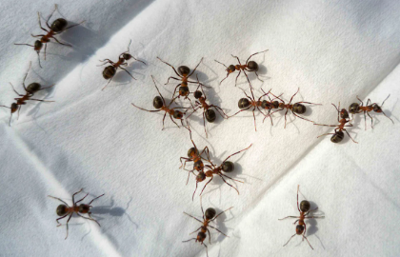

A line of ants crossing the kitchen counter sends many homeowners straight to the spice cabinet. Cinnamon, peppermint oil, vinegar, and coffee grounds all circulate as home remedies, and the idea is appealing because the ingredients are cheap, familiar, and already in the house. Sprinkling a line of cinnamon across a windowsill often does seem to work. Ants pause, turn around, and the counter looks clear for a day. The trouble starts when the trail returns a week later, or shows up two feet over. Strong smells interfere with how ants move, not with how a colony survives. The sections below explain trail behavior, what cinnamon actually does, why a colony outlasts it, and what produces durable results. Understanding that difference saves time, mess, and repeated disappointment.
How Ants Build and Follow Their Trails
Ants communicate through scent. A scout that finds food returns to the nest while laying down a pheromone trail, and nestmates follow the chemical path to the source, reinforcing it with their own trails on the way back. A productive food source soon carries a busy, orderly stream of workers, which is why a single crumb can produce a procession by evening.
Only a small portion of a colony forages at any given time. The queen, the brood, and most workers stay in the nest, which may be in soil, a wall void, a rotting log, or beneath a slab. Foragers extend the territory, searching for sugars, proteins, and water. Argentine, odorous house, pavement, and carpenter ants differ in what they prefer, but all depend on trails.
Because trails are chemical, a strong competing smell can confuse them. Ants that meet an unfamiliar, irritating substance may stop, reroute, or lose the pheromone path. That is the basis of every home deterrent, and it explains why the results look convincing at first. The effect, however, lives at the level of the trail, while the real source of the problem sits further back, in the nest and in the conditions that let ants reach food in the first place.
What Cinnamon Does and Does Not Do
Using cinnamon for ants belongs to a family of remedies that rely on aroma and mild irritation. Cinnamon contains aromatic compounds, including cinnamaldehyde, and laboratory work on plant oils has shown repellent effects on some insects. Ground cinnamon on a countertop can mask a pheromone line and make ants hesitate. A fine barrier at a threshold may also discourage some foragers from crossing.
Several limits apply. The powder loses its scent within hours as it dries and spreads, so the effect fades quickly. Wiping the surface, mopping, or a little moisture removes it altogether. Ants already committed to a food source often walk around a line, or cross it in numbers, since the ones at the front pave a route for the rest. Concentrated essential oil sprays act more strongly but carry cautions of their own, because some are toxic to cats and dogs and may irritate skin or lungs.
Cinnamon is a pantry product, not a registered treatment, and nothing suggests it kills a colony. Think of it as a temporary nudge, helpful in a small way, that leaves the underlying situation unchanged.
Why the Colony Outlasts the Deterrent
A deterrent works on the ants that are visible, and the visible ants are a small share of the colony. The nest keeps producing workers, and a mature colony of some species holds thousands of them, often with several queens. Pushing foragers away from one counter does not reduce that output. When one route is blocked, workers lay a new trail along another, often a few inches away, and the problem resurfaces beside the dishwasher or behind a baseboard.
Deterrents can also make matters worse. Some species respond to stress by splitting into several nests, a process called budding, which spreads the problem across a property. Odorous house ants and Argentine ants are known for it. Repelling foragers interferes with baits as well. A bait works because workers carry it back and share it, and a barrier of cinnamon or vinegar near a bait station may drive them away from the very product that would have reached the queen.
Entry conditions remain untouched, too. A gap at a window frame, a leaking supply line, a pet bowl left out overnight, or a branch touching the roof stays open to the same ants. Without addressing those, even the best-timed deterrent resets nothing.
Separating Short-Term Deterrence From Lasting Control
A fair view of this aromatic home remedy places it in the category of short-term deterrence. It can be reasonable for a one-off situation, such as a few scouts on a picnic table or a trail that needs a day to fade while a proper fix is arranged. It should not be mistaken for control, which means reducing or eliminating the colony and removing the reasons ants return.
The difference shows up in what each approach changes. Deterrence alters where ants walk today. Control alters what the colony can do tomorrow. Slow-acting baits, for example, let foragers carry a small dose to the nest, where it reaches the queen and larvae over several days. Results are not immediate, and a growing crowd at the bait during the first days is a good sign rather than a failure. Perimeter treatments and nest treatments applied by professionals address colonies that live in walls, soil, or trees.
Identification supports every choice. Sugar-loving ants respond to sugar baits, grease-feeding species may prefer protein, and carpenter ants require attention to moisture-damaged wood. Photos and notes about where trails appear, and at what time of day, help a professional select the right method.
Steps That Resolve Ant Problems for Good
Lasting results come from removing access, food, and moisture, then dealing with the nest. A sensible sequence looks like this:
- Wipe the trail with soapy water, which removes the pheromone line more reliably than perfumed scents.
- Seal entry gaps around windows, doors, pipes, and cables with caulk or weatherstripping.
- Store food in sealed containers, wipe counters nightly, and pick up pet bowls overnight.
- Fix leaks and dry damp areas under sinks and beside dishwashers.
- Place bait along the trail and leave it undisturbed while the colony feeds.
- Trim vegetation touching the house and look for outdoor nests.
Patience matters during the baiting stage. Cleaning away every ant near the bait defeats its purpose, so resist the urge to spray what appears to be a growing problem.
Some situations call for outside help. Large colonies, ants emerging from walls, carpenter ants, and trails that persist after a month of steady effort all suggest a nest homeowners cannot reach. A professional inspection can also identify hidden moisture damage that keeps drawing ants back.
Cinnamon can interrupt an ant trail for a few hours, and that small effect explains its popularity. It does not reach the nest, it does not remove the food, water, or gaps that bring ants in, and it can even interfere with baits that would work. Treating it as a temporary measure keeps expectations honest. The reliable path is slower and less dramatic: clean the trail, close the entry points, remove food and moisture, bait where appropriate, and call for help when the colony is out of reach. Homeowners who follow that sequence usually see the problem end, rather than shift to the next counter.

(0) comments
We welcome your comments
Log In
Post a comment as Guest
Keep it Clean. Please avoid obscene, vulgar, lewd, racist or sexually-oriented language.
PLEASE TURN OFF YOUR CAPS LOCK.
Don't Threaten. Threats of harming another person will not be tolerated.
Be Truthful. Don't knowingly lie about anyone or anything.
Be Nice. No racism, sexism or any sort of -ism that is degrading to another person.
Be Proactive. Use the 'Report' link on each comment to let us know of abusive posts.
Share with Us. We'd love to hear eyewitness accounts, the history behind an article.