
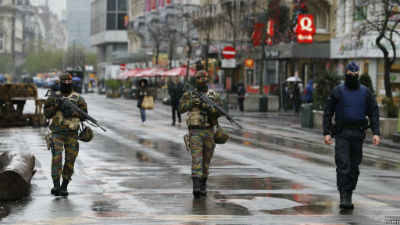
Statistically, we live in the most peaceful period in human history. At no other point in time has the average person had less of a chance of dying in a violent manner. Mongol hordes aren’t rampaging across the land, religious strife hasn’t torn Europe in two, warring Chinese dynasties aren’t slaughtering millions in a quest for the Mandate of Heaven. But, especially in the past two years, it hasn’t always seemed that way.
The primary cause is ISIS, also known as IS, Daesh, or Isil. Emerging from the chaos of war-torn Iraq, the group wasn’t known outside of the intelligence community until early 2014. Before that, ISIS was just a splinter group of Al-Qaeda, literally known as Al-Qaeda in Iraq or AQI. When the civil war in Syria broke out after protests against the Assad regime turned into full scale conflict, AQI moved into Syria to assist the radical side of the Syrian rebels. This led to a splintering with the main group of Al-Qaeda and the former members of AQI, now joined with the fighters from Syria, rebranding themselves as the Islamic State of Iraq and Syria, or ISIS for short.
You would think that something like a terrorist civil war would make the news, but, alas, it wasn’t until June 2014 when, in a blitz offensive, ISIS captured the Iraqi city of Mosul, that most people in the West became aware of them. This was a huge event for the region. Not only did it give ISIS large amounts of resources to continue fighting their campaign, but it also gave them legitimacy in the eyes of many extremists.
It was after this victory that the group’s leaders declared they were building a Caliphate, a territory governed by Islamic law, and that all good, loyal, devote Muslims must swear allegiance to them or be branded as heretics. In response, terror cells all over the world began to declare their allegiance and fly the black flag of ISIS, including the infamous Nigerian group Boko Haram. Since then, they have continued to take territory in Iraq and Syria (although their push towards the Iraqi capital of Baghdad failed) and have established movements in half a dozen countries.
While there have been some who mused about the potential benefits a Caliphate, and by extension, a Caliph, might have for Islam in general, no one could possibly support the violence and savagery that ISIS has brought to a region already stained with blood. In its territory, the group has acted with a level of cruelty and wanton disregard for human life the likes of which the Middle East hasn’t seen since the Mongols pillaged the region in the 13th century. Violence in the region is far from rare, but ISIS in particular became notorious for the use of social media to spread their atrocities to those who might never have heard of the terrorist organization.
Instances of the barbarity include videos of group members drowning dissenters, burning people alive, and, most shockingly, beheading captives, including US journalist James Foley. The crimes ISIS has committed against the religious minorities in the region, in particular the Yazidi, a group of people based out of northern Iraq, are astounding in their brutality. The crimes directed against them include slavery, mass executions, and the systematic rape of Yazidi women. It is so severe that US Secretary of State John Kerry has classified it as genocide.
The world has not simply stood back and let ISIS march unopposed. A coalition of states, primarily led by the United States (although Russia has contributed significantly as well) has been conducting a series of airstrikes as the primary method to combat ISIS. Airstrikes can be used to level ISIS convoys and groups of fighters without too high a risk for American soldiers. And, for the most part, that has worked. There have been very few soldiers killed in combat with ISIS fighters. But ISIS hasn’t been going after our soldiers. Their aim has been to kill civilians. And they have been horrifyingly effective.
What could be considered a major attack came in October of 2015 when a bomb was detonated aboard a Russian airliner, killing all 224 on board. Bombings in places like Baghdad, Beruit, and Ankara have killed hundreds. Then, on the November 13th, a group of gunmen and suicide bombers launched a series of deadly and horrifying attacks across various locations in Paris, killing 130 people and leaving 400 wounded. And then, mere months into 2016, ISIS struck again. On March 22, 35 people were killed in Brussels as a coordinated series of bombing struck an airport and train station.
These attacks are horrible for two reasons. The first is the obvious: people are killed, lives and families are destroyed. The pain and suffering of the victims cannot be overstated. But the second reason is the reaction it causes from those left behind. When one of these attacks happens, there are a myriad of instantaneous reactions: grief, heartbreak, sympathy, fear, and anger. The last two are the most important. People are afraid. A New York Times/CBS News poll taken in December of 2015 showed that Americans are more afraid of a terrorist attack now than anytime since 9/11, with 80% of people believing an attack was likely in the next few months. And unfortunately, they were right.
More Americans also believe that direct action is needed. Before Brussels, most Americans were opposed to sending ground forces into Iraq to fight against ISIS. Since then, for the first time ever, a poll found that 53% of Americans now support the idea of sending soldiers to fight ISIS on the ground.
With rising fears, especially in the wake of the attack in Brussels, one can only wonder what effect this will have on the upcoming presidential election. On the Democratic side, concerns over national security should play directly into Hillary Clinton’s hand as her time as Secretary of State should help to assure voters that she can handle difficult situations like the one posed by ISIS. On the GOP side, there is no single candidate who stands head and shoulders above the rest as an expert on foreign affairs. The one who seems the most likely to receive the nomination, however, is Donald Trump. Trump’s promises of harsh, immediate action against ISIS, and Islam in general, seem to appeal to a portion of the Republican base.
There is no clear way out of this complex and terrifying situation. Clearly, the dismantling of ISIS is the goal, but the path to achieving that is fraught with peril. One thing is certain, however. Barring some miracle that leaves the group shattered and broken, one of the biggest questions US voters will face at the polls in November is who is the right person to deal with the ISIS crisis.
(0) comments
We welcome your comments
Log In
Post a comment as Guest
Keep it Clean. Please avoid obscene, vulgar, lewd, racist or sexually-oriented language.
PLEASE TURN OFF YOUR CAPS LOCK.
Don't Threaten. Threats of harming another person will not be tolerated.
Be Truthful. Don't knowingly lie about anyone or anything.
Be Nice. No racism, sexism or any sort of -ism that is degrading to another person.
Be Proactive. Use the 'Report' link on each comment to let us know of abusive posts.
Share with Us. We'd love to hear eyewitness accounts, the history behind an article.