
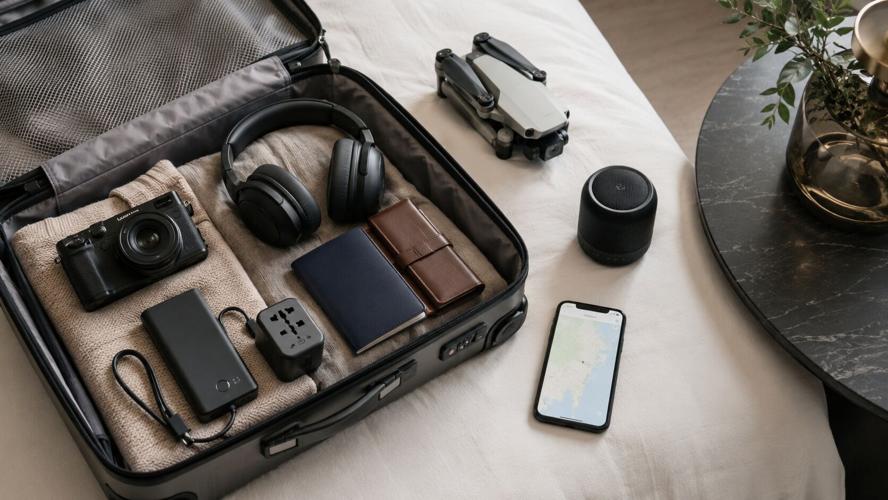

Travel is often more enjoyable when the technology you bring solves a real problem rather than simply taking up space in your luggage. The right devices can help you stay connected, protect your belongings, capture memorable moments, and make long travel days more comfortable.
That does not mean packing every gadget you own. A thoughtfully selected collection of travel tech essentials should be compact, dependable, and useful throughout the trip. Whether you are planning a weekend getaway, an international vacation, or a longer road trip, these seven items can make the journey easier without overloading your suitcase.
A Compact Camera for Better Travel Photos
Smartphone cameras are convenient, but a dedicated camera can still be worthwhile for travelers who want greater control over image quality, zoom, low-light photography, or video. A lightweight mirrorless or compact camera can capture landscapes, architectural details, meals, and candid moments without the bulk of professional equipment.
Before choosing a travel camera, consider how you actually plan to use it. A small point-and-shoot model may be ideal for city sightseeing, while an interchangeable-lens camera gives you more flexibility for wildlife, landscapes, and editorial photography. Travelers who primarily create social media content may prefer a camera with a flip screen, reliable stabilization, and straightforward wireless transfers.
Keeping the setup simple is usually the better approach. One camera, one versatile lens, an extra battery, and a protective case are often enough for most trips. You can also review FINE Magazine’s guide to taking better photographs for social media campaigns.
A Portable Charger for Long Travel Days
A portable charger is one of the most practical travel tech essentials because phones now serve as cameras, maps, boarding passes, wallets, translators, and communication devices. Heavy use can drain a battery quickly, especially during long flights, sightseeing days, or road trips.
Choose a charger that offers enough capacity for at least one full phone recharge while remaining small enough to carry comfortably. Multiple charging ports can be useful when traveling with a partner or carrying several devices. A visible battery indicator also helps you know when the charger itself needs to be recharged.
Keep in mind that airlines may restrict where lithium-battery power banks can be packed. Portable chargers generally belong in carry-on luggage rather than checked baggage, so review your airline’s current rules before traveling.
A Universal Travel Adapter for International Trips
International travelers should not assume that hotel rooms will have compatible outlets or enough USB ports. A universal travel adapter allows you to connect devices in countries that use different plug configurations.
Look for an adapter with multiple USB ports so you can charge a phone, watch, tablet, or camera from a single outlet. Some newer models also include USB-C connections, which can reduce the number of separate chargers you need to pack.
It is important to understand that a plug adapter does not always convert voltage. Many modern electronics are dual-voltage, but certain appliances, including some hair tools, may require a separate voltage converter. Check the voltage information printed on each device before plugging it in abroad.
A Luggage Tracker for Added Reassurance
A compact luggage tracker can help you monitor the approximate location of a suitcase, backpack, camera bag, or other important item. It cannot prevent baggage delays, but it may provide helpful information when an airline or transportation provider is trying to locate a missing bag.
Place the tracker securely inside the luggage rather than attaching it to an exposed handle. Travelers may also want to add trackers to carry-on bags, purses, or equipment cases when moving through busy airports, train stations, and hotels.
A luggage tracker is most effective when used alongside traditional precautions. Keep identifying information inside the bag, remove outdated baggage tags, photograph the suitcase before checking it, and place medications, valuables, travel documents, and essential clothing in your carry-on.
Noise-Canceling Headphones for Quieter Journeys
Noise-canceling headphones can make flights, train rides, and hotel stays considerably more comfortable. They reduce the distraction of engine noise, conversations, and other background sounds, making it easier to listen to music, watch a film, work, or rest.
Over-ear headphones generally provide greater comfort and sound isolation, while noise-canceling earbuds take up less space. The better option depends on your luggage limits and personal comfort preferences.
Battery life is especially important for long travel days. Select headphones that can last through the expected journey, and pack the appropriate charging cable. A wired connection can also be useful when connecting to an airplane entertainment system.
A Portable Bluetooth Speaker for Private Spaces
A portable Bluetooth speaker can be useful in a vacation rental, hotel suite, poolside cabana, campsite, or beach setting where music is permitted. It creates a more relaxed atmosphere without relying on the limited sound quality of a phone or laptop.
For travel, prioritize a compact design, dependable battery life, and water resistance. A speaker with a durable exterior is better suited to outdoor trips, while a smaller model may be preferable for air travel and limited luggage space.
Use speakers thoughtfully in shared environments. Beaches, hotel pools, parks, balconies, and campgrounds may have noise restrictions, and nearby guests may not want to hear someone else’s playlist. Headphones remain the better choice in crowded or quiet public spaces.

A Drone for Responsible Aerial Photography
A drone can produce dramatic aerial photographs and video, but it is not an essential purchase for every traveler. It requires extra planning, careful packing, battery management, and a clear understanding of local regulations.
Rules can vary by country, city, park, resort, and protected area. Some destinations prohibit drone use entirely, while others require registration, permits, pilot certification, or advance approval. Restrictions may also apply near airports, military facilities, crowds, wildlife, historic sites, and private property.
Before bringing a drone, research every destination on your itinerary rather than assuming the same rules apply throughout the trip. Travelers should also consider whether the available flying opportunities justify the additional equipment. In many cases, a camera or stabilized smartphone will be easier and more appropriate.
Pack Technology With a Purpose
The most useful travel tech essentials are the devices that support the way you already travel. A portable charger may be indispensable for one person, while another traveler may place greater value on a camera, headphones, or luggage tracker.
Before packing, charge every device, install necessary updates, download offline maps and entertainment, and test each cable and accessory. It is also helpful to label chargers and consolidate smaller items in one organizer so they are easy to find.
Technology should make a trip smoother, not create additional work. By choosing versatile, compact, and reliable devices, you can stay connected, capture meaningful experiences, and spend more time enjoying the destination.
(0) comments
We welcome your comments
Log In
Post a comment as Guest
Keep it Clean. Please avoid obscene, vulgar, lewd, racist or sexually-oriented language.
PLEASE TURN OFF YOUR CAPS LOCK.
Don't Threaten. Threats of harming another person will not be tolerated.
Be Truthful. Don't knowingly lie about anyone or anything.
Be Nice. No racism, sexism or any sort of -ism that is degrading to another person.
Be Proactive. Use the 'Report' link on each comment to let us know of abusive posts.
Share with Us. We'd love to hear eyewitness accounts, the history behind an article.