
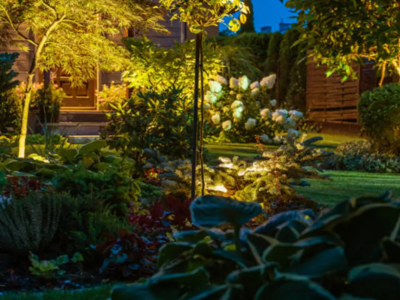
Installing a new low-voltage landscape lighting system can transform how a property looks after dark. At first, tree uplights are perfectly aimed, path lights remain unobstructed, and every fixture seems to sit exactly where it should.
Three to five years later, the same yard may look noticeably different. Shrubs have spread, tree canopies have expanded, and groundcover may have grown around fixtures. The lights may still be working properly, yet the overall effect can become darker, uneven, or poorly balanced.
That is because a landscape is never static. Understanding how plant growth affects light distribution makes it easier to plan for future adjustments and decide when a fixture should be re-aimed, moved, or supplemented.

How Plant Growth Changes Landscape Lighting
Even a well-planned lighting layout can lose its balance as the landscape matures. The most common changes usually show up in three ways:
- Foliage starts blocking fixtures and beams. Groundcover spreads, ornamental grasses fill out, and shrubs extend into spaces that were open when the lights were installed. Path lights may become partly hidden, while accent lights can end up illuminating leaves instead of the walkway, wall, or planting feature they were meant to highlight.
- Trees become too large for the original lighting setup. A single uplight may work well on a young tree, but the same beam can look too narrow once the trunk thickens and the canopy spreads. What once felt balanced may eventually leave the upper canopy underlit.
- The balance between light and shadow changes. Denser planting creates stronger shadows and can make some parts of the yard feel brighter while others recede. Focal points that once stood out may become less noticeable as surrounding plants fill in.
How to Design Lighting That Can Adapt Over Time
A landscape lighting system is easier to adjust when future plant growth is considered from the beginning. A few practical choices during installation can make later changes much simpler:
- Leave room to reposition fixtures. Avoid cutting low-voltage cable so tightly that a fixture has nowhere to move. Leaving sufficient service slack gives you more flexibility to shift a light away from an expanding shrub or adjust its position as planting beds fill in. In many cases, a small change in location can restore the original lighting effect without requiring a new cable run.
- Choose adjustable fixtures. Knuckles, risers, and repositionable mounts make it easier to change fixture height or aiming direction without replacing the light. An uplight may need to be aimed higher as a tree grows, while a path light may eventually need to sit above surrounding groundcover. Hardware that allows for simple adjustment gives the system more room to evolve with the landscape.
- Plan for changing beam spread. A narrow beam may work well on a young tree but feel too concentrated once the canopy becomes wider. Depending on how the plant develops, the solution may be a wider beam, a different aiming position, or an additional fixture. Different landscape lighting techniques can help create a layout that remains flexible as the yard matures.
- Design around mature plant size. Fixture placement should account for where trees and shrubs are likely to be several years from now, not just where their branches end today. Mature height, spread, foliage density, and access for future adjustments are all worth considering before installation. A small shrub near a path light today may occupy much more space in a few growing seasons, so planning around its mature footprint can reduce unnecessary changes later.
When to Trim, Re-Aim, Move, or Add a Fixture
As plants mature, the right adjustment depends on what has changed and whether that change is seasonal or permanent.
- Trim: Light pruning makes sense when seasonal growth temporarily blocks a beam. Ornamental grasses, perennials, or a few new branches may simply need to be cleared away from a path light or accent fixture.
- Re-aim: If the fixture is still in a good location but the target has changed, adjusting the angle may be enough. This is common with uplighting as a tree grows taller and its canopy spreads.
- Move: Relocation is usually the better option when a mature shrub or other permanent planting has grown into the original beam path. Continually pruning a healthy plant just to preserve an old fixture position rarely makes sense.
- Add or change a fixture: A larger tree or planting area may eventually need broader coverage. Depending on the situation, that could mean using a wider beam, changing the fixture position, or adding another light to cover the expanded canopy more evenly.
Make Plant Growth Part of Your Annual Lighting Check
Treat plant growth as a regular part of landscape lighting maintenance rather than something to address only when a fixture appears to fail. Once or twice a year, especially after periods of active plant growth, walk the property with the lights on and look at how the system is performing.
Ask a more useful question than, “Are the lights still working?”
Instead ask: “Are the lights still working for the landscape as it exists today?”
Look specifically for:
- Beams blocked by new foliage, branches, or overgrown groundcover
- Fixtures partially hidden by mulch or spreading plants
- Uneven canopy lighting where one section of a tree appears much brighter than another
- New dark areas or unintended hotspots that were not there before
- Fixtures that have become difficult to reach for cleaning or adjustment
- Trees or planting areas that may now benefit from a wider beam or an additional light
Seasonal changes matter as well. A tree that looks open and evenly lit in winter can behave very differently once its canopy fills out in summer.
Make a note of what has changed, then start with the simplest adjustment before considering a larger redesign.
A landscape never stays exactly the way it looked on installation day, and a lighting plan should not be expected to stay fixed either. Trees spread, planting beds fill in, and the way light moves through the yard changes with them.
If you are planning a new system or reviewing an older one, look beyond tonight’s appearance. Consider where plants are headed, how easily fixtures can be adjusted, and whether the layout leaves room to evolve.
Designing for growth now can make future changes simpler, less disruptive, and more intentional. Instead of treating plant growth as a problem to correct later, make it part of the lighting plan from the start.
The best landscape lighting should not just fit the garden you have today—it should be ready for the garden you are growing into.

(0) comments
We welcome your comments
Log In
Post a comment as Guest
Keep it Clean. Please avoid obscene, vulgar, lewd, racist or sexually-oriented language.
PLEASE TURN OFF YOUR CAPS LOCK.
Don't Threaten. Threats of harming another person will not be tolerated.
Be Truthful. Don't knowingly lie about anyone or anything.
Be Nice. No racism, sexism or any sort of -ism that is degrading to another person.
Be Proactive. Use the 'Report' link on each comment to let us know of abusive posts.
Share with Us. We'd love to hear eyewitness accounts, the history behind an article.