
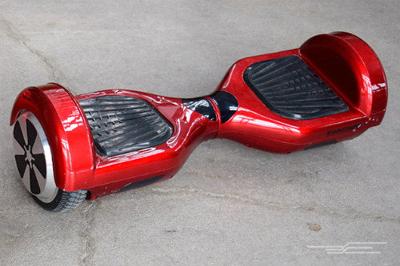
The phrase "1.21 gigawatts at 88 miles per hour" is iconic. Almost as iconic is Marty McFly’s overboard from "Back to the Future II." In the film, we see McFly zipping around town on a board without wheels, seemingly floating in the air as he races around. As the future predicted in the film got closer and closer, the Internet clamored with cries of "Where’s my hoverboard?" One can only imagine their surprise when these products began to flood the market.
If you’ve been on the Internet pretty much at all in the last two years, you’ll have seen these boards. From appearing on the The Tonight Show with Jimmy Fallon, to appearing on the Instagram of celebrities including Justin Bieber, Chris Brown, and Nicki Minaj, they seemed to have reached some kind of cultural peak. These boards have emerged, seemingly out of nowhere, and become so popular so quickly that many cities have put ordinances in place that the boards can’t be ridden on the sidewalk with violators able to be fined.
But, first, what are these boards? In essence, they are just Segways without the wheels, which, of course, makes them much more cool. They work in generally the same way. Essentially, there are tiny sensors inside the wheels that pick up on when the user tilts. The wheels then interpret which way the user wants to move and moves forward in that direction. Much like a Segway, anyone’s first experience with one is going to be tilting back and forth, wildly trying to stay upright at the board tries to make sense of their wild flailing, but, after a little while, you can have a surprising amount of control over where the board goes. Just a quick Google search will show people doing some pretty incredible tricks on them and some performers have used them on stage during shows to great effect.
But just, where did this craze come from and why did it become so popular? Well, like many things, it originated in China. In August of 2014 a Chinese company called Chic Robotics, which is also known as Hangzhou Chic Intelligent Technology Co., Ltd, introduced their first board, the Smart S1, at the Canton Fair, the largest consumer electronic trade show in China. The board was a huge success and soon Chic was simply out of boards. As people zipped around the trade show, other manufacturers took notice and soon knock-off boards and competing brands began to pump out their own boards to compete with the S1. It’s this level of variation that allows the level of choice one currently has when looking for a board. A quick search on Amazon reveals that these boards sell for as little as $200 to as much as a whopping $1,800. Before you rush off to pick up a sweet $200 overboard however, Jeff Wells, the maker of a $1,600 board called The Scoot, says that many of the cheaper boards reach that price because of the manufacturers cutting corners. "Weaker motors, not as reliable batteries, gyro boards, improper motherboard design," he lists as just a few ways manufacturers try to cut down on costs when making their boards.
For all their space-age appeal, these boards have quite the reputation for being unsafe. In addition to the major issue with them, that we will address in a second, the boards have an image problem. Right now, they are seen as toys especially by the tween and young teen demographics. Now, these age groups aren’t exactly known for their decision-making abilities and, add in the fact that they are trying to show off to their friends when on these boards, it all adds up to a recipe for disaster. These boards can go up to six miles an hour on flat ground, which certainly doesn't sound like much, but as anyone who has taken a Segway tour before can attest, it seems much faster than it is and a fall from one can have nasty repercussions. This branding, the fact that it is seen as a fashion accessory to so many young people, and their tendency to not wear protective gear has led to many cities banning them. While at first this may seem harsh, having these boards near cars traveling at high speeds with unsteady, distracted riders is just a tragedy waiting to happen.
And then there’s the issue that they spontaneously combust.
Well, not exactly, the boards aren’t going to explode underneath the Christmas tree, but there have been several incidents linking the charging of the boards to fires. The battery inside can leak if charged for too long and subsequently catch fire, although some people have reported their boards bursting into flames simply by being ridden. Many airlines have banned hoverboards because of concerns about fire safety.
At the end of the day, while these boards are certainly fun and make for great videos, there are too many problems associated with them – from manufacturing defects to operator error.
And come on, they're not even hoverboards! You had one job, Internet, and you wasted that amazingly cool name on something that really isn’t anything but a broken Segway. The time will come when Marty McFly-worthy hoverboards really will be on the market. Until then, probably best to stay on terra firma.
(0) comments
We welcome your comments
Log In
Post a comment as Guest
Keep it Clean. Please avoid obscene, vulgar, lewd, racist or sexually-oriented language.
PLEASE TURN OFF YOUR CAPS LOCK.
Don't Threaten. Threats of harming another person will not be tolerated.
Be Truthful. Don't knowingly lie about anyone or anything.
Be Nice. No racism, sexism or any sort of -ism that is degrading to another person.
Be Proactive. Use the 'Report' link on each comment to let us know of abusive posts.
Share with Us. We'd love to hear eyewitness accounts, the history behind an article.