
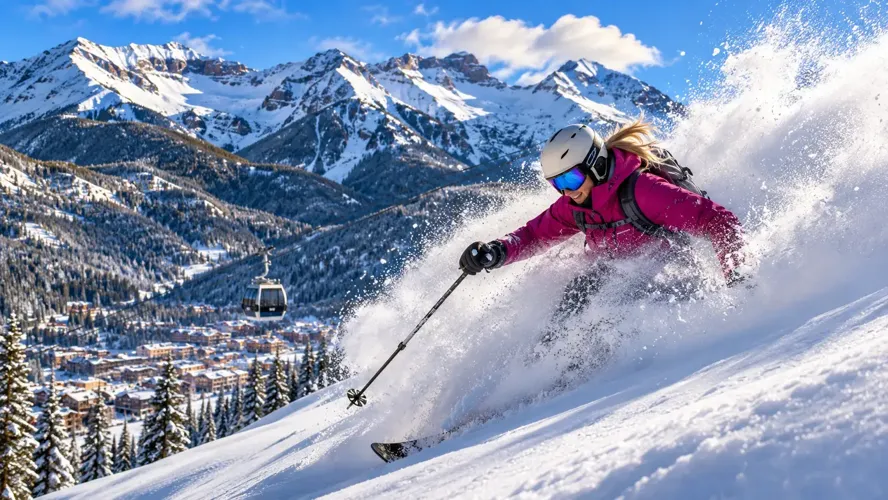

Skier carving through deep powder above Telluride Colorado with the San Juan Mountains in the background
A strong El Niño, serious mountain terrain, a newly recognized dining scene and the coming arrival of Four Seasons are giving travelers more reasons than ever to look toward Colorado’s San Juan Mountains.
There are ski destinations that become fashionable, and then there are places that never needed much convincing.
Telluride belongs firmly in the second category.
Tucked into a dramatic box canyon in Colorado’s San Juan Mountains, the former mining town has managed something increasingly rare in luxury travel. It has become more sophisticated without becoming generic. Historic buildings still line Colorado Avenue. Mountains rise abruptly at the end of town. The ski terrain remains formidable. And the closest thing Telluride has to a commuter train happens to be a gondola suspended above some of the most spectacular scenery in Colorado.
As the Telluride ski season approaches, the destination has several new reasons to command attention. A strong El Niño is expected to influence weather patterns through the winter, Michelin has added Telluride to its Colorado coverage for the first time, and Four Seasons Resort and Residences Telluride is taking shape in Mountain Village with a planned 2028 opening.
That combination makes this winter an especially good time to look not only at where Telluride has been, but where it is going.
The Mountain Still Earns Top Billing

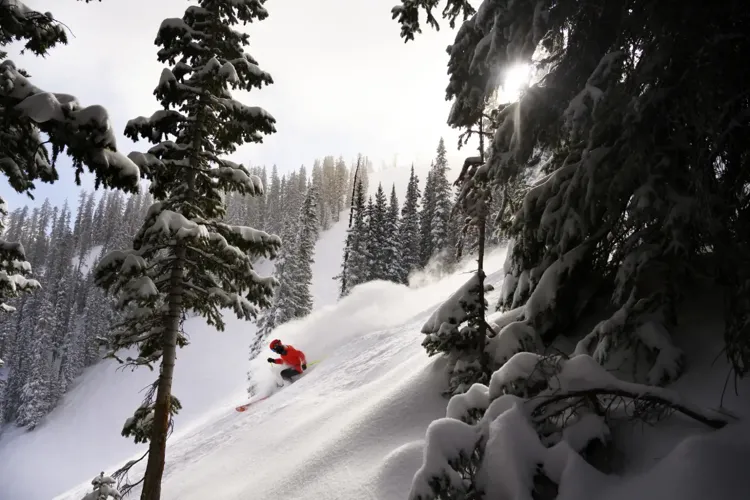
Skier descending through deep powder and snow-covered trees at Telluride Ski Resort
Luxury may be evolving in Telluride, but fortunately nobody has forgotten why people came here in the first place.
The Telluride Ski Resort has more than 2,000 skiable acres, 149 trails and a vertical drop of 4,425 feet. About 41 percent of the mountain is classified as advanced or expert terrain, while intermediates and beginners still have plenty of room to explore. Galloping Goose stretches for 4.6 miles, while Telluride’s upper mountain delivers bowls, glades and steep terrain capable of reminding even experienced skiers that confidence and ability are not always the same thing.
For the 2026–27 Telluride ski season, the resort is targeting December 5, 2026, for opening day, with operations planned through April 4, weather permitting. Those dates matter because Telluride is not simply a place to pose next to a fireplace wearing attractive ski boots. This remains a mountain where the actual skiing is very much the point.
El Niño Gives This Winter Another Reason to Watch
The weather story deserves attention, although perhaps not quite the breathless attention that comes with phrases like “historic snowfall.”
NOAA’s latest seasonal outlook says a strong El Niño continues and is expected to persist through winter, influencing temperature and precipitation patterns across the country. NOAA’s November outlook also says a strong-to-very strong El Niño is likely to persist through January–March 2027.
That is meaningful. It is not, however, a guarantee that every storm will take aim at Telluride or that powder will magically appear precisely during your vacation week. Mountains remain stubbornly unwilling to coordinate with hotel reservations.
That distinction actually makes the Telluride ski season more interesting, not less. Travelers have a legitimate reason to watch conditions closely without relying on exaggerated snowfall promises. And Telluride begins with considerable advantages regardless of the forecast, including high elevation, substantial vertical terrain and a location deep within the San Juan Mountains.
One Gondola Changes the Entire Experience

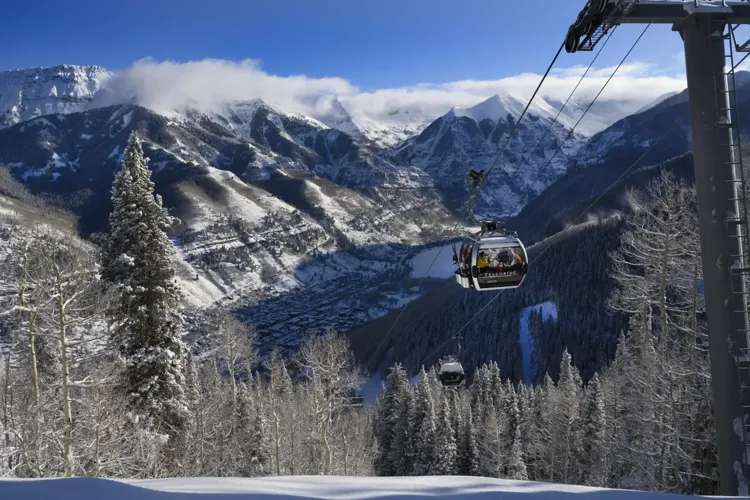
Telluride gondola traveling above the snowy San Juan Mountains between
Part of Telluride’s appeal is that getting around can become one of the best parts of the trip.
Historic Telluride sits at 8,750 feet, while Mountain Village occupies the slopes above it. Connecting the two is the free Telluride and Mountain Village gondola, a roughly 12-minute ride that climbs through San Sophia Station at 10,540 feet. For winter 2026–27, the gondola is scheduled to operate from November 20 through April 4, seven days a week from 6:30 a.m. until midnight, with extended hours during certain peak periods.
Calling it public transportation is technically correct and emotionally inadequate. During daylight, the cabins float above a landscape of mountains, forests and snow. At night, the valley lights glow below as the surrounding peaks disappear into darkness. More importantly, visitors can move between skiing, dinner, shopping and their hotel without building the entire vacation around a rental car. Luxury sometimes means marble bathrooms. Sometimes it means not hunting for parking in ski boots.
Telluride Has Something Money Cannot Manufacture

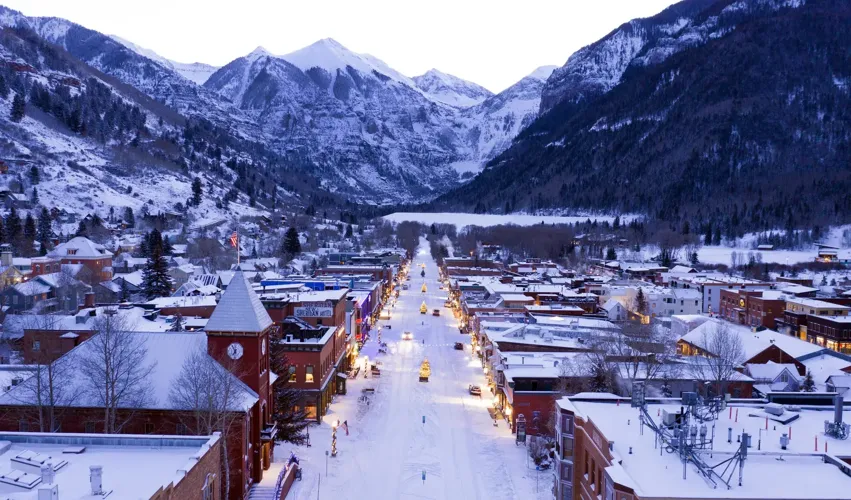
Historic downtown Telluride Colorado covered in snow beneath the San Juan Mountains
This is where Telluride separates itself from many purpose-built mountain destinations.
Its historic downtown actually has history. Telluride developed during Colorado’s mining boom, and the town’s core was designated a National Historic Landmark District in 1961 because of its importance to the American West. The ski resort arrived later, opening in 1972 and helping transform a declining mining town into an internationally recognized mountain destination. The Town of Telluride’s history remains visible in its Victorian buildings, narrow streets and preserved architectural character.
That matters because authenticity has become one of luxury travel’s most overused words and one of its most difficult qualities to deliver. Telluride does not need a development team to manufacture mountain charm because the town existed long before anyone started discussing branded residences. Its challenge now is protecting that character while welcoming the next generation of luxury hospitality.
The Dining Scene Has Entered a New Conversation
Something else changed in Telluride this year.
In 2026, Michelin added Telluride to its Colorado coverage for the first time, with The National earning a place among the guide’s recommended restaurants. Located in a historic downtown brick building, The National serves Mediterranean and North African-influenced food, with Michelin highlighting its seasonal approach, house-made pastas and rooftop setting.
It is only one restaurant, so there is no need to declare Telluride the new culinary capital of the Rockies before dessert arrives. But Michelin’s arrival is significant. It reflects a larger evolution taking place around the Telluride ski season, where skiing can anchor the trip without being the trip’s only pleasure. This is increasingly a destination for travelers who expect excellent terrain in the morning and a worthwhile dinner reservation at night.
Four Seasons Is Betting on Telluride’s Next Chapter

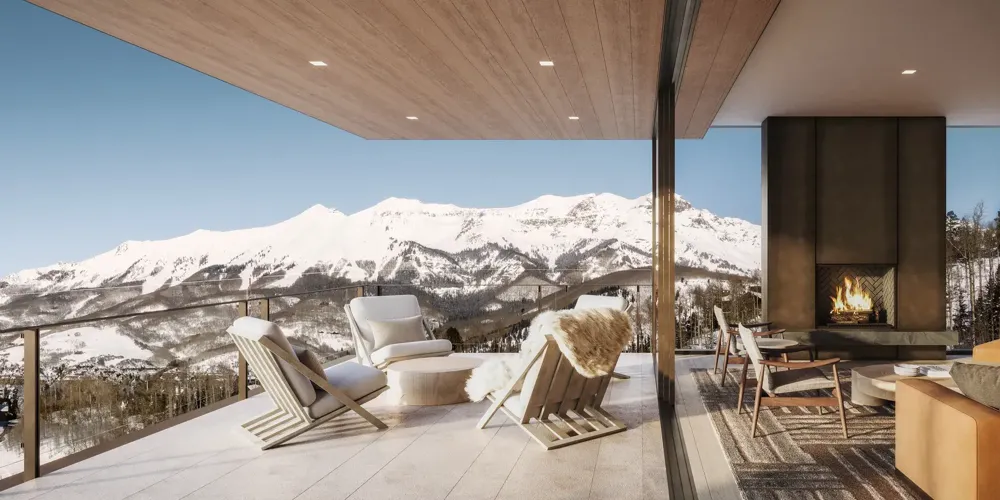
Four Seasons Resort and Residences Telluride residence with mountain views and indoor outdoor living
The biggest physical expression of Telluride’s changing luxury landscape is still a few years away.
Four Seasons Resort and Residences Telluride is currently planned to open in Mountain Village in 2028. Four Seasons lists Fort Partners and Merrimac Ventures as the developers, with Olson Kundig involved in architecture and design and Clements Design contributing to the interiors. The residential component totals 69 residences, while planned amenities include ski-in and ski-out access, a private ski lounge, indoor lap pool, outdoor hot tub, spa and fitness facilities.
The significance extends beyond another luxury name appearing on a hotel sign. A brand with Four Seasons’ global reach choosing Telluride reinforces a larger point about the destination. Telluride is no longer simply competing for passionate skiers. It is competing for travelers who might otherwise be weighing Aspen, Deer Valley, European alpine resorts or other high-end winter destinations.
The challenge will be adding another level of hospitality without polishing away the personality that made Telluride attractive in the first place.
Telluride Does Luxury Differently
Aspen has celebrity mythology. Vail has scale. Deer Valley has built its reputation around highly polished service.
Telluride’s advantage is more difficult to package.
The mountains feel enormous because they rise so close to town. The journey takes a little more intention. Historic buildings do not merely provide a decorative backdrop for boutiques. The gondola functions as actual transportation. And a polished dinner can still follow a day spent skiing terrain that is decidedly uninterested in how luxurious your hotel suite may be.
Readers considering other western winter escapes can see a different interpretation of mountain luxury in FINE’s The Art of a Winter Escape in Lake Tahoe and Snowmass, while our California’s Winter Escape guide to Mammoth, June Mountain and Big Bear explores destinations closer to home.
Telluride belongs in that conversation, but its combination of remoteness, history and high-alpine drama gives it a personality all its own.
Why This May Be the Winter to Go

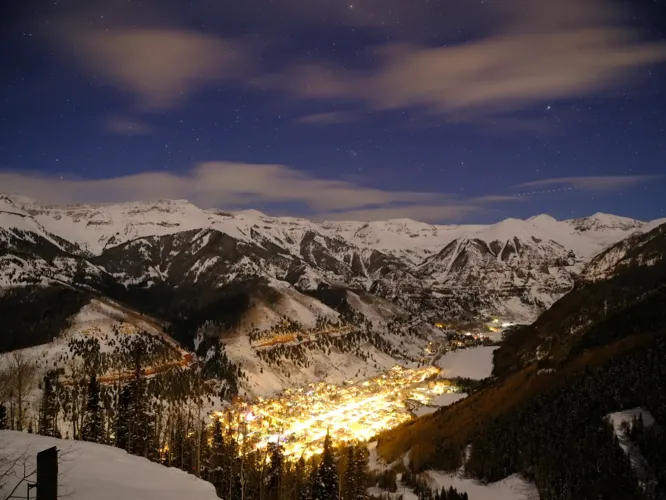
Telluride Colorado illuminated at night beneath snow-covered San Juan Mountains
No responsible travel writer can promise the perfect ski week months in advance.
What we can say is that the pieces are aligning.
The 2026–27 Telluride ski season arrives with a strong El Niño influencing the national winter outlook, more than 2,000 acres of terrain preparing to open, Michelin paying new attention to the town’s dining scene and one of hospitality’s biggest luxury names investing heavily in its future.
Perhaps most importantly, Telluride still feels like Telluride.
Four Seasons is not creating the destination’s appeal. Michelin did not discover it. El Niño certainly did not invent it. They are simply putting fresh attention on a mountain town that has spent decades quietly giving travelers reasons to return.
And that may be Telluride’s greatest luxury of all.
In an era when many destinations seem increasingly determined to become the next version of somewhere else, Telluride still appears remarkably comfortable being itself.

(0) comments
We welcome your comments
Log In
Post a comment as Guest
Keep it Clean. Please avoid obscene, vulgar, lewd, racist or sexually-oriented language.
PLEASE TURN OFF YOUR CAPS LOCK.
Don't Threaten. Threats of harming another person will not be tolerated.
Be Truthful. Don't knowingly lie about anyone or anything.
Be Nice. No racism, sexism or any sort of -ism that is degrading to another person.
Be Proactive. Use the 'Report' link on each comment to let us know of abusive posts.
Share with Us. We'd love to hear eyewitness accounts, the history behind an article.