
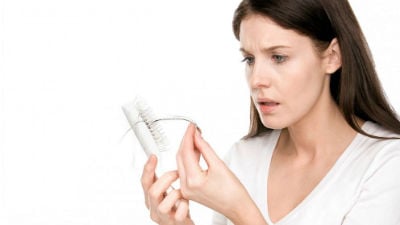
About half of female hair loss cases are a result of androgenic alopecia, says Melinda Galloway H.P.T, a Holistic Practitioner of Trichology in Sorrento Valley. Similar to male pattern baldness, female pattern baldness is caused by too many androgens. But female AA manifests differently from male "caesar crown;" it starts with a wider part, eventually spreading to the rest of the scalp. Not all hair is ever lost, but it can get very, very thin.
The exact biology of female AA is still a mystery. It’s likely a multifactorial genetic circumstance. The phenotype could be influenced by both androgen-related and non-androgen-related traits, so as you might have guessed, there is still a lot of DNA for science to untangle.
Another potential cause is telogen effluvium, or hair loss caused by a stressful event. Traction alopecia comes from tight hairstyles, such as cornrows and slick ponytails; this one is easy to prevent, so try and loosen up your hairstyle. Trichotillomania is an anxiety disorder that causes people to compulsively pull out their own hair and can be treated successfully with therapy or medication. Alopecia areata is an autoimmune condition that causes sections of scalp hair to fall out without warning. Certain drugs such as chemotherapy, oral contraceptives or an incorrect dosage of a different medication can cause hair loss as well. A lack of iron and thyroid problems might also be responsible. So in short: there’s an explanation, and when there’s an explanation, there’s a way to fix it.
Galloway tells us that most women first bring up their hair loss to a stylist, yet most stylists don’t know anything about potential underlying medical conditions. If you have hair loss, she recommends seeing your primary care physician as soon as possible. You could also see a dermatologist that specializes in hair loss, who can perform a scalp biopsy and will tell you just why your hair has been falling out. Don’t trust anyone who just looks at the strands.
Galloway tells me that the stage of hair loss will determine if a woman is able to restore her hair, so she urges women to get help sooner rather than later. She also advises women to be careful about who they seek help from. "Because celebrities are wearing hair extensions," she says, "they’ve become more of an accepted hair accessory available to everyone. There’s been a huge increase of hair extension bars catering to clientele without hair loss. These places are often just cosmetic quick fixes that, if done improperly, can cause long-term consequences. So don’t go to anyone who's recently jumped on the hair extension bandwagon, it could really jeopardize your hair and your bank account. I see a lot of people with and without thinning hair get taken advantage of and it really upsets me."
If you have androgenic alopecia and there’s no underlying cause to treat, or if you’ve already lost a lot of hair, don’t worry. There are still plenty of things you can do.
First, let’s get this out of the way: hair transplants are probably a no. They’ve come a long way from the clumpy doll-hair "plugs" of yesteryear, and they work well on men. However, Galloway points out that hair transplant success rates are much lower in women. "[Women] lose their hair from ear to ear to mid-crown. That’s a big area to fill in." Also, hair doesn’t often take due to hormonal differences. A transplant can cost about $12,000 and won’t be covered by insurance, so take a deep breath: if you’re a woman experiencing hair loss, you no longer have to worry about shelling out this kind of money.
What does work? Topical drugs. Minoxidil is the only drug that’s proven to be effective. It’s available in many over-the-counter generic forms worldwide with names like Rogaine. You’ll pay $25 for a three-month supply, it could take a year to work, and you’ll have to keep applying it twice a day. It’s also the butt of a lot of jokes, which it shouldn’t be. But it does stop hair loss in 80% of women, though less than half will experience some regrowth. An oral medication called Finasteride and laser hair combs can also do the trick, although there is less empirical evidence backing them up.
Hair prosthetics are also foolproof and instant; it's the second-best thing to hair growing from your scalp. They look and feel like your natural hair, and so many people wear them that there’s nothing to be ashamed of. Many luxurious contemporary prostheses have each hair hand-tied on, one by one, to create a realistic part. On the high-tech side of things, a professional can graft a prosthetic to your head; it’s attached with a safe, topical surgical adhesive, so it feels real and you’ll never take it off. You don’t even have to shave your head. Every month and a half or so, you’ll go in and get it cleaned. "These women ride motorcycles, play polo and go swimming, and you would never know," Galloway says of her prosthetic patients at Advanced Hair Aesthetics.

Hair Loss Tips
40% of women with hair loss report marital problems and 63% report career issues. And these aren’t the only problems; these statistics are clearly a reflection of what’s going on inside. So even after seeing your doctor and getting treatment, it’s important to consider a therapist. Or, for more efficiency, work with an empathetic hair loss specialist.
"Physicians often are unable to psychologically make you feel better," Galloway notes. "They are focused on a diagnosis or curing the hair loss. Of course you need to remain healthy, but health is so influenced by emotional and mental well being."
Galloway has enough heartbreaking hair stories to fill ten more articles. "It can impact emotionally down into the bone," she tells me. "These women don’t share with others that they’re going through the hair loss and that they feel ugly. And then they go through depression. You might think, ‘Oh gosh it’s just hair,’ but hair is what makes us sexy. It’s what makes us feel confident, and I’ve had women tell me that they’d rather lose their right arm than lose their hair."
Alopecia isn’t physically harmful, but the social aspect and unreliability of treatment can lead to severe psychological symptoms. Alopecia was once considered a psychosomatic (involving both mind and body) disorder due to its effect on quality of life. This designation has been removed due to lack of evidence, but it’s clear to many professionals that it still deserves that label. With hair loss, women experience literal grieving symptoms since hair is undoubtedly connected to femininity, sexuality and personality. Hair loss can also cause a literal change of identity since eyebrows and eyelashes define your face, a cornerstone of personal perception. Counseling to accept the hair loss, either instead of or in a supplement to hair replacement therapies, is a worthy consideration. The important thing is to not suffer alone.
"There’s someone there that could help you gain your confidence and be with you every step of the way," Galloway promises. "You don’t have to buy hair extensions online or camouflage ‘hair make-up’ from an infomercial and be in tears at night in your bathroom. You really have to be gentle to yourself."
(UPDATED)
For Related Articles Try:
3 Simple Changes to Stop Hair LossFall in Love with Stunning Hair Extensions5 Tips to Get Flawless Waves

(0) comments
We welcome your comments
Log In
Post a comment as Guest
Keep it Clean. Please avoid obscene, vulgar, lewd, racist or sexually-oriented language.
PLEASE TURN OFF YOUR CAPS LOCK.
Don't Threaten. Threats of harming another person will not be tolerated.
Be Truthful. Don't knowingly lie about anyone or anything.
Be Nice. No racism, sexism or any sort of -ism that is degrading to another person.
Be Proactive. Use the 'Report' link on each comment to let us know of abusive posts.
Share with Us. We'd love to hear eyewitness accounts, the history behind an article.