
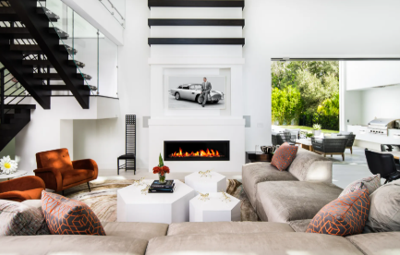

Luxury homes don't really announce themselves the way people expect.
There's this idea that luxury means big rooms, expensive furniture, dramatic entryways, all that. And sure, sometimes it does. But most of the homes that actually feel luxurious in a lived-in way don't rely on showing off.
They feel intentional instead.
You notice it when you walk through them. Not in one obvious moment, more like a slow impression that builds as you move from room to room. Light feels right. Spaces connect without feeling empty. Materials don't fight each other. It's quieter than people expect.
Today, homeowners are less focused on filling a space with expensive objects and more focused on how the space actually behaves. Natural light, openness, material quality, and custom architectural details tend to matter more than decor alone.
And in a lot of projects, especially higher-end residential ones, designers end up working with specialists like showerdoorprices.com when custom glass is part of the plan. Not as decoration, but as a way to shape openness, bring daylight deeper into interiors, and keep the overall design visually clean.
Glass ends up doing more than people think it does at first.
Quality Materials Set the Foundation
Materials are usually the first thing people feel in a space, even if they don't realize it.
Natural stone is a good example. Marble, limestone, quartzite — these materials have variation in them. Slight irregularities. Veining. Texture shifts. And that's exactly what makes them feel real in a way manufactured surfaces often don't fully replicate.
Manufactured finishes can look convincing, but they sometimes feel a bit too uniform. Too controlled. Real materials have small inconsistencies that give them depth.
Wood behaves the same way. Solid wood and high-quality engineered hardwood both bring warmth, but they also age differently. Good materials don't just survive time — they usually improve with it. Or at least settle into it in a more natural way.
Metal finishes are another layer people underestimate. Handles, trims, fixtures — these are touched constantly. They quietly shape how a home feels day to day, even if nobody ever comments on them directly.
Architectural glass fits into this same category of foundational material, even though it behaves differently. It isn't about texture or warmth in the traditional sense. It's about light, transparency, and spatial clarity.
One thing that often gets overlooked is consistency. Luxury isn't about using the most expensive material in every corner. It's about how those materials relate to each other across the home. When everything feels like it belongs to the same design language, the result is much more cohesive.
At the end of the day, luxury is less about cost and more about craftsmanship and attention to detail. That part gets repeated a lot, but it's still true.
Open Spaces Feel More Luxurious
Space feels different when it's uninterrupted.
Modern luxury homes tend to avoid unnecessary visual breaks. Not because walls are bad, but because too many of them can make a space feel segmented in a way that limits how light and movement behave.
Open floor plans are one response to that. They allow living areas, kitchens, and dining spaces to connect more naturally. The result is less about size and more about continuity.
Sightlines play a big role here too. When you can see across a space without constant interruption, the home feels larger. Not physically larger, just more open. The eye moves more freely.
There's also something about minimal visual barriers that changes how comfortable a space feels. Fewer interruptions, fewer abrupt transitions. Everything flows a bit more naturally.
Indoor-outdoor connection is part of the same idea — large openings, glass doors, and transparent elements help extend interior spaces visually into exterior ones. Even if you're standing inside, the boundary feels less rigid.
Natural light is probably the most important factor in all of this. The more light can move through a space, the less enclosed it feels. And glass plays a major role in that process because it allows separation without blocking illumination. In many cases, transparent architectural elements are what make openness actually work in practice instead of just conceptually.
Custom Features Make Every Home Unique
There's a noticeable difference between a home that's been upgraded and one that has been designed around its architecture.
Standard upgrades tend to improve things in predictable ways. New fixtures, new finishes, updated surfaces. They make a home newer, but not necessarily more distinctive. Custom features are different — they're shaped around the specific proportions and layout of a space, which means they often feel more integrated.
Custom glass installations are a good example of this. Frameless partitions, tailored enclosures, and made-to-measure panels allow design decisions to follow architecture instead of forcing the architecture to adapt.
Floating staircases are another. They change how vertical movement feels in a home, especially when paired with minimalist railings that reduce visual weight.
Oversized mirrors can also have a strong impact. They expand perception and increase light distribution.
Hidden hardware is one of those details people don't always notice directly, but they feel it. When handles, hinges, and fittings disappear into the design, the overall result feels more refined. Less cluttered.
Custom architectural details across a home — built-ins, transitions, integrated lighting — create a sense that the space wasn't assembled from separate parts, but designed as a single system.
Luxury Should Also Be Practical
There's a tendency to associate luxury with appearance alone, but in practice, the most successful homes are usually the ones that function well over time.
Easy maintenance matters more than people expect. A beautiful material that is difficult to care for tends to lose its appeal after daily life sets in.
Durability is another factor. Materials and systems that hold up under long-term use often provide more value than those that simply look impressive at the beginning. Long-term performance becomes especially important in high-use areas like kitchens, bathrooms, and shared living spaces. These aren't static environments. They're used constantly.
Safety also plays a role, particularly in architectural elements like glass, stair systems, and structural components. Modern materials are designed with these considerations in mind, which makes them both visually light and structurally reliable.
Functionality ties everything together. A home can look impressive, but if it doesn't support daily life comfortably, that impression doesn't last.
Timeless design choices tend to address all of these factors at once. They avoid overly specific trends and instead focus on proportions, materials, and layouts that remain relevant over time. This balance between aesthetics and function is a core part of interior design.
The most luxurious homes aren't necessarily the biggest or the most expensive — they're the ones where design decisions were made with intention rather than accumulation.
Premium materials create a strong foundation. Open layouts allow light and space to move freely. Custom architectural features give the home its identity. Practical design ensures it all works in real life, not just in theory. And when all of those elements align, the result feels less like a collection of upgrades and more like a cohesive environment.
That's really what modern luxury has shifted toward — not excess but clarity, comfort, and design that actually makes sense to live in.

(0) comments
We welcome your comments
Log In
Post a comment as Guest
Keep it Clean. Please avoid obscene, vulgar, lewd, racist or sexually-oriented language.
PLEASE TURN OFF YOUR CAPS LOCK.
Don't Threaten. Threats of harming another person will not be tolerated.
Be Truthful. Don't knowingly lie about anyone or anything.
Be Nice. No racism, sexism or any sort of -ism that is degrading to another person.
Be Proactive. Use the 'Report' link on each comment to let us know of abusive posts.
Share with Us. We'd love to hear eyewitness accounts, the history behind an article.