
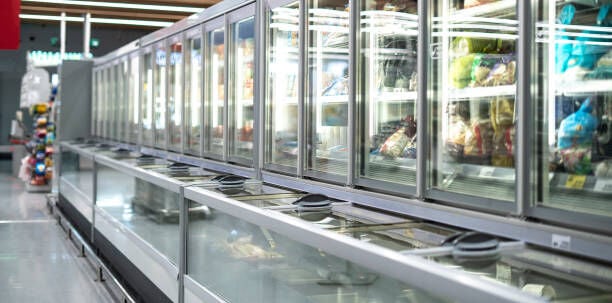
supermarket fresh food in the fridge shelves
Commercial refrigeration is a crucial technology for various industries, enabling the preservation and storage of perishable goods. This system differs significantly from residential refrigeration, not only in scale but also in design, functionality, and efficiency.
It involves utilizing large-scale refrigeration equipment, such as reach-in refrigerators, freezers, and walk-in fridges and freezers, often complemented by professional air conditioning services. These integrated solutions are designed to meet the high demands of businesses, ensuring that products remain at optimal temperatures to maintain freshness and prevent spoilage.
Types of Commercial Refrigeration Equipment
Several types of equipment fall under the umbrella of commercial refrigeration, each serving a specific purpose:
Reach-in Refrigerators and Freezers: These are the most common types, found in nearly every commercial kitchen. They are designed for easy access to food items, with glass or solid doors.
Walk-in Fridges and Freezers: Used for storing large quantities of food products, these units are essential for businesses that require bulk storage.
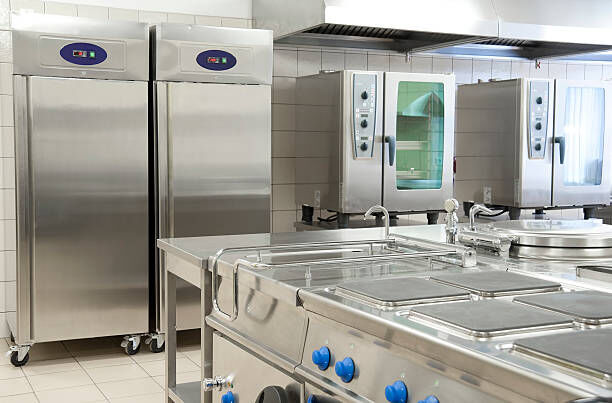
Empty restaurant kitchen with professional equipment
Specialty Food Stores Equipment: This includes display refrigerators for bakeries, delis, and confectioneries, designed to showcase products while keeping them at the right temperature.
Industries Relying on Commercial Refrigeration
Food and Beverage Storage
The backbone of the food industry, commercial refrigeration, ensures the longevity and safety of products, from farm to table.
Key Uses: Storage of dairy products, meats, vegetables, and fruits.
Example: Large distribution centers utilize walk-in coolers to store products before distribution to retail outlets.
Convenience Stores
These stores rely heavily on commercial refrigeration to offer customers a variety of cold drinks and perishable items.
Key Uses: Display coolers for beverages, and refrigerated snack sections.
Example: 7-Eleven stores feature multiple reach-in coolers for easy customer access.
Restaurants and Cafes
A vital component for the food service industry, ensuring that ingredients remain fresh until they're cooked and served.
Key Uses: Salad bars, dessert coolers, and under-counter refrigerators for easy access.
Example: Starbucks uses under-counter refrigerators for milk and creamer storage.
Hospitals
Refrigeration in hospitals is not only for food but also for storing sensitive medical supplies.
Key Uses: Storing blood banks, vaccines, and certain medications that require cooling.
Example: Large hospitals have dedicated cold storage rooms for pharmaceuticals.
Medical Research Clinics
These facilities use commercial refrigeration to store samples and compounds critical for research and development.
Key Uses: Preservation of biological samples, chemicals, and experimental drugs.
Example: Research labs often have multiple small reach-in units for different projects.
Florists
Not an obvious industry at first, but florists use refrigeration to extend the life of cut flowers and arrangements.
Key Uses: Walk-in coolers to keep flowers fresh before sale.
Example: Boutique florist shops have display coolers for customers to view arrangements.
The Refrigeration Process Explained
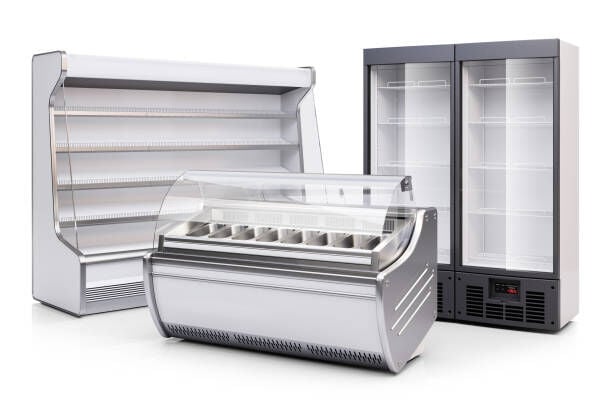
Freezer showcase, refrigerated cabinet and fridge showcase isolated on white background 3d
At its core, commercial refrigeration works by removing heat from the interior of the unit and expelling it to the outside environment. This process involves a refrigerant cycling through a series of coils and a compressor.
The refrigerant absorbs heat as it turns from a liquid into a gas in the evaporator coil. It then travels to the compressor, where it's compressed into a high-pressure gas, moving to the condenser coil, where it releases the absorbed heat and turns back into a liquid.
Coolers vs. Condensers: The Difference and Maintenance Importance
A common point of confusion lies in distinguishing between coolers and condensers within the refrigeration system. Simply put, the cooler (or evaporator) is where the refrigerant absorbs heat from inside the unit. In contrast, the condenser is where the refrigerant releases the absorbed heat to the outside environment. Both components are crucial for the refrigeration cycle, and their efficiency directly impacts the system's overall performance.
Importance of Regular Servicing
Regular maintenance of both coolers and condensers is essential for several reasons:
Efficiency: Clean and well-maintained components work more efficiently, reducing energy consumption and operational costs.
Longevity: Regular servicing extends the life of the refrigeration system, preventing premature failures and expensive replacements.
Safety: Proper maintenance ensures safe operation, reducing the risk of accidents and food spoilage, which can lead to health hazards.
Recognizing when your commercial refrigerator needs servicing is crucial for ensuring its operational efficiency and extending its useful life. Early identification of issues, such as fluctuating temperatures, odd noises, and increased energy consumption, can prevent costly repairs and downtime. Other telltale signs include:
Inconsistent Temperatures: If the unit struggles to maintain the set temperature, it may indicate a failing compressor or inadequate refrigerant levels.
Unusual Noises: Buzzing, clicking, or humming sounds can suggest mechanical issues or loose components.
Increased Energy Bills: A sudden spike in energy costs can be a sign of decreased efficiency due to aging or malfunctioning parts.
Ice Buildup: Excessive frost or ice in areas where it shouldn't be points to sealing issues or malfunctioning defrost cycles.
Poor Cooling: If the unit is not cooling as effectively as it used to, it’s time for a professional check-up.
Commercial refrigeration plays a pivotal role across various industries, from food service and retail to medical and floral. Understanding the types of refrigeration equipment, their applications, and the underlying technology is crucial for businesses relying on these systems.
Equally important is noticing the difference between coolers and condensers and the need for regular maintenance to ensure optimal performance. By prioritizing the efficiency and upkeep of their refrigeration systems, businesses can safeguard their products, reduce operational costs, and contribute to a safer, healthier environment for everyone.


(0) comments
We welcome your comments
Log In
Post a comment as Guest
Keep it Clean. Please avoid obscene, vulgar, lewd, racist or sexually-oriented language.
PLEASE TURN OFF YOUR CAPS LOCK.
Don't Threaten. Threats of harming another person will not be tolerated.
Be Truthful. Don't knowingly lie about anyone or anything.
Be Nice. No racism, sexism or any sort of -ism that is degrading to another person.
Be Proactive. Use the 'Report' link on each comment to let us know of abusive posts.
Share with Us. We'd love to hear eyewitness accounts, the history behind an article.