
Every project begins with optimism. The budget looks reasonable, the timeline appears civilized, and everyone nods as if no one has ever seen a deadline quietly turn into a bonfire. Then reality arrives, usually carrying scope changes, missing information, delayed approvals, supply issues, staffing gaps, or a stakeholder who suddenly remembers “one small thing.”
That is why risk management matters. It is not the gloomy side of project management. It is the grown-up part. Strong project risk management helps teams identify what could go wrong, understand what matters most, plan sensible responses, and keep decision-makers informed before small issues become expensive emergencies.
The Project Management Institute defines risk management in a project context as identifying, analyzing, and responding to risk factors throughout a project’s life in the best interests of its objectives. In simpler terms, it is how smart teams avoid being surprised by things they probably should have seen coming.
What Risk Management Means in Project Management
Risk management is the process of recognizing uncertainty and deciding what to do about it. A project risk may be a threat, such as a vendor delay or budget overrun, but it can also be an opportunity, such as a faster approval process, a better supplier option, or a chance to improve the final outcome.
The goal is not to eliminate every risk. That would be lovely, and also fictional. The goal is to understand which risks could affect cost, schedule, quality, safety, reputation, compliance, or stakeholder satisfaction, then manage those risks with discipline instead of panic.
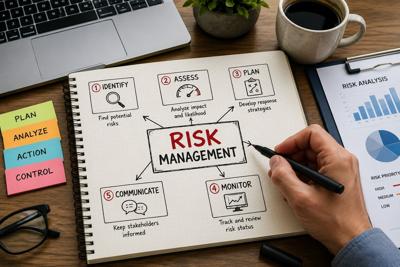
Step 1 Is Risk Identification
The first step is identifying what could affect the project. This sounds simple until a team realizes how many assumptions are quietly holding the project together. Risk identification brings those assumptions into the open.
Project managers can identify risks through team workshops, stakeholder interviews, lessons learned from past projects, checklists, SWOT analysis, vendor reviews, site assessments, technical reviews, and schedule analysis. The point is to gather input from people close enough to the work to know where things might break.
A risk register is often used to capture this information. It usually includes the risk description, possible cause, potential impact, owner, probability, response plan, status, and next action. FINE’s article on how to keep costs down in a new business connects well here because unmanaged risks are one of the fastest ways for budgets to lose their manners.
Step 2 Is Risk Assessment
Once risks are identified, they need to be assessed. Not every risk deserves the same level of attention. A minor inconvenience should not receive the same response as a risk that could delay the entire project, damage the client relationship, or create serious compliance problems.
Risk assessment usually looks at probability and impact. How likely is the risk to happen? If it happens, how serious would the effect be? Many project teams use a probability-impact matrix to rank risks as low, medium, or high priority.
The Association for Project Management describes risk management as a process that helps individual risk events and overall risk be understood and managed proactively, minimizing threats and maximizing opportunities. That proactive part is important. Waiting until every risk has become a problem is not management. It is cleanup.
Step 3 Is Risk Response Planning
After the team understands which risks matter most, the next step is deciding what to do about them. Risk response planning turns awareness into action.
For threats, common responses include avoiding the risk, reducing its likelihood or impact, transferring part of the risk through contracts or insurance, or accepting the risk with a clear contingency plan. For opportunities, the response may involve exploiting, enhancing, sharing, or accepting the potential upside.
This is where project managers need to be realistic. A response plan should name who owns the risk, what action will be taken, when it will happen, what trigger will activate the plan, and what resources are needed. “We will keep an eye on it” is not a plan. It is a sentence people say right before the project starts sending alarming emails.
Step 4 Is Risk Monitoring
Risk management is not something a team does once at the beginning and then files away with kickoff notes nobody opens again. Risks change as the project changes. New risks appear, old risks disappear, and some risks become more serious as deadlines approach.
Risk monitoring keeps the risk register alive. Project managers should review top risks during status meetings, update risk owners, track response actions, monitor triggers, and add new risks as conditions change. This step helps teams avoid the classic project mistake of noticing a problem only after it has grown teeth.
For technology, cybersecurity, government, and regulated projects, formal risk frameworks can become even more important. The NIST Risk Management Framework is one example of a structured approach that integrates security, privacy, and cyber supply chain risk management activities into the system development life cycle.
Step 5 Is Risk Communication
Risks should not live quietly in a spreadsheet while the rest of the team continues cheerfully toward trouble. Communication is one of the most important parts of project risk management because the right people need the right information at the right time.
Stakeholders do not need every detail about every possible issue. They need clear reporting on the risks that could affect scope, schedule, budget, quality, safety, compliance, or reputation. Good risk communication explains what the risk is, what its likely impact could be, what is being done, who owns it, and when a decision may be needed.
FINE’s article on why elite tradesmen are choosing job management software touches on a related truth: organized communication and clear systems can reduce confusion before it becomes expensive.
Why Project Risk Management Often Fails
Risk management usually fails for very human reasons. Teams are too optimistic. Stakeholders avoid difficult conversations. Risks are identified but never assigned to owners. The risk register is created and then abandoned. Leaders focus only on immediate problems instead of future threats.
Another common failure is vague language. “Vendor issue” is not enough. A useful risk statement should be specific: “If the vendor does not deliver the required materials by July 15, installation may be delayed by two weeks and labor costs may increase.” Specific risks lead to specific responses. Vague risks lead to meetings that should have been emails.
The Difference Between Risks and Issues
A risk is something that might happen. An issue is something that has already happened. This distinction matters because risks can be planned for, while issues must be handled immediately.
For example, “the supplier may miss the delivery date” is a risk. “The supplier missed the delivery date yesterday” is an issue. A strong project manager tracks both, but risk management is designed to keep possible problems from becoming real ones whenever possible.
Risk Management Helps Protect the Budget
Budget problems rarely appear all at once. They build through small decisions, missed assumptions, delayed approvals, change requests, overtime, rework, and unclear responsibilities. Risk management gives teams a better chance to catch those problems early.
Cost-related risks should be tracked carefully, especially when projects rely on external vendors, fixed-price contracts, volatile material pricing, or specialized labor. A good risk plan does not guarantee a perfect budget, but it does reduce the odds of everyone acting shocked by predictable expenses.
Risk Management Also Protects Relationships
Projects do not fail only because of technical problems. They also fail because people lose trust. Poor communication, surprise delays, unclear expectations, and late warnings can damage stakeholder confidence even when the underlying issue is fixable.
Strong risk communication helps protect relationships by making uncertainty visible early. Clients and leadership may not love hearing about possible problems, but they usually prefer early warning over last-minute bad news delivered with the energy of someone hiding behind a calendar invite.
Simple Risk Management Checklist
- Identify risks early in project planning.
- Include input from team members, stakeholders, vendors, and subject-matter experts.
- Create a risk register and keep it updated.
- Assess each risk by probability and impact.
- Assign an owner to each major risk.
- Create response plans for high-priority risks.
- Define triggers that show when action is needed.
- Review risks during project status meetings.
- Communicate major risks clearly to stakeholders.
- Capture lessons learned after the project ends.
How Better Risk Management Builds Better Project Managers
Project managers who handle risk well tend to be calmer, clearer, and more trusted. They do not wait for problems to explode before acknowledging them. They give teams structure, help leaders make informed decisions, and create room for practical solutions.
Risk management also helps project managers grow beyond task tracking. It requires judgment, communication, prioritization, leadership, and the ability to see how one delay, decision, or assumption can affect the entire project.
The Bottom Line on Project Risk Management
Project risk management is not a paperwork exercise. It is a practical discipline that helps teams protect budgets, timelines, quality, relationships, and outcomes.
The five essential steps are clear: identify risks, assess them, plan responses, monitor changes, and communicate with the people who need to know. When those steps are handled well, projects are not magically free of problems. They are simply better prepared for them, which is often the difference between a controlled adjustment and a full project meltdown with snacks.

(0) comments
We welcome your comments
Log In
Post a comment as Guest
Keep it Clean. Please avoid obscene, vulgar, lewd, racist or sexually-oriented language.
PLEASE TURN OFF YOUR CAPS LOCK.
Don't Threaten. Threats of harming another person will not be tolerated.
Be Truthful. Don't knowingly lie about anyone or anything.
Be Nice. No racism, sexism or any sort of -ism that is degrading to another person.
Be Proactive. Use the 'Report' link on each comment to let us know of abusive posts.
Share with Us. We'd love to hear eyewitness accounts, the history behind an article.