


There are cities that reveal themselves immediately, and then there are cities that make you reconsider what you thought you knew about them.
San Antonio did the latter.
Before our trip, we knew the familiar version. The Alamo. The River Walk. Tex-Mex. Texas history. We expected to enjoy all of it, but if I am being completely fair, I was not expecting San Antonio to feel especially lively.
Then we arrived.
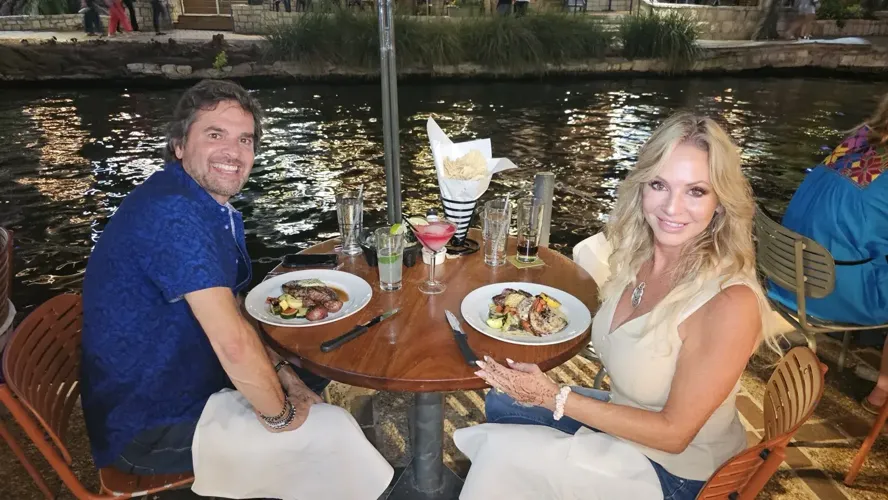
By our first night, the river was glowing beneath restaurant terraces and mature trees. Color reflected across the water. Electric boats moved quietly underneath stone bridges. People lingered over margaritas, walked after dinner and disappeared around bends in the river that made you want to follow just to see what was next.
And this was not a Saturday night.
It was a Thursday.
David and I kept looking around wondering where all these people had come from. Back home, finding this much energy on an ordinary weeknight can take some effort. Here, it seemed to be happening naturally.
That was when San Antonio started to surprise us.
The River Walk Is Better After Dark
We liked the San Antonio River Walk during the day.
Then we saw it at night and realized we had been doing it wrong.
Once the sun begins to drop, the heat softens, the restaurant patios fill and the lights along the water completely change the mood.
It can feel romantic without trying very hard to be romantic.
One of the things we loved most was that there was no real pressure to keep moving toward some major attraction. You could leave dinner, walk a little farther, stop somewhere else for a drink, head back up to street level, get distracted by something completely different and eventually find your way back to the river.
That became a pattern.
We would start with a plan and somehow end up doing something else.
A dinner turned into a walk. A walk turned into another drink. Someone would tell us about another place we needed to see, and suddenly the plan changed again.
That is part of what made San Antonio fun.
It was not just the things on the itinerary. It was what happened in between them.
Seeing the River From the Water Changes Everything
At some point, you should stop walking beside the River Walk and actually get onto it.
GO RIO Cruises operates the colorful boats that have become part of the downtown landscape, and seeing the city from the water gives you a completely different perspective.
David noticed something before I did.
“I like that the boats are electric.”
I looked at him, then back at the river.
He was right.
No exhaust. No engine noise interrupting conversations. No rumbling every time a boat passed a restaurant patio.
They simply glided by.
It was one of those details I probably would never have thought to put on a list of reasons to enjoy a city, but once you notice it, you appreciate it every single time another boat passes.
The ride also helps make sense of downtown.
Places that seem disconnected when you are moving between streets suddenly fit together. Bridges, hotels, restaurants and public spaces start to connect, and the River Walk begins to feel less like one attraction and more like the organizing feature of downtown.
For a first visit, I would absolutely do both.
Walk it and ride it.
They are not the same experience.
Hotel Contessa Puts the City Outside Your Door
For this trip, Hotel Contessa gave us exactly the kind of location that works best in San Antonio.
The all-suite hotel sits directly on the River Walk, which meant we developed a slightly dangerous habit: leaving the hotel with one plan and coming back several hours later after doing something completely different.
Dinner could turn into drinks.
Drinks could become another walk.
A walk could turn into someone telling us about another place we suddenly decided we had to see.
That freedom became one of the best parts of the stay.
We could walk to dinner, continue along the river afterward, head toward the Alamo or move between downtown stops without making transportation part of every decision.
There is a particular kind of luxury in that.
It is not always another amenity or another service. Sometimes it is being able to leave the hotel after dinner and simply see where the night takes you.
Hotel Contessa's suites have separate living and sleeping areas, which made the property especially comfortable after long days of running around the city.
But for us, the real advantage was location.
San Antonio gets more interesting the more you walk through it.
Hemisfair Shows a Different Side of Downtown
Just beyond the most familiar sections of the River Walk, San Antonio keeps changing.
Hemisfair is one of the clearest examples.
The former site of the 1968 World's Fair is being transformed into a walkable downtown district built around public parks, restaurants, local businesses and gathering spaces.
What I liked was the contrast.
Historic San Antonio is everywhere, but the city does not feel frozen in history.

One minute you are thinking about centuries-old missions and archaeology. A few minutes later, you are drinking Texas wine in a modern tasting room or sitting in a contemporary public space surrounded by new restaurants.
At Hemisfair, we tasted Texas wine at Re 210 and started asking the kind of questions we always ask when we travel somewhere new.
What makes Texas wine taste like Texas?
Why are so many wineries associated with Hill Country if the grapes are often grown elsewhere?
What would you pour for a California wine drinker who is skeptical of Texas wine?
That conversation deserves its own article, especially because it quickly moved from wine into sustainability, food pairing and the psychology of taste.
That is exactly the sort of thing that happens when you stop treating a city like a checklist.
Pearl Is Where San Antonio Starts Feeling Local
If downtown introduces you to San Antonio, Pearl helps explain where the city is going.
The former brewery complex has become a dining, shopping and gathering district, but what stood out to us was how many locals were actually using it.
People brought their dogs. Friends met outside. Families occupied the lawns. People sat with books. Restaurants were busy.
It did not feel like a district built solely for visitors.
And that matters.
Some destinations create places tourists are supposed to admire.
The more interesting places create spaces locals genuinely want to use.
Pearl felt like the latter.
We also kept hearing about it from people we met elsewhere in the city. When locals repeatedly recommend the same area, we pay attention.
That is usually a better sign than any tourism brochure.
Its brewery history also fits into something else we kept noticing throughout the trip: San Antonio has far more cultural layers than the shorthand version suggests.
Spanish colonial history, Mexican and Tejano influence, Indigenous history, German immigration and modern Texas culture all overlap here.
You feel that most clearly when you move between neighborhoods instead of staying in one place.
San Antonio’s History Is Not Sitting Behind Glass
The clearest example of that came at The Alamo.
We expected history.
We did not expect archaeology to become one of the most fascinating parts of the trip.
We attended an archaeology program where we learned about preservation work, hundreds of thousands of artifacts and discoveries sitting only a few feet beneath areas visitors walk across every day.
At one point, archaeologists described mission-era adobe pavers that had been found, documented, preserved in place and covered again for future study.
That was the moment the Alamo stopped feeling like a monument and started feeling like an active archaeological site.
And then there were the artifacts.
Ceramics. Musket balls. Stone tools. Bottles. Everyday objects.
One archaeologist talked about a fork with an animal-bone handle from the U.S. military occupation period and why something so ordinary could be one of her favorite finds.
That stayed with me.
History is easier to connect with when it stops being abstract.
A fork is not a battle.
A piece of pottery is not a date on a timeline.
They are ordinary things used by ordinary people who happened to live in an extraordinary place.
We will go much deeper into that in the Alamo article because there is far too much material to squeeze into a few paragraphs here.
The River Connects More Than Attractions
The longer we stayed, the clearer it became that the river is not simply San Antonio's prettiest backdrop.
It is part of the reason the city exists.
The Spanish missions were established along the San Antonio River, and acequia irrigation systems helped move water through agricultural areas and communities.
Centuries later, the river is still connecting the city, just in an entirely different way.
One local explained it to us in the simplest terms: without the river, there would not have been the missions and there would not have been the same San Antonio.
That made sense.
The River Walk works because it is not decoration.
It is tied to the city's history, growth and geography.
And visually, it is unusually well done.
One thing I kept noticing was how many mature trees had been preserved along the river. Instead of stripping everything out and starting over, the walk seems to bend around them.
That gives parts of the River Walk an established, almost hidden quality.
You do not feel like you are walking through something newly manufactured.
You feel like the city grew around the river.
San Antonio Was Not What We Expected
That may be the strongest compliment we can give it.
We arrived knowing we would see the Alamo.
We knew we would eat well.
We expected to walk along the River Walk and take the required photographs.
We did all of those things.
What we did not expect was how much fun we would have simply being there.
There was more energy than anticipated. More people were out at night. The river felt more intimate than photographs suggested. The history did not feel separated from modern San Antonio.
And several times, we found ourselves changing our plans because someone local told us about something we absolutely needed to see.
That even included returning to places we thought we had already finished with.
We visited the Alamo during the day and assumed we had checked that box.
Then someone told us we needed to go back at night.
Instead of saying, “We already did the Alamo,” our reaction had become, “Okay, maybe we need to go back.”
That is what San Antonio did to us.
The city kept giving us another reason to stay out a little longer, walk a little farther and change the plan one more time.
The best trips do not simply confirm what you expected to find.
They make you realize there was more there than you knew to look for.


(0) comments
We welcome your comments
Log In
Post a comment as Guest
Keep it Clean. Please avoid obscene, vulgar, lewd, racist or sexually-oriented language.
PLEASE TURN OFF YOUR CAPS LOCK.
Don't Threaten. Threats of harming another person will not be tolerated.
Be Truthful. Don't knowingly lie about anyone or anything.
Be Nice. No racism, sexism or any sort of -ism that is degrading to another person.
Be Proactive. Use the 'Report' link on each comment to let us know of abusive posts.
Share with Us. We'd love to hear eyewitness accounts, the history behind an article.