
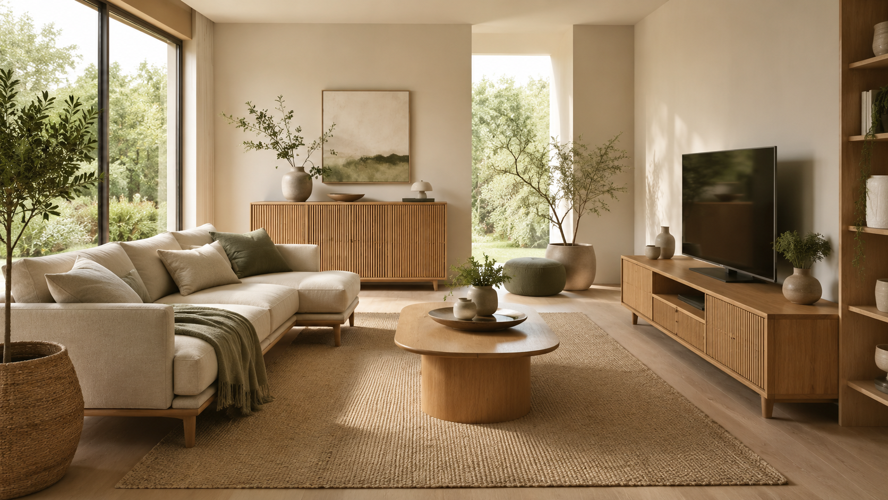

You spent money on your living room. You picked a sofa you loved in the store, found a rug that seemed to tie everything together, and added a few decorative pieces along the way. But something still feels off. The room looks fine on paper — maybe even great in photos — yet every time you sit in it, you feel vaguely unsettled. Restless. Like you can't fully exhale.
That feeling isn't in your head. It's your nervous system responding to your environment.
Interior design has spent decades focused almost entirely on aesthetics — what looks good, what photographs well, what trends are in season. But a growing body of research in environmental psychology tells us something designers have long sensed intuitively: spaces don't just look a certain way. They feel a certain way. And the way they feel has a direct effect on your stress levels, your focus, your relationships, and your ability to rest.
Your living room, more than any other room in your home, is where this plays out the most.
Visual Noise Is a Hidden Stressor
The human brain is constantly scanning its environment for threats. It's an ancient survival mechanism, and it doesn't switch off just because you're sitting on a comfortable sofa. When your living room sends too many competing visual signals — mismatched shapes, clashing colors, surfaces cluttered with objects, furniture that doesn't relate to anything else in the room — your brain reads that as disorder. And disorder, even at a low level, keeps your nervous system in a mild state of alert.
You won't necessarily feel anxious. You'll just feel like you can't fully relax. Like something needs to be done, even when there's nothing specific to do.
The fix isn't minimalism for its own sake. It's reducing what designers call visual noise — the number of unrelated elements competing for your brain's attention at once. A room with fewer, more intentional choices gives the eye a clear path to travel and signals to the brain that the environment is safe, ordered, and under control.
This is why cohesion matters so much, and why it's so often underestimated. When your larger furniture pieces — your sofa, TV unit, storage cabinet, and coffee table — share a common design language through similar proportions, related materials, or a consistent color story, the room stops feeling like a collection of things and starts feeling like a place. One of the most reliable ways to achieve this is to start with pieces that were designed to coexist. Browsing modern living room sets is one way to see how key pieces can be built around shared materials, lines, and proportions from the start — which removes a lot of the guesswork that leads to visual noise in the first place.
The Emotional Center of the Room Is Probably Not Where You Think
Most people treat the sofa as the anchor of the living room. And in terms of scale, it usually is. But in terms of emotional function — how the room actually feels when people are in it — the coffee table plays a more influential role than almost any other piece.
Here's why: the coffee table sits at the center of the social zone. It defines how close people sit to each other, whether the space feels open or crowded, how easy it is to set something down and lean back, and whether the room invites lingering or subtly encourages people to leave. A table that's too large creates a barrier. One that's too small feels incomplete, like there's something missing. One that's the wrong height makes conversation feel awkward without anyone being able to say exactly why.
Shape matters here too, and not just aesthetically. Round and oval tables soften a room's energy — they remove hard corners from the social space, which research in environmental design suggests can reduce unconscious tension during conversation. Rectangular tables create a more defined, directed flow. Square tables work well in symmetrical or conversational layouts where balance is the goal.
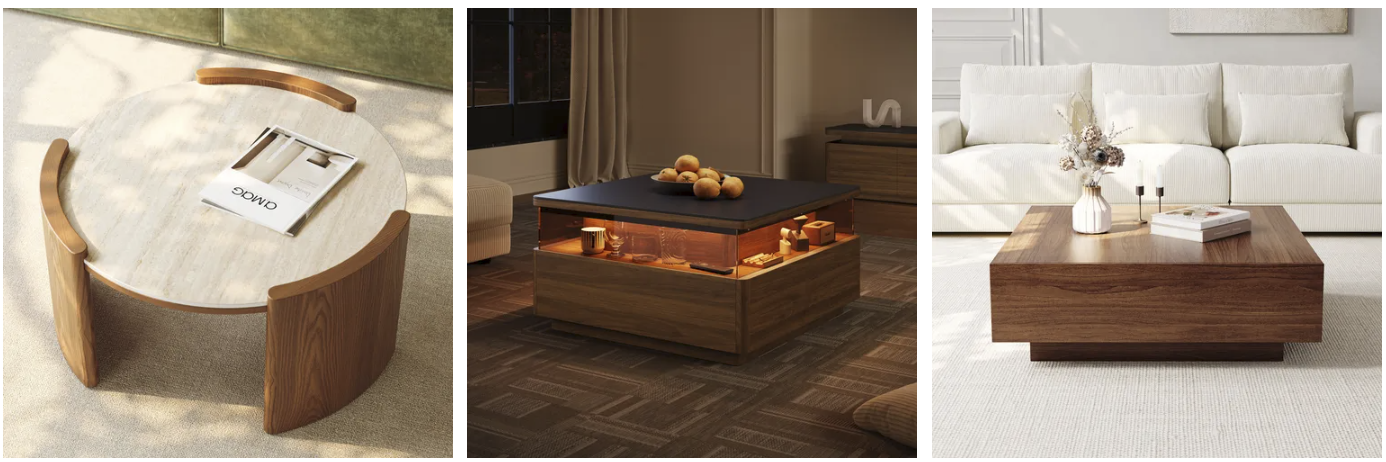
Beyond shape, the surface and storage capacity of a coffee table shape how the room functions hour to hour. A table with thoughtful storage — drawers, a lower shelf, hidden compartments — gives everyday objects a home without forcing them out of reach. That matters because clutter on a surface is one of the fastest ways to reintroduce visual noise into an otherwise calm room. Exploring different modern coffee tables with this in mind — filtering by shape, finish, and storage features — can shift your thinking from "does this look good?" to "does this support how I actually live?"
Color and Texture Are Talking to Your Body
Color psychology is often reduced to simple rules: blue is calming, red is energizing, green is grounding. The reality is more nuanced, but the core principle holds: color affects physiology. Warm, muted tones — soft terracottas, warm whites, earthy taupes — tend to lower heart rate and create a sense of enclosure and safety. Cool, high-contrast palettes can feel energizing in short bursts but fatiguing over time in a space you occupy for hours each day.
What's often overlooked is texture. Texture adds what designers call haptic warmth — a quality that your brain reads even when you're not touching anything. A linen sofa, a jute rug, a wooden coffee table, a ceramic vase — these materials signal warmth, naturalness, and organic depth in a way that polished, synthetic surfaces don't. A room that's visually all glass and metal can feel impressive but cold. A room that layers natural textures alongside cleaner elements gives the nervous system something to relax into.
The goal isn't to follow a formula. It's to get specific about the feeling you're chasing. Start by sitting quietly in your living room for five minutes — not to assess it, but to notice how it makes you feel. That answer is more useful than any mood board.
Light, Layout, and the Sense of Safety
Beyond what you put in a room, how you arrange it — and how much light it receives — has a direct effect on how safe your nervous system feels inside it.
Natural light regulates your circadian rhythm, which affects sleep, mood, and cortisol levels. A living room that's chronically dim — or one that relies entirely on a single overhead fixture — can subtly suppress your energy and your mood without you connecting the cause. Layering light sources at different heights (floor lamps, table lamps, ambient ceiling light) creates warmth and dimension, and gives you control over the atmosphere depending on the time of day and what you need.
Sightlines matter because of that same survival-wired brain. Ideally, the main seating area should have a clear view of the room's entrance. When your back is to a doorway, or when the layout forces you to sit facing a wall, your brain maintains a background vigilance that prevents full relaxation. It's a small thing that has a surprisingly large effect on whether a room feels comfortable or quietly stressful.
Design for How You Want to Feel
The most important shift in how we think about interior design isn't a trend. It's a question: instead of asking what you want your living room to look like, ask what you want it to feel like.
Do you want to feel calm when you walk in after a long day? Energized when you're working from home? Connected when you're hosting people you care about? Each of those emotional goals has design implications — for layout, for material choices, for lighting, for how much visual information the room asks your brain to process.
When you start there — with feeling — the decisions that follow become clearer. And the room you end up with won't just photograph well. It will actually work for the life you're living in it.


(0) comments
We welcome your comments
Log In
Post a comment as Guest
Keep it Clean. Please avoid obscene, vulgar, lewd, racist or sexually-oriented language.
PLEASE TURN OFF YOUR CAPS LOCK.
Don't Threaten. Threats of harming another person will not be tolerated.
Be Truthful. Don't knowingly lie about anyone or anything.
Be Nice. No racism, sexism or any sort of -ism that is degrading to another person.
Be Proactive. Use the 'Report' link on each comment to let us know of abusive posts.
Share with Us. We'd love to hear eyewitness accounts, the history behind an article.