
The quotes you’re getting for a shaded patio cover are all over the map — one contractor says your 4-inch slab is fine, another specs bathtub-deep footings, and a third claims no permit is needed. This 2026 guide scores nine licensed Santa Clarita pros on permits, warranties, and footing math, and decodes the 2025 California Building Codes governing projects submitted after January 1, 2026. If you live in Stevenson Ranch, Castaic, or any unincorporated pocket, LA County rules apply instead.
How We Scored The Nine Pros

We graded each installer with a 100-point rubric that rewards evidence, not marketing: license and insurance (20 points), years in business (15), patio-cover specialization (15), permit or engineering help (15), written warranty strength (15), local showroom presence (10), and recent customer sentiment from 2024–2026 reviews (10).
To earn a place, a company needed an active CSLB license or decades of documented work plus solid customer feedback. We excluded suspended licenses and lead-generation shell sites. Scores reflect data pulled on August 13, 2026.
Nine Installers At A Glance
Rank | Company | Years* | Best for | Permit help | Warranty snapshot |
|---|---|---|---|---|---|
1 | Vinyl Fence Depot | 20+ | Showrooms; vinyl or aluminum mix | Full | Limited lifetime, transferable |
2 | PatioCovered | 25 | Local specialist; fast permits | Full | Written terms on request |
3 | JNR Home Improvements | 15+ | Wind-engineered aluminum | Full | Material plus limited labor |
4 | Strong Construction | 40 | Long-time SCV wood builder | Partial | Basic labor; manufacturer material |
5 | Perfect Patios | 29 | Owner-designed custom wood | Partial | Case by case |
6 | Superior Awning | 40+ | Retractable and fabric shade | Partial | Up to 10-year fabric |
7 | M1 Patio Covers | 40+ | Mixed wood / 4K aluminum | Partial | Project specific |
8 | Made in the Shade | 20+ | Patio plus whole-yard remodels | Full | Standard GC warranty |
9 | AlumWorks | 10+ | Motorized louver systems | Full | Manufacturer motor and structure |
*Years refer to continuous operation, based on CSLB records verified August 13, 2026.
1. Vinyl Fence Depot: Best For Showroom Shopping And Bullet-Proof Warranties

Vinyl Fence Depot Santa Clarita patio cover contractor website screenshot.
Two brick-and-mortar showrooms, in Santa Clarita at 26210 Bouquet Canyon Rd and Van Nuys at 14700 Oxnard St, let you see full-size beams, posts, and color chips before you sign — rare in a market where many installers sell from a tablet.
Operating for more than 20 years, the company fabricates its own USA-made rigid PVC with titanium-dioxide pigment and aluminum parts at its Van Nuys plant. Because it controls production, it backs all its patio covers with a limited lifetime transferable warranty; commercial and multi-family work carries 30 years plus lifetime protection against discoloration.
Paperwork is equally tight. Proposals list the ICC-ES or IAPMO evaluation-report number for each component, footing sizes matched to City tables, and who will submit the permit. Quotes are free: on-site estimate, contract with a 10% deposit, fabrication, installation. Contact 818-989-9940 or vfd@vinylfencedepot.com.
2. PatioCovered: Best When You Want The Permit Handled Yesterday
PatioCovered treats permitting like a concierge task. Its runners visit the Planning counter daily, know which inspectors accept photo verification before concrete, and often secure over-the-counter approval in a single visit.
Operating under parent company MAZZCO Construction since 1999 and re-branded in 2015, the firm holds active CSLB license #776512. Founder Michelle Mazza’s carpentry background means the crew frames custom cedar pergolas as confidently as it assembles Alumawood kits. Proposals break out engineering, plan prep, footing size, electrical runs, and inspection standby.
In 2025–2026 Google reviews, homeowners report builds starting within seven days of permit issuance — much faster than the local two-to-three-week norm. PatioCovered passes along manufacturer material warranties and provides a written one-year labor guarantee.
3. JNR Home Improvements: Best For Wind-Engineered Aluminum
Founded in 2012 by Jeromie Roberts under CSLB license #981478, JNR designs every aluminum cover to match Santa Clarita’s pre-engineered metal standards: 95-mph Exposure C wind and Seismic Design Category E. Those numbers align with the worksheet plan checkers keep on their desks.
Engineering never hurts style. Crews recess LED lights into insulated panels, route fan wiring inside posts, and powder-coat beams in earth tones that outshine basic kit white.
Because JNR prepares stamped calculations, evaluation reports, and anchor inspection logs in-house, plan reviewers rarely send corrections. More than 100 reviews from 2024–2026 mention “no surprises” at final inspection. Aluminum structures carry a limited lifetime material warranty with one-year labor coverage.
4. Strong Construction: Best For Four Decades Of Local Staying Power
Operating under CSLB license #496745, Strong Construction has built decks and patio covers in Santa Clarita since 1985. That longevity means you can call the same license number years from now if a warranty issue appears.
Time on local soil brings practical insight. Crews know Valencia’s expansive clay, the buried pool lines in Saugus, and HOA boards that ask for three paint samples before sign-off. Their wood details stay classic: 4×6 redwood beams, through-bolted ledgers, and footings poured to the City’s 12-inch standard rather than the thin pads in many DIY kits.
Strong prepares plan sets in-house but outsources structural calculations, so plan review may run slightly longer. Reviews from 2024–2026 average 4.5 stars, praising craftsmanship that “looks like it grew out of the house.” Coverage is one-year labor plus manufacturer material warranties.
5. Best For Owner-Designed, One-Of-A-Kind Woodwork
Custom arches, reclaimed-barn posts, and rafter tails that echo Craftsman eaves are the hallmarks here. Owner-builder Mark Duncan has drawn patio covers since 1997 under CSLB license #743356 and personally guides each design from CAD file to final nail.
The shop stays intentionally small, so the foreman who prices your project also swings the hammer. That limits change orders, but lead times can stretch four to six weeks. Duncan files Planning applications himself, which helps when an HOA needs elevation drawings or you are placing a freestanding pergola near a setback.
Redwood or cedar structures carry a five-year workmanship warranty backed by manufacturer hardware guarantees. Houzz and Angi reviews from 2024–2026 average 4.8 stars, citing meticulous joinery.
6. Superior Awning: Best For Retractable Shade When Full Roofs Feel Heavy
Need shade that slides out with the sun? Superior Awning has designed motorized fabric systems, fixed metal awnings, and low-profile aluminum covers since 1982 under CSLB license #535675, serving Santa Clarita from Chatsworth.
Solution-dyed acrylic fabrics resist Valley UV better than vinyl laminate, and optional valances shed winter rain instead of pooling it. Superior prepares wall-anchor details, shear-wall calculations, and setback diagrams, then submits the packet. Because retractable systems rarely add roof load, many projects earn same-day approval and lower plan-check fees than post-supported covers.
Warranty runs up to 10 years on fabric, five on Somfy motors, and one on labor — fair for a product where fade, not structural rot, is the main risk. Eighty-six reviews average 4.4 stars.
7. M1 Patio Covers: Best For Blending Wood Warmth With Sleek 4K Aluminum
M1 has served Southern California patios since 1984 under CSLB license #609458, riding every material wave: solid redwood in the 1980s, roll-formed aluminum during the 1990s termite boom, and today’s upscale 4K extruded-aluminum line that looks like timber without the sanding.
That range lets homeowners phase upgrades. Many start with a budget lattice, then call M1 later to enclose a bay with insulated panels or replace posts with thicker 4K columns that hide fan wiring.
M1’s in-house designer sizes joists and beams with the City’s standard-plan tables; projects exceeding those limits go to a structural engineer, so inspectors see stamped calculations. Roll-formed kits carry a limited lifetime material warranty; the 4K system is backed 20 years on finish and structure, with one-year labor.
8. Made In The Shade Construction: Best When Your Patio Cover Is Only Phase One
Backyard makeovers rarely stop at shade. Made in the Shade holds CSLB B-license #855662 and has coordinated multi-trade projects in Santa Clarita for more than 20 years, from patio covers to full room additions.
Estimators map gas stubs, drainage slopes, and future hardscape, then fold those allowances into the first permit set. City inspectors can sign off rough wiring and stub-outs during the patio-cover inspection, saving roughly 200 dollars in duplicate fees and 7–10 days of rescheduling. Electrical chases, post footings sized for a future kitchen roof, and conduit caps all appear on one plan sheet.
Standard terms include one-year labor plus manufacturer material warranties. Confirm how later phases affect that clock. Twelve reviews from 2024–2026 average 4.6 stars.
9. AlumWorks: Best For Motorized Louvers That Turn Patios Into Light Dials
Think Solara or Equinox blades that pivot 0–160 degrees: open for stargazing, shut tight for rain, or stopped anywhere between. AlumWorks has focused on adjustable-louver systems since 2004 under CSLB license #857189.

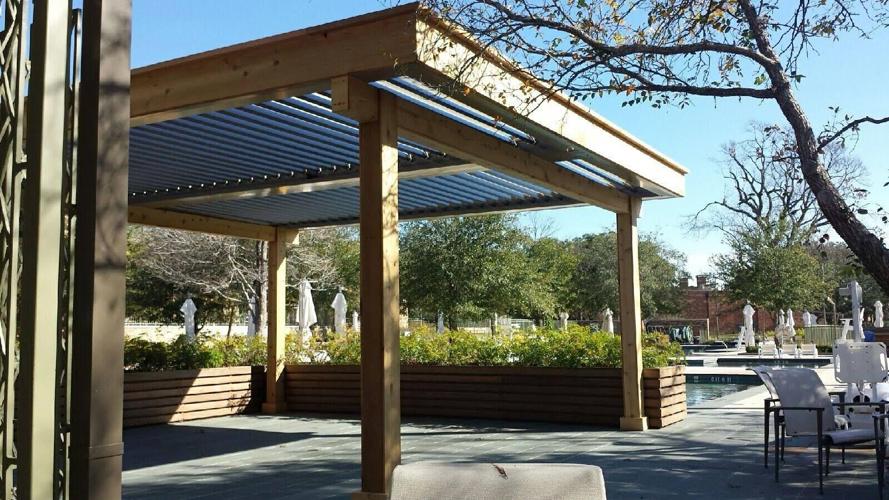
Motorized louvered aluminum patio cover example.
Extruded aluminum frames satisfy the 95-mph Exposure C wind rule and Seismic Design Category E. AlumWorks submits the evaluation report, low-voltage load calculations, and drainage tie-ins on one plan sheet, which speeds approvals on gadget-heavy projects. Crews laser-level posts, run motor wiring in metallic conduit, and flash wall penetrations to keep water out of the attic.
Warranty covers 15 years on structure, five on the actuator motor, two on labor. Ask about battery-backup kits if you want louvers to move during an outage.
How Much Does A Patio Cover Cost In Santa Clarita?
“Average cost” widgets fall apart once you add engineered footings, permit fees, or a single ceiling fan. Our August 2026 snapshot draws on RSMeans SoCal labor data, three anonymized 12 × 20 quotes from local homeowners, and the City’s 2025–2026 permit-fee brochure, where plan check plus building permit runs about 410 dollars on a 10,000-dollar valuation.
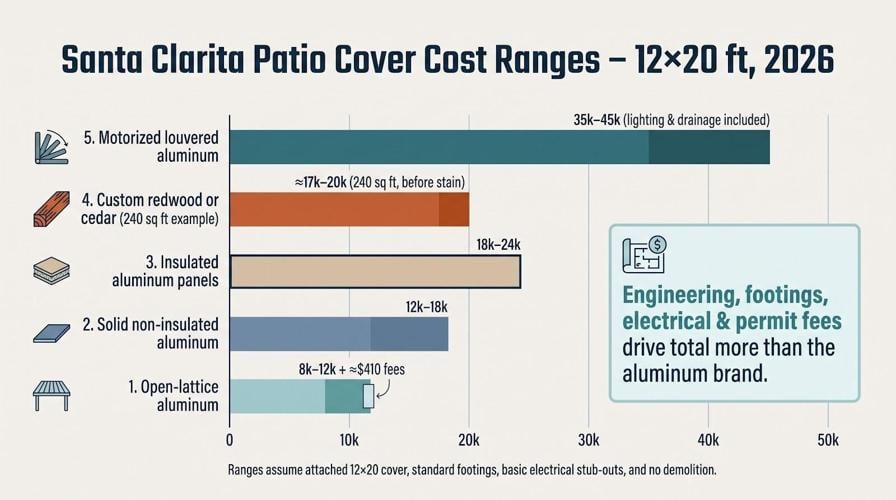
- Open-lattice aluminum: 8,000–12,000 dollars installed, plus 410 dollars in baseline City fees
- Solid non-insulated aluminum: 12,000–18,000 dollars
- Insulated aluminum panels: 18,000–24,000 dollars
- Custom redwood or cedar: 70–85 dollars per sq ft, so a 240-sq-ft cover lands at 17,000–20,000 dollars before stain
- Motorized louvered aluminum: 35,000–45,000 dollars, lighting and drainage included

These ranges assume an attached 12 × 20 cover, standard footings, basic electrical stub-outs, and no demolition. Hillside lots, fire-zone roofing, or special-inspection anchors can add 10–20 percent. Engineering, footings, electrical, and permit fees move the total far more than the aluminum brand you choose.
Santa Clarita Permits, Setbacks And Footings
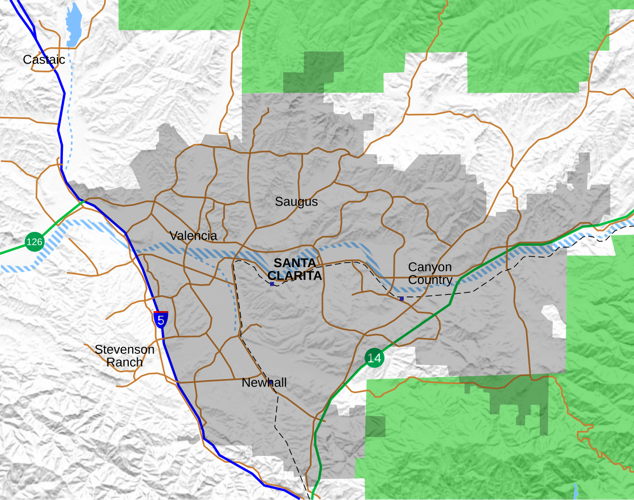
A “Santa Clarita” mailing address doesn’t guarantee City jurisdiction. Stevenson Ranch, Castaic, and parts of Canyon Country fall under unincorporated Los Angeles County.

Santa Clarita versus LA County patio cover permit jurisdiction map.
Check the City’s interactive service map first; if the parcel isn’t listed, open the County’s EPIC-LA portal. Lock this in before drawings, because a cover sized for the City may need a County variance.
Setbacks. Inside City limits, allow 5 ft to the face of the post at side and rear lines and 20 ft at the front. Unincorporated County parcels typically require 5 ft, though hillside or equestrian districts can jump to 10 ft. Detached covers share the same buffers and count toward the rule that you may roof only 50 percent of the required rear yard.
Plan route. A standard wood plan (12 ft or lower, open on two or more sides) and pre-engineered metal with a current evaluation report both clear over the counter the same day. Anything taller, enclosed, or motorized becomes a custom plan: 2–3 weeks in the City, 4–6 weeks in the County.
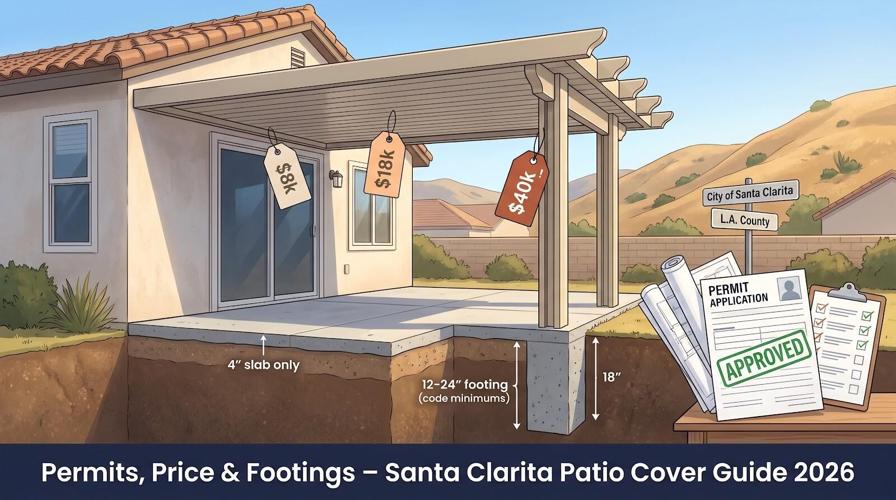
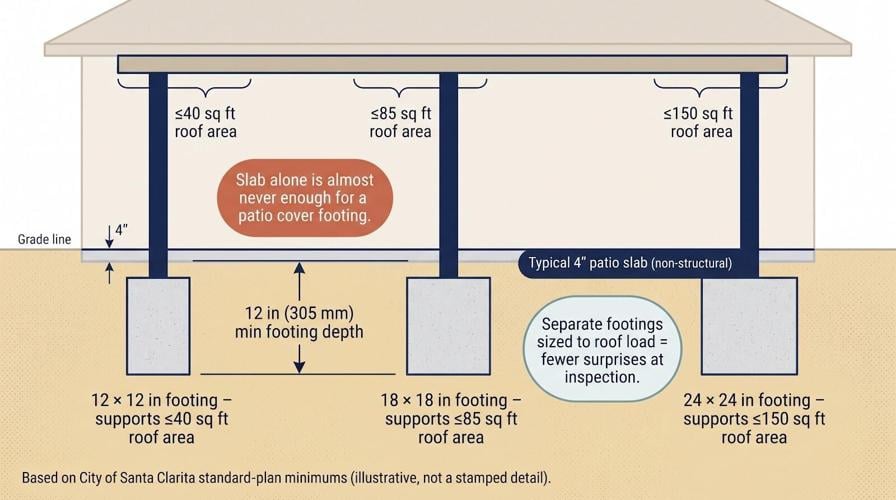
Footings. City standard-plan minimums run 12 inches deep, with pad size scaling to supported roof area per post: 12 × 12 inches up to 40 sq ft, 18 × 18 up to 85 sq ft, and 24 × 24 up to 150 sq ft.

Smart contractors core-drill the slab first. If they hit soil, they price new footings and inspection standby up front.
Inspections. The minimum City sequence is footing excavation, framing or panel attachment, then final. Add a special-inspection torque test for post-installed anchors and a separate electrical inspection for fans, GFCI outlets, or low-voltage lights. The re-trip fee is 89 dollars, so build in a week of inspection float. Scan the signed permit card and confirm the contractor registers your warranty within 30 days.
How To Compare Patio-Cover Bids
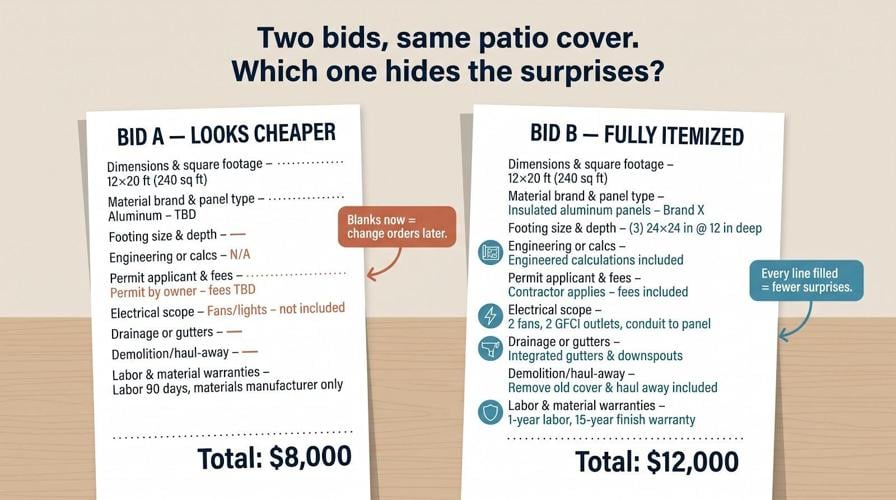
The lowest number on a quote can hide the biggest surprises. We’ve seen an 8,000-dollar bid balloon to 14,000 after footings, electrical, and permit fees appeared, while a 12,000-dollar proposal that listed every line stayed almost exact.

Ask each contractor to price the same 12 × 20 ft example and itemize dimensions and square footage, material brand and panel type, footing size and depth, engineering or calculations, permit applicant and fees, electrical scope, drainage or gutters, demolition and haul-away, and both labor and material warranty terms.
Gather at least three apples-to-apples bids. Ignore the grand totals first and scan for blanks. No number under “engineering” means you’ll pay an engineer later; an empty warranty line often signals a labor guarantee shorter than a California summer. Fill every blank, then add the numbers — nine times out of ten the bid that looks higher up front proves more predictable.
Frequently Asked Questions
Do I need a permit for a patio cover in Santa Clarita?
Yes. Attached or solid-roof covers require a permit in both City and County jurisdictions, and even open lattice counts as a shade structure. A freestanding, open-sided pergola under 120 sq ft may be exempt if it sits inside all setbacks, but confirm with the agency first.
Will my existing slab work as a footing?
Almost never. Standard patio slabs are 4 inches thick and float on soil, while the City calls for footings at least 12 inches deep and up to 24 inches wide depending on roof load. An engineer’s letter is the only safe shortcut.
Which material lasts longest in Valley heat?
Extruded aluminum with a factory powder coat resists rust and needs little upkeep. High-quality rigid PVC with titanium-dioxide pigment stays cooler to the touch, is UV-stable and non-yellowing, and will not peel or rot. Painted wood needs a new finish every three to five years.
Are ceiling fans and lights included in the base bid?
Usually not. Budget 600–1,200 dollars for wiring, fan-rated boxes, and GFCI outlets, depending on the distance to your panel.
Can I enclose the cover later?
Yes, but adding screens or glass turns the structure into an enclosed patio or sunroom, which triggers new permits, deeper footings, and fresh engineering. Plan for that load during the first build if enclosure is on your horizon.
Start with jurisdiction, then setbacks, then footings — in that order. Price the same 12 × 20 example with every bidder, insist on itemized engineering and permit lines, and read the warranty before the deposit rather than after the pour. With those answers in hand you can move from sketches to shaded reality without last-minute surprises.

(0) comments
We welcome your comments
Log In
Post a comment as Guest
Keep it Clean. Please avoid obscene, vulgar, lewd, racist or sexually-oriented language.
PLEASE TURN OFF YOUR CAPS LOCK.
Don't Threaten. Threats of harming another person will not be tolerated.
Be Truthful. Don't knowingly lie about anyone or anything.
Be Nice. No racism, sexism or any sort of -ism that is degrading to another person.
Be Proactive. Use the 'Report' link on each comment to let us know of abusive posts.
Share with Us. We'd love to hear eyewitness accounts, the history behind an article.