
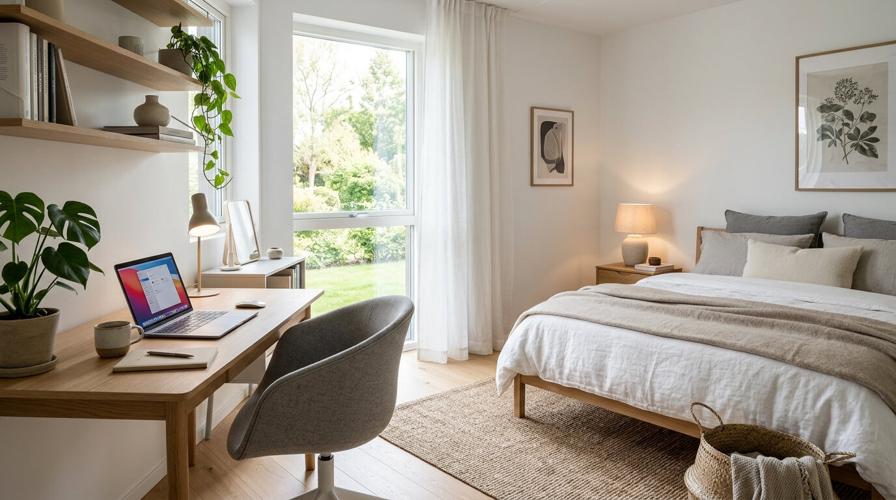
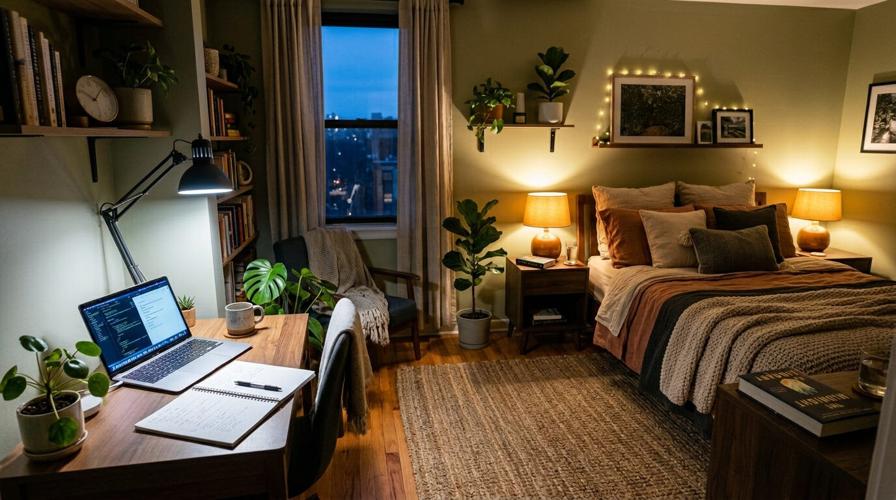

Your bedroom should be your personal sanctuary—a space to switch off, recharge, and truly escape. But for many of us, that same room now needs to pull double duty as a home office too.
Designing a bedroom that supports both productivity and proper rest without one sabotaging the other comes down to thoughtful planning. From choosing the optimal layout to picking hard-working furniture, this step-by-step guide will help you create distinct zones for work and wellness.
Step 1: Assess Your Space and Define Your Needs
Good layouts don't start with buying furniture; they start with a tape measure. Understanding your room's exact dimensions prevents costly spatial mistakes before they happen.
Measure Your Bedroom Dimensions
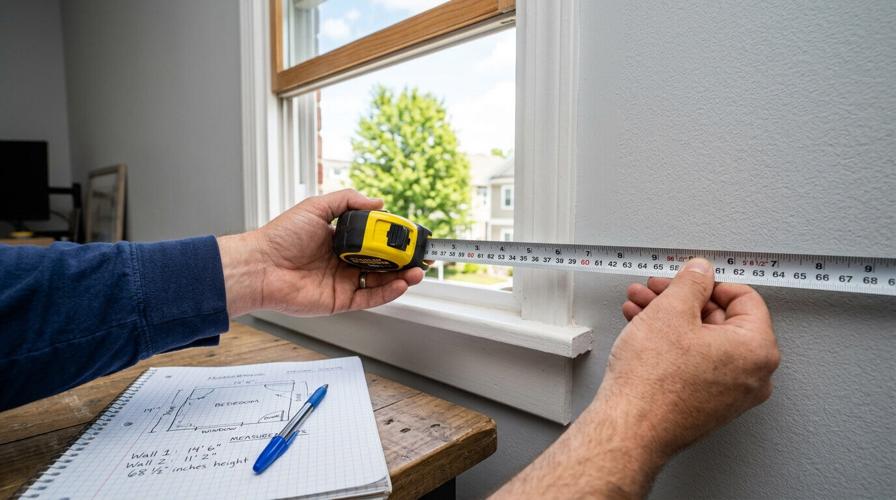
Grab a pencil, paper, and a tape measure. Sketch a rough outline of your room and work your way around clockwise so nothing gets missed. Mark every window, door, and the direction the doors swing.
Be sure to measure:
- Wall Profiles: The exact length and height of each wall.
- Openings: The width and height of every window and door (including frames).
- Clearances: The distance from the edge of the wall to each window and door, as well as the distance between them.
- Fixed Obstacles: Radiators, fireplaces, chimney breasts, and sloping ceilings.
- Power Sources: Note where plug sockets are located—this dictates where your desk and bedside lighting can realistically go.

Pictured: Hands holding a metal tape measure against a light grey bedroom wall.
Takeaway Tip: For small bedrooms, measure to the nearest quarter inch. A tiny miscalculation can mean a wardrobe door that jams against your bed frame or blocks a primary walkway.
Identify Natural Light Sources
Natural light impacts your mood, productivity, and sleep quality. Note which direction your windows face and when sunlight enters the room:
- Morning Light: Great for waking up, but requires quality blinds if you like to sleep in.
- Afternoon Light: Excellent for work but watch out for screen glare.
If your room has limited natural light, position mirrors opposite windows to bounce light deeper into the space.
Inventory Your Requirements
Before moving anything, list your essential pieces from most to least important. For a bedroom office, your non-negotiables might look like this:
- Bed (Rest Anchor)
- Desk & Ergonomic Chair (Work Anchor)
- Wardrobe / Clothing Storage
- Tech Equipment (Monitor, Printer, Cables)
- Bedside Lighting / Reading Setup
Plan for Traffic Flow
Your layout should work for your actual daily habits. Aim for 60 to 80 cm of clearance around your bed, wardrobes, and main walkways. Keeping a physical distance between your bed and your desk makes it much easier to separate work and rest mentally.
Step 2: Choose the Best Layout for Work-Rest Balance
Where you place your furniture determines whether your room feels like a spacious retreat or a cramped compromise.
Position Your Bed for Optimal Rest
Your bed is the anchor of the room. Position it in the "command position"—where you can see the doorway without being directly in line with it. This provides a psychological sense of security, making it easier to unwind. Try to avoid the "coffin position" (feet pointing directly out the door), which can make the space feel less restful.
- Large Rooms: Centre the bed on the main wall opposite the door, leaving 60 to 70 cm of clearance on both sides for symmetrical access. If you're starting from scratch, choosing the right bed frames can help establish this layout balance instantly.
- Small/Awkward Rooms: Tuck the bed into a corner or against a single wall to maximize open floor space. Avoid placing it directly beneath a window, where drafts and noise might disrupt your sleep.
Select the Right Desk Location
Where should the workspace go? Consider these six layout variations based on your room's unique shape:

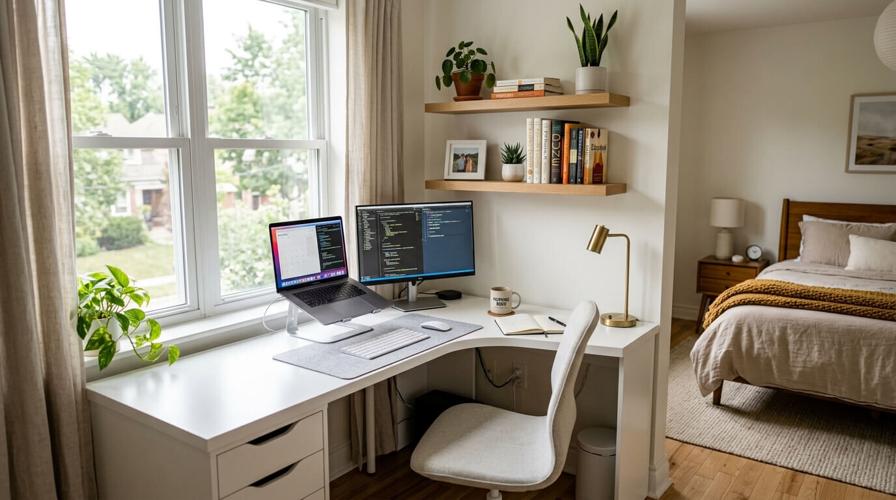
Pictured: A compact home office setup tucked into a bright corner of a bedroom. A sleek, white corner desk holds a laptop and monitors.
Desk Position | Best For | Key Advantage |
|---|---|---|
Against the Wall | Standard rectangular rooms | Maximizes central floor space; creates a clear physical boundary. |
In the Corner | Small or irregular spaces | Capitalizes on underutilized square footage; feels tucked away. |
By the Window | Creatives & daylight lovers | Offers natural light and views, boosting daytime productivity. |
Converted Wardrobe | Ultra-compact bedrooms | Completely hides your workspace behind closed doors at 5 PM. |
Between Wardrobes | Built-in storage walls | Creates a sleek, seamless "nook" aesthetic with storage in arm's reach. |
Opposite the Bed | Long, deep rooms | Easy transition between zones, though requires excellent cable management. |
Step 3: Select Multi-Functional Furniture

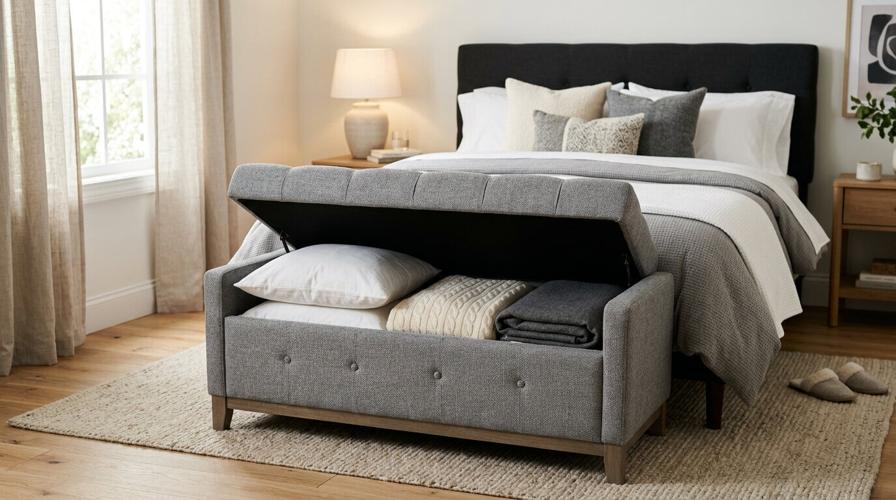
Pictured: Grey fabric storage ottoman sitting at the foot of a neatly made bed.
When one room handles two entirely different tasks, the furniture needs to work twice as hard. Look for pieces that maximize storage and fold away when not in use.
- Beds with Built-In Storage: Look for side-drawer frames with smooth metal slides to hold extra linens and pillows. Investing in storage beds with built-in drawers keeps your extra linens perfectly organised and much easier to retrieve than loose items shoved into a dark space. Alternatively, hydraulic lift ottoman beds allow you to raise the entire mattress effortlessly to reveal a massive, hidden storage cavity underneath—perfect for keeping spare bedding out of sight.
- Desks That Double as Vanities: Use a sleek secretary desk or writing table. Center an adjustable LED makeup mirror on it for your morning routine, then slide it aside or close the lid when it’s time to log onto work.
- Storage Ottomans: Positioned at the foot of the bed, an ottoman offers extra seating, adds a touch of style, and hides extra blankets or office supplies under its padded lid.
- Wall-Mounted & Foldable Systems: Wall beds (Murphy beds) can shift a room from a spacious office to a cozy bedroom in seconds.
Takeaway Tip: Pair a wall-mounted fold-down desk with a wall bed. When the bed comes down, the desk folds up, keeping your sleeping area completely clutter-free.
Step 4: Creating Zones with Lighting and Rugs

Pictured: Desk nook in the corner is illuminated by focused, cool-toned task lighting.
You don’t need to build a physical wall to separate your professional life from your personal life. Visual and sensory cues can divide the room just as effectively.
Use Rugs as Anchors
Rugs visually isolate different functional areas. Place a large, soft rug under your bed to define the relaxation zone—ensure it extends far enough so your feet land on it when you wake up. Place a separate, low-pile rug under your desk and chair. While the rugs define separate zones, keep them cohesive by choosing matching tones or textures.
Let Furniture Do the Heavy Lifting
Open shelving, double-sided bookcases, and fitted cabinets make excellent faux walls. A lightweight, open-backed bookcase between your desk and your bed blocks your view of work files while you're trying to sleep, all while keeping the room feeling airy.
Add Curtains or Folding Screens
Fabric dividers on ceiling tracks or freestanding folding screens offer flexible privacy.
- Sheer curtains keep the space feeling bright and open while establishing boundaries.
- Blackout curtains completely block out the sight of your desk, creating a cozy, distraction-free sleep nook at night.
Shift the Mood with Lighting
Lighting is the ultimate tool for changing a room’s psychology.
- The Work Zone: Use bright, focused task lighting. A desk lamp with a cooler colour temperature (around 4,000 K) keeps you alert and reduces eye strain.
- The Sleep Zone: Opt for warm, soft light (around 2,700 K). Use bedside lamps, dimmers, or warm fairy lights to signal to your brain that it is time to wind down.
Step 5: Keep Storage Smart and Spaces Clutter-Free
Clutter is the enemy of both sleep and focus. When your workspace spills over into your rest space, stress levels naturally rise.
Go Vertical in the Work Zone
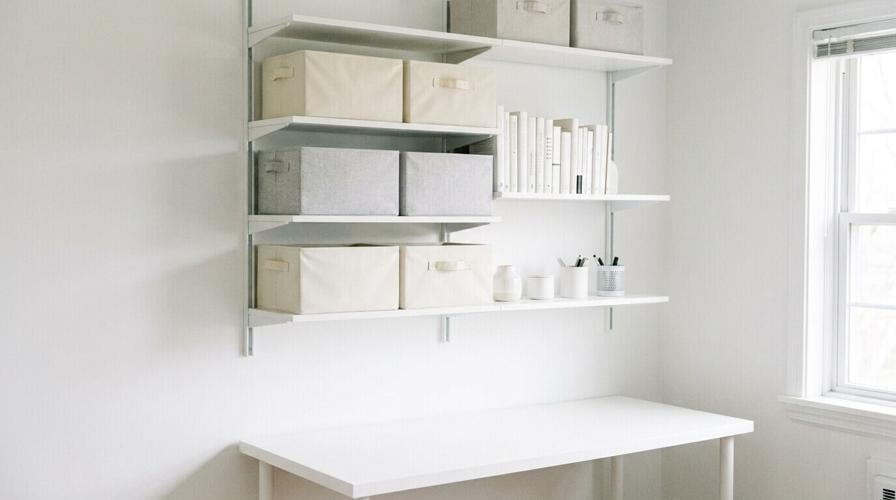
When floor space is limited, look up. Install floating shelves at eye level for everyday office supplies. Use a customizable pegboard system for cables, scissors, and tools to keep your desk surface completely clear.
Maximise the Under-Bed Real Estate
Utilize clear plastic bins or vacuum-sealed storage bags under the bed for out-of-season clothes, extra duvets, and luggage. If your current base doesn't allow for this, exploring a dedicated divan bed base with built-in compartments can instantly reclaim that lost square footage.

Pictured: White vertical shelving unit installed on a bedroom wall above a simple desk.
Takeaway Tip: Label every under-bed bin clearly (e.g., "Winter Coats," "Extra Bedding") so you don't have to pull out every single container just to find one item.
Commit to Regular Decluttering
As a rule of thumb, your bedroom should only house things that directly support rest, dressing, or your immediate daily work. Establish a "shutdown routine" at the end of every workday: file away papers, hide your laptop, tuck away pens, and restore the bedroom to its peaceful, original purpose.
With a clear layout, multi-functional furniture, and distinct sensory boundaries, your bedroom can effortlessly balance peak productivity by day and deep, restorative sleep by night.
(0) comments
We welcome your comments
Log In
Post a comment as Guest
Keep it Clean. Please avoid obscene, vulgar, lewd, racist or sexually-oriented language.
PLEASE TURN OFF YOUR CAPS LOCK.
Don't Threaten. Threats of harming another person will not be tolerated.
Be Truthful. Don't knowingly lie about anyone or anything.
Be Nice. No racism, sexism or any sort of -ism that is degrading to another person.
Be Proactive. Use the 'Report' link on each comment to let us know of abusive posts.
Share with Us. We'd love to hear eyewitness accounts, the history behind an article.