
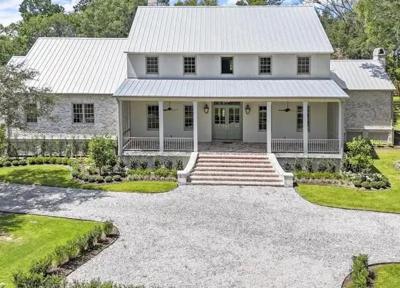
In Baton Rouge, a roof does not get an easy assignment. It spends long summer months under intense Louisiana sun, endures heat and humidity, absorbs heavy rainfall, and still has to be prepared when severe thunderstorms or tropical weather move through the region.
That makes roofing far more than a cosmetic decision.
According to the National Weather Service, Baton Rouge receives nearly 62 inches of precipitation in an average year, while average high temperatures rise above 90 degrees during June, July, and August. For homeowners replacing a roof—or designing a home intended to age gracefully in South Louisiana—those conditions make durability, water management, heat performance, and installation quality especially important.
Metal roofing addresses many of those concerns at once. But its real advantage is not simply that the roof is made of metal. The best installations combine the right material, coating, roof assembly, fastening system, and workmanship for the particular home.
That distinction is what separates an attractive new roof from a genuinely long-term upgrade.
Baton Rouge Weather Changes the Roofing Conversation
Every roofing material has to contend with sun and rain. Baton Rouge simply raises the stakes.
Long stretches of summer heat expose roofing materials to sustained thermal stress, while Louisiana's abundant rainfall repeatedly tests flashing, seams, penetrations, valleys, and drainage systems. Add strong winds from thunderstorms and tropical systems, and the roof becomes one of the home's most important lines of defense.
The LSU AgCenter emphasizes that wind and rain resistance depend on more than the visible roofing material. Roof decking, fasteners, edge details, connections, and installation practices all influence how well the complete system performs.
This is where a properly specified metal roof can be particularly compelling.
Standing-seam systems use large metal panels joined by raised seams rather than relying on rows of individual shingles. Concealed-fastener systems also place the primary fasteners beneath the roofing surface, protecting them from direct exposure to weather.
That does not make every metal roof hurricane-proof, nor does metal automatically outperform every other roofing material. Tested roof assemblies have specific ratings and installation requirements. What metal provides is the opportunity to create a highly durable roofing system when the entire assembly is chosen and installed correctly.
A Cooler Roof Can Matter in a Louisiana Summer
Metal roofs are often promoted as energy efficient, but the reality is more nuanced.
The metal itself is only part of the equation. Color, coating, solar reflectance, thermal emittance, insulation, ventilation, roof configuration, and the rest of the building envelope all influence how a roof affects indoor temperatures.
The U.S. Department of Energy explains that cool roofs are designed to reflect more sunlight and absorb less solar energy than conventional roofs, with the greatest cooling benefits typically found in hot climates.
That makes the concept particularly relevant in Baton Rouge.
A metal roof with an appropriate reflective finish can reduce the amount of solar energy absorbed by the roof surface. The exact impact on a homeowner's utility bill varies considerably, however, which is why sweeping promises about percentage savings should be viewed cautiously.
A poorly insulated house does not suddenly become highly efficient because metal panels were installed above it.
For homeowners already replacing a roof, however, the project creates an opportunity to look at the entire roof system. Insulation, ventilation, air sealing, roof color, and reflective performance can be considered together rather than treated as unrelated improvements.
That approach is usually more valuable than choosing a roofing material based on an energy-efficiency claim alone.
Longevity Can Change the Cost Equation
Metal roofing generally costs more upfront than conventional asphalt shingles. That is one of its principal disadvantages and should be part of any realistic comparison.
The better question is what the higher initial investment may buy over time.
Research cited by the Metal Construction Association found that certain aluminum-zinc-coated steel standing-seam roofing systems installed according to best practices can achieve service lives exceeding 60 years.
That does not mean every residential metal roof will last six decades. Material choice, coatings, workmanship, maintenance, sealants, roof design, exposure, and installation all matter.
Still, longevity changes the financial conversation.
A homeowner planning to remain in a property for many years may be less concerned with finding the lowest installation price and more interested in reducing the likelihood of repeated major roof replacements.
The same thinking is routinely applied elsewhere in a luxury home. Natural stone, premium windows, quality cabinetry, and durable exterior finishes are rarely selected because they are the least expensive choice on installation day. They are selected because appearance, performance, and longevity can make the higher initial investment worthwhile.
Roofing deserves the same consideration.
Metal Roofing Has Become an Architectural Choice
The image of a metal roof as little more than shiny corrugated panels belongs largely to another era.
Today's residential metal roofs can look exceptionally refined.
Standing-seam panels work particularly well with contemporary, transitional, modern farmhouse, and Southern architecture. Other metal profiles can create more traditional appearances while retaining many of the practical characteristics homeowners want from the material.
On the right house, the crisp vertical lines of a standing-seam roof can strengthen the architecture rather than merely cover it. Darker metal can provide dramatic definition against white stucco or painted brick, while softer finishes can complement natural wood, stone, and traditional Southern exteriors.
That matters because the roof represents a significant portion of a home's visible exterior.
As FINE has previously explored in our guide to choosing the right roof to complement your home design, roofing should work with a home's proportions, materials, and architectural character rather than being treated simply as a protective cap.
For higher-end homes, durability and design do not have to compete.
Standing Seam and Exposed Fasteners Are Not the Same
One of the most important things homeowners can learn before requesting estimates is that “metal roofing” does not describe a single system.
Standing-seam roofing typically conceals its fasteners beneath raised seams. Along with creating a cleaner architectural appearance, the design protects those attachment points from direct weather exposure.
Exposed-fastener systems, sometimes called screw-down panels, attach through the face of the metal. They can be an economical and appropriate solution for certain buildings, but the screws and sealing washers remain exposed to sunlight, rain, and temperature changes.
That distinction matters because metal expands and contracts as temperatures fluctuate.
For a primary residence—particularly a substantial or architecturally important home—it is worth asking exactly which roofing system is being proposed rather than comparing bids based solely on the phrase “metal roof.”
Two metal roofs can differ significantly in construction, appearance, maintenance requirements, and price.
What Is Beneath the Metal Matters Just as Much
The visible panels may get the attention, but some of the most important parts of a roof are the ones homeowners never see.
Baton Rouge reroofing requirements address elements including underlayment, decking, fastening, roof slope, and roofing materials. Local documentation also calls for information such as decking thickness, fastener type and spacing, underlayment, manufacturer, and the roofing material being installed.
The city's reroofing requirements reinforce an important point: a roof should be evaluated as a system.
Deck condition matters.
Underlayment matters.
Flashing matters.
Valleys and penetrations matter.
Fastener placement matters.
Ventilation and moisture management matter.
FINE has previously examined why a well-executed roof job depends on the complete roofing system, not simply the visible surface material.
That principle becomes even more important when homeowners are investing in a roofing material intended to perform for decades.
What Baton Rouge Homeowners Should Ask Before Signing
The most useful question is not simply, “How much does a metal roof cost?”
Homeowners should know exactly what that price includes.
Ask which metal and panel profile are being proposed. Find out whether the system uses concealed or exposed fasteners and which coating or finish will be applied.
Ask which tested wind-uplift requirements apply to the complete roof assembly.
Find out how the existing roof will be removed or prepared, whether any damaged decking will be replaced, which underlayment will be installed, and how chimneys, vents, skylights, valleys, and other penetrations will be flashed.
Warranty language also deserves close attention.
A manufacturer's material warranty, a finish warranty, and a contractor's workmanship warranty can cover very different things. Homeowners should know who is responsible if a problem develops and how long each part of the installation is protected.
If reducing solar heat gain is part of the reason for selecting metal, ask whether the proposed color and finish have published solar-reflectance information.
Those questions reveal considerably more about the quality of a proposal than simply placing three contractor prices side by side.
When Metal Roofing Makes the Most Sense
Metal roofing will not be the right answer for every Baton Rouge home.
A homeowner expecting to sell relatively soon may have difficulty justifying a substantial premium based primarily on longevity. Certain architectural styles may also be better suited to slate, tile, architectural shingles, or another roofing material.
And perhaps most importantly, an expensive metal roof installed poorly can be a worse investment than a less costly material installed exceptionally well.
But for homeowners who intend to stay, value architectural appearance, want to minimize future roof replacements, and are designing around Louisiana's heat, rain, humidity, and severe-weather exposure, metal deserves serious consideration.
Its appeal does not come from one spectacular feature.
It comes from the combination.
A thoughtfully designed metal roof can contribute to the architecture, reduce solar heat absorption when an appropriate finish is chosen, avoid some of the vulnerabilities associated with individual shingles, and potentially remain in service for decades.
In Baton Rouge, where a roof is routinely asked to handle far more than an occasional rainstorm and a few hot afternoons, that combination can make metal roofing more than an exterior upgrade.
It can become a carefully considered long-term investment in the home itself.
(0) comments
We welcome your comments
Log In
Post a comment as Guest
Keep it Clean. Please avoid obscene, vulgar, lewd, racist or sexually-oriented language.
PLEASE TURN OFF YOUR CAPS LOCK.
Don't Threaten. Threats of harming another person will not be tolerated.
Be Truthful. Don't knowingly lie about anyone or anything.
Be Nice. No racism, sexism or any sort of -ism that is degrading to another person.
Be Proactive. Use the 'Report' link on each comment to let us know of abusive posts.
Share with Us. We'd love to hear eyewitness accounts, the history behind an article.