

Finding the best hormone replacement therapy in Estero isn’t as simple as scanning star ratings. In a village where 52 percent of 38,000 neighbors are 65-plus and median income tops $104,000, many women still ride out hot flashes: nationwide, only about 4.7 percent of postmenopausal women were using prescription hormone therapy in 2017 to 2020, according to a JAMA Health Forum study. In this quick guide, we stack six local options (hospital gynecology, menopause-certified primary care, and spa-style pellet clinics) side by side so you can weigh setting, safety, and budget. All information is educational, not personal medical advice.
Gynecologist or Med Spa? The Quick Decision Guide

Your clinic choice shapes every dose change, follow-up, and invoice that follows.
- Start with medical risk. Post-menopausal bleeding, breast-cancer history, clots, stroke, heart attack, liver disease, or complex endocrine issues call for a gynecologist, menopause specialist, or hospital clinic that can order imaging, bill insurance, and coordinate other specialists on the spot.
- Consider insurance and diagnostics. If you need mammography, DEXA, or same-day lab draws billed under your plan, mainstream OB/GYN or health-system practices streamline that paperwork.
- Weigh appointment style. Want 60-minute visits, text follow-ups, or a spa atmosphere? Physician-supervised wellness clinics and med spas offer that flexibility, but visits are self-pay.
- Decide on delivery route. Pellets are compounded implants that typically last about 3 to 4 months for women (and 4 to 6 months for men). They are convenient yet difficult to reverse. If you choose this route, confirm who prescribes, which 503A or 503B pharmacy compounds the dose, and how side effects will be handled.
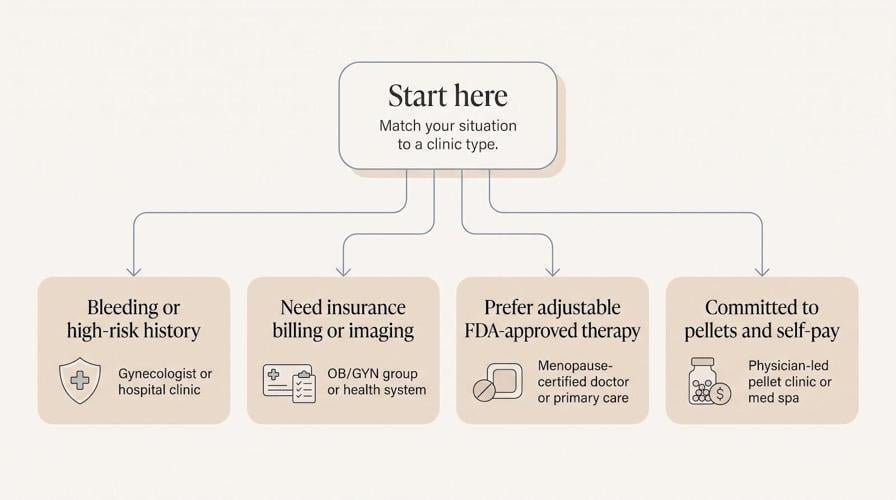
Quick Decision Tree

- Bleeding or high-risk history → Gynecologist or hospital clinic
- Need insurance billing or imaging → OB/GYN group or health system
- Prefer adjustable FDA-approved patches, gels, or pills → Menopause-certified doctor or evidence-based primary care
- Committed to pellets and self-pay → Compare physician-led pellet clinics with med spas
Match your situation to the path above, and you will book the right first appointment.
How We Compared Estero-Area HRT Providers
We screened every practice that publicly promotes menopausal hormone therapy within an easy drive of Estero, then kept only clinics that met all three baseline tests:
- An active Florida medical or prescribing license
- A physical Estero-area address for in-person visits
- Sufficient public information to judge safety, follow-up, and pricing
This filter left six finalists, each representing a different care model (hospital gynecology, large OB/GYN group, menopause-certified primary care, physician-led pellet clinic, boutique multimodal practice, and spa-based pellet program).
Next, we scored those clinics on nine evidence-focused factors, giving more weight to items that affect medical safety:
- Credentials and menopause-specific training (20 points)
- Clarity on FDA-approved versus compounded therapy (20)
- Assessment and monitoring protocol (15)
- Route options (10)
- Price transparency (10)
- Insurance or financing pathways (10)
- Convenience features (10)
- Consumer reviews (5)
- Public-data completeness (5)
Unknown or unclear details received zero credit.
Findings are current as of November 18, 2026. Verify prices and formulary status before booking. Health-care details can change quickly. A comparison table now condenses these scores into a one-glance snapshot.
6 Hormone Therapy Options Near Estero Compared
Below, we profile six clinics, each a different care model, so you can zero in on the one that matches your risk, route preference, and budget. All prices reflect the most recent figures the practices published or quoted to us as of November 18, 2026.
1. Contemporary Health Center: Best for Physician-Led Pellet Care and Transparent Pricing
Led by Richard L. Bloy, MD, the practice has served men and women across Southwest Florida for more than 40 years from offices in Fort Myers and Naples.
The practice focuses on bioidentical pellet implantation. After baseline labs, the clinic's site notes that a pellet slightly larger than a grain of rice releases hormone for about 3 to 4 months in women, and the female insertion fee is $425. Labs bill separately, so ask for a bundled first-year estimate that includes follow-up bloodwork.
Insurance rarely covers the pellets themselves, though the practice notes that many lab tests and office visits may be covered depending on your plan, and many patients like the set-and-forget convenience.
Before the first insertion, the team draws a blood sample to set your baseline hormone levels and your dose, and follow-up bloodwork shows how you respond. Nail down the first follow-up date to keep dosing on track.
Official site: contemporaryhealthcenter.com
2. Shine Direct Primary Care: Best for Menopause-Certified, Adjustable Therapy
Frances Romero, MD, board-certified in family medicine and a Menopause Society Certified Practitioner, combines primary care and menopause expertise under one roof.
Upload prior records and labs before a 90-minute consult, so in-person time zeroes in on symptoms and goals. ShineWell describes its program as personalized, evidence-based hormone care, so ask which FDA-approved estradiol and progesterone options fit your history.
Pricing (quoted November 18, 2026) is straightforward: $525 for a single consult; $799 for three-visit and $1,450 for five-visit packages over six months. Labs bill separately but can run through insurance. You do not need to be a Shine primary-care member to book, and you can move into its separate direct-primary-care membership afterward.
Visits are self-pay, but you receive a superbill to seek reimbursement. Telehealth check-ins and secure messaging make dose tweaks easy, which is useful for seasonal residents who split time between Estero and cooler climates.
Official site: shinedpc.com
3. Lee Health Coconut Point: Best for Insurance and Health-System Coordination
For readers who want a hospital badge on every lab and prescription, Lee Health’s Coconut Point campus delivers. The Estero complex houses OB/GYN clinics, labs, imaging, a breast-health center, and an on-site pharmacy, so results flow into the same electronic chart your primary-care or cardiology team already sees.
Lee Health Coconut Point Estero Women’s Health and Menopause Care Website Screenshot.
Menopause care follows mainstream guidelines: systemic estrogen for vasomotor symptoms, a progestogen when a uterus is present, and annual reassessment. Multiple gynecologists rotate here, so request one who manages menopause daily.
Insurance is the headline. Lee Health bills most major plans, runs labs in-house, and fills FDA-approved patches or pills downstairs. One exception: beginning January 1, 2027, Lee Health hospitals and physicians will be out of network for affected UnitedHealthcare employer-based, individual, and Medicare Advantage plans, so UnitedHealthcare members should check coverage before booking. Copays, deductibles, and prior authorizations still apply; bring your formulary login to speed approvals.
No published cash bundle or pellet option keeps choices simple for patients who prefer regulated products. Before leaving, confirm follow-up timing and which clinician reviews your labs; large systems work best when every hand-off is explicit. (Details confirmed November 18, 2026.)
Official site: leehealth.org
4. A Woman’s Place: Best for Full-Service Gynecology and In-Office Diagnostics
This long-standing Naples OB/GYN group lets you book an annual exam, mammogram, DEXA, and hormone consult in one location with board-certified physicians and advanced-practice clinicians.
Menopause care spans FDA-approved estradiol and micronized progesterone to Biote pellet insertion, plus bone-density scans, breast ultrasound, and vaginal-laser therapy, which is useful when you want every screening and treatment in the same electronic record.
Commercial insurance coverage is broad, and CareCredit eases gaps, but Medicare or Medicare Advantage patients should verify network status. Prices for hormone visits and pellets are not public; request a written quote that bundles consultation, labs, medication, insertion, and follow-ups. (Information confirmed November 18, 2026.)
Patient reviews are plentiful across platforms; scores vary by office, so treat them as bedside-manner clues, not safety data. At check-in, ask which clinician focuses on menopause, whether the proposed hormone is FDA-approved or compounded, and, if you still have a uterus, how progestogen protection will be handled.
Official site: awpnaples.com
5. Dr. Mel Irvine: Best for Hormone Care With a Sexual-Health Focus
Melissa Irvine, DNP, a certified clinical sexologist who trained in sexual medicine, blends hormone management with sexual-health care in Estero, so libido, pelvic pain, and dryness get equal attention alongside hot flashes.
Her practice lists hormone replacement therapy for women and men beside sexual-wellness treatments. Ask which delivery routes she offers after reviewing your labs, anatomy, and risk factors, and how often follow-up labs and visits are scheduled.
Pricing is not public, so ask whether visits are cash-pay and whether a superbill is available. Secure a first-year quote that bundles consultation, baseline and repeat labs, medication, and, if you choose pellets, insertion fees.
If a compounded product is proposed, remember it is not FDA-approved, and ask whether the pharmacy is 503A or 503B. Ask for the pharmacy’s name, dose verification method, reversal plan, and, if you have a uterus, how the practice will protect your endometrial lining.
6. The Laser Lounge Spa Estero: Best for Spa Ambiance and Pellet Convenience
Licensed physician assistant Jonathan Sigg, PA-C, who founded the spa with his wife April, offers hormone care in a resort-style med-spa setting.
The Laser Lounge Spa Estero Hormone Pellet Therapy Med Spa Website Screenshot.
The menu is straightforward: compounded pellets only. After medical history, baseline labs, and consultation, a small pellet is placed beneath the skin in a 20 to 30 minute treatment and releases hormone for typically 3 to 5 months, depending on dosage and metabolism. Follow-up labs check levels before the next dose.
Pricing (inquiry-only, confirmed November 18, 2026) is self-pay; Cherry financing can spread costs, and most insurers will not cover compounded pellets. Request a written first-year quote that bundles consultation, labs, insertion, and repeat testing.
Because pellets are difficult to remove, ask who prescribes them, the 503A or 503B status of the compounding pharmacy, how excess dosing will be handled, and, if you still have a uterus, what progestogen protection plan is in place. Also confirm the after-hours contact for holiday or weekend side effects.
Official site: thelaserloungespa.com
What Safe, Evidence-Based Hormone Care Should Include
FDA-Approved Does Not Mean “Synthetic,” and Bioidentical Is Not Always Compounded
Bioidentical simply means the molecule matches ovarian hormones. Common FDA-approved examples include the estradiol patch Climara and micronized progesterone Prometrium, and both are bioidentical. Custom pellets or creams can be bioidentical too, but because they are compounded, each batch skips individual FDA review, so potency and absorption can vary. That is why a careful clinic names its compounding pharmacy and explains how each dose is checked.
If a clinic suggests compounded therapy, ask:
- Which pharmacy will mix it (503A or 503B)?
- How is potency verified?
- What is the fallback plan if the dose is off?
Clear answers separate evidence-based care from marketing gloss.
The 2025 to 2026 FDA Label Change Is Not a Blank Check
On February 12, 2026 the FDA approved label revisions for six menopausal-hormone products, removing outdated class-wide statements about cardiovascular disease, breast cancer, and probable dementia from their boxed warnings. Earlier, in November 2025, the agency had instructed manufacturers to propose the changes.
Clarification is not carte blanche. The boxed warning about endometrial cancer when systemic estrogen is given without a progestogen to women with a uterus is still in force, and cautions about blood clots and stroke remain for higher-risk patients. Clinicians must still tailor route, dose, and timing to age, years since menopause, and personal risk factors.
Your takeaway: ask which risks apply to you and how the proposed route (patch, pill, gel, or pellet) modifies that picture.
Route and Anatomy Matter
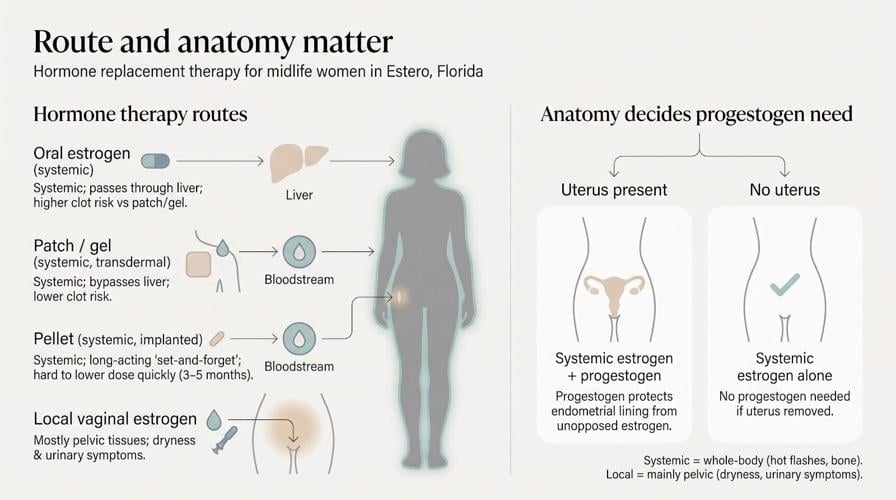
Systemic estrogen, delivered by patch, pill, or pellet, moves through the bloodstream to tame hot flashes, night sweats, and bone loss. Local vaginal estrogen stays mostly in pelvic tissue to ease dryness and urinary symptoms. Mixing them up misfires: the wrong hormone level reaches the wrong place, so confirm which symptom each prescription targets.
Delivery form alters risk as well. Oral estrogen passes through the liver first and, in a pooled analysis of observational studies, carried nearly double the venous-clot risk of non-users (risk ratio about 1.9), while patches and gels skip that detour and showed no added VTE risk (risk ratio about 1.0). Pellets provide set-and-forget convenience but lock in the dose for 3 to 5 months, so rapid dose cuts are tough.

Anatomy flips the rules again. If you still have a uterus, a progestogen must shield the endometrial lining from unopposed estrogen. No uterus, no progestogen required. That single surgical detail turns a two-drug plan into one.
These forks (systemic versus local, oral versus transdermal, uterus versus no uterus) show why “one hormone fits all” is marketing, not medicine. Reputable clinicians map each choice to your history and document the rationale.
Labs Have Different Purposes
Bloodwork can look reassuring, but single numbers rarely prove menopause after age 45 because cycles fluctuate and hormone levels swing daily. For most women over 45, perimenopause is diagnosed clinically, from age, cycle pattern, and symptoms, rather than from one estradiol or FSH draw.
So why test at all? Baseline labs rule out thyroid disease, anemia, or iron overload that can mimic night sweats and fatigue, and they set safety markers before systemic estrogen or testosterone. When clinics use compounded pellets or off-label testosterone, they usually repeat labs every 3 to 6 months to catch hormone peaks or red-blood-cell spikes that raise clot risk.
Reputable practices label each tube, explain what it measures, why it matters, and how the result could change your plan. If a provider cannot connect those dots in plain English, keep shopping.
HRT Costs, Insurance, and HSA/FSA Tips in Estero
Hormone care usually hides five separate charges under one umbrella: consultation, baseline testing, medication, a pellet-insertion fee (if used), and follow-up labs or visits. Ask every clinic for a written first-year estimate that lists those five lines.
Insurance can ease the total if you stay inside an OB/GYN network and choose FDA-approved patches or pills. Compounded pellets and most self-pay wellness visits rarely qualify. Check your employer policy line by line.
Paying cash? You can still use an HSA or FSA card. Since January 1, 2026, people enrolled in certain direct-primary-care arrangements can contribute to an HSA and pay the periodic membership fees from it tax-free, under IRS guidance on the One, Big, Beautiful Bill; ask your plan administrator to confirm your arrangement qualifies. Tax preparers will not accept “my clinic said so.”
Before handing over a card, run this quick checklist with the front desk:
- Is prior authorization required?
- Will labs bill in-house or to an outside lab?
- Does the practice provide a detailed superbill?
Clear answers will show whether your wallet or your insurance takes the bigger hit.
8 Questions to Ask Before You Book
A quick two-minute chat at the front desk (ideally noted in writing) can spare weeks of back-and-forth later. Walk in or call with these questions ready:
- Who will prescribe and monitor my therapy, and what menopause-specific training or credentials do they hold?
- Is the drug FDA-approved, custom-compounded, or used off-label, and why?
- Why is this route (patch, pill, gel, injection, pellet) the best fit for my history and risk factors?
- If I still have a uterus, how will you protect my endometrial lining?
- Which baseline tests are essential, and which are optional add-ons?
- When is the first follow-up visit, and what labs or symptom checks happen then?
- What is the total first-year cost, itemized for consultation, labs, medication, and any procedure fees?
- If side effects hit at 10 p.m. on a holiday, who answers the phone and how soon can the dose be adjusted?
The Best Choice Fits Your Risk, Route, and Budget
The ideal clinic is personal. A hospital clinic suits complex medical histories, a menopause-certified DPC offers adjustable patches, and a med spa can work if you are set on pellet therapy and self-pay convenience. Compare at least two consultations, bring a brief symptom timeline and your insurance formulary, and request written first-year cost estimates. Then weigh safety, flexibility, and follow-up access against price. When those pieces line up, relief can last long after the first hot-flash pause.
Frequently Asked Questions
Is it better to get HRT from a gynecologist or a med spa?
Gynecologists and menopause-certified physicians can order imaging, bill insurance, and prescribe adjustable FDA-approved patches, gels, or pills. Med spas emphasize convenience and ambiance, often relying on compounded pellets and self-pay pricing. Match the setting to your medical complexity, need for insurance billing, and comfort with compounded therapy. Then confirm the prescriber’s menopause training and the pharmacy’s 503A or 503B status.
Are bioidentical hormone pellets FDA-approved?
No. Pellets are custom-compounded for each order and do not undergo individual FDA review. Bioidentical describes molecular structure, not regulatory status. Always ask the pharmacy’s name, how potency is tested, and what the dose-adjustment plan is if side effects appear.
How much does HRT cost near Estero, and does insurance cover it?
First-year cash costs vary widely by clinic and route, so ask each practice for an itemized estimate that includes labs, insertion fees, and follow-ups. FDA-approved drugs and standard office visits may bill through insurance, while compounded pellets and wellness-clinic consultations are usually self-pay.
Do I need hormone blood tests before starting HRT?
Not always. For women over 45 with classic vasomotor symptoms, diagnosis is usually clinical. Baseline labs still rule out thyroid disease, anemia, or other mimics and create safety markers before systemic estrogen or testosterone. Good clinics explain which tests will change your treatment plan and which will not.
Hormone therapy is never one size fits all, and southwest Florida offers several ways to match care setting with medical need:
- Contemporary Health Center: physician-led pellet care with transparent pricing
- Shine Direct Primary Care: menopause-certified oversight and adjustable FDA-approved options
- Lee Health Coconut Point: hospital system coordination for diagnostics and insurance billing
- A Woman’s Place: full-service OB/GYN diagnostics under one roof
- Dr. Mel Irvine: hormone care with sexual-health expertise
- The Laser Lounge Spa: spa ambiance and pellet convenience for self-pay clients
Use the quick-decision guide to shortlist one or two clinics. Arrive with your symptom timeline, insurance formulary, and the eight questions above, and request a written first-year cost estimate. Relief is within reach when the setting fits your risk, route preference, and budget.

(0) comments
We welcome your comments
Log In
Post a comment as Guest
Keep it Clean. Please avoid obscene, vulgar, lewd, racist or sexually-oriented language.
PLEASE TURN OFF YOUR CAPS LOCK.
Don't Threaten. Threats of harming another person will not be tolerated.
Be Truthful. Don't knowingly lie about anyone or anything.
Be Nice. No racism, sexism or any sort of -ism that is degrading to another person.
Be Proactive. Use the 'Report' link on each comment to let us know of abusive posts.
Share with Us. We'd love to hear eyewitness accounts, the history behind an article.