
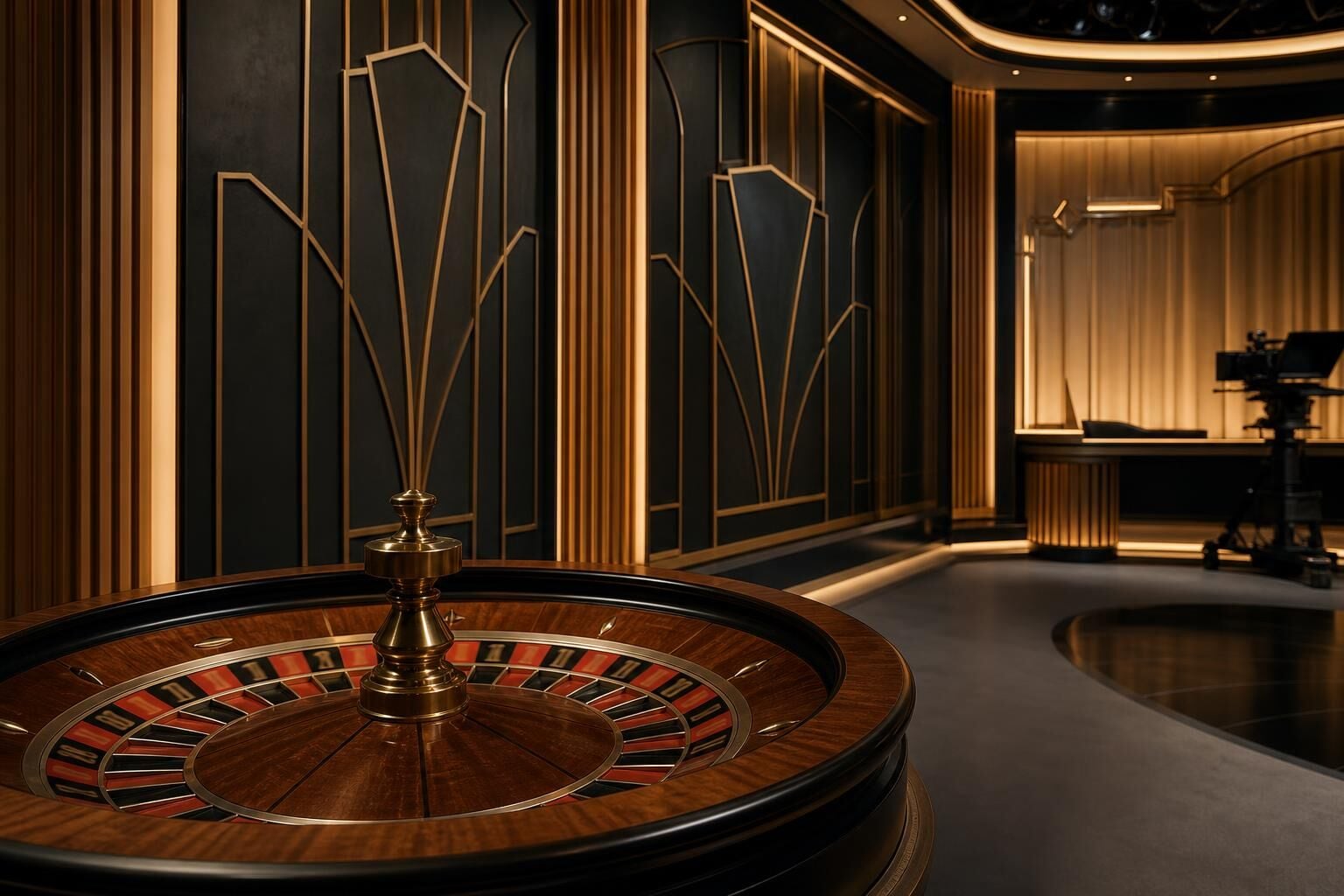
Black and gold give the roulette broadcast its first impression. Then the action takes over: a presenter pulls a lever, numbers light up, and a ball travels around a physical wheel. The surroundings hold these events together, borrowing an Art Deco style familiar from theaters, restaurants and decorative interiors.
That combination gives design-minded viewers something to consider beyond the equipment. A live broadcast has many of the demands of an entertainment space, compressed into a camera frame. Its scenery must accommodate people, movement and information while maintaining a consistent appearance.
The Ontario Connection
For a design-focused look at live roulette ontario, one format offers a clear example: an automated wheel and live presenter set against a black-and-gold Art Deco background, with digital graphics built into the presentation.
The format was included in a supplier’s Ontario launch portfolio when the province’s regulated private-operator market opened on April 4, 2022. A provincial online product listing also establishes its availability.
This places the broadcast within Ontario’s online entertainment landscape. Its appearance draws on a much older history, however, when designers brought coordinated decoration to public rooms intended for performance, dining and social occasions.
A Style With Roots in Entertainment
Art Deco spread across architecture, furniture, textiles, jewelry and interiors between the world wars. Its name comes from the international decorative arts exhibition held in Paris in 1925, where displays ranged from buildings and interiors to perfume.
The Metropolitan Museum of Art describes a style rich in ornament, with abstract geometric decoration appearing alongside stylized people, plants and animals. Designers worked across many materials and crafts, making the relationship between individual objects and their surroundings part of the story.
Entertainment interiors show how those ideas could fill a room. Donald Deskey oversaw the Art Deco decoration of Radio City Music Hall in 1932, with work extending to the auditorium carpet and furniture.
Toronto offers a local connection through the former Eaton’s College Street Store. Jacques Carlu designed its seventh-floor auditorium, Round Room restaurant and adjoining foyer. Together, those spaces show how Art Deco could accompany an evening’s entertainment across several connected rooms.
How the Set Accommodates the Action
The roulette setting applies its decoration to a sequence that repeats on screen. An automated wheel spins the ball. After betting closes, the presenter pulls a lever to begin the software selection of between one and five numbers, each assigned a multiplier.
The selected numbers appear through the interface, accompanied by lightning effects. An integrated digital backdrop carries part of that display, so the scenery has an information-bearing role as well as a decorative one.
Physical equipment and software perform separate jobs within the scene. The ball settles into a numbered pocket on the wheel, while a random number generator selects the multiplier numbers. The broadcast brings both processes into view through the presenter, wheel and changing graphics.
Lighting and sound accompany the sequence. Attention shifts between the lever, the illuminated selections and the moving ball, while the black-and-gold palette remains consistent. The set gives these different actions a shared visual setting without requiring each element to look alike.
The Rules Behind the Presentation
A broadcast involving physical equipment and live staff also depends on controls outside the camera frame. Ontario’s requirements cover technical certification, access to live-dealer gaming supplies and measures protecting game integrity in relation to presenters.
Official market-entry guidance states that games and supporting critical gaming systems require certification by an independent testing laboratory registered with the provincial regulator before becoming available in Ontario. Private operators also need regulatory registration and an operating agreement with the agency that conducts and manages that market.
Other requirements address the information available to participants, including rules, wagers, odds and payouts. Access to live-dealer supplies must be restricted according to business need, with privileges logged and periodically reviewed. Monitoring continues throughout the operation of gaming systems and equipment.
Participants must be at least 19 and physically in Ontario. Gambling carries financial and personal risks. Anyone participating should set time and spending limits, take breaks and seek support if gambling affects their finances, relationships or well-being.
From the Auditorium to the Camera Frame
Earlier entertainment interiors gave designers an entire building, or a series of rooms, through which to develop a decorative scheme. The broadcast concentrates that work into a single view, where scenery shares space with a presenter, moving equipment and changing information.
The difference in scale gives Art Deco another application. Its role here is to establish an appearance that persists as the action changes. Black, gold, lighting and digital effects surround the wheel throughout each round, carrying a style associated with public interiors into a setting viewed on a screen.

(0) comments
We welcome your comments
Log In
Post a comment as Guest
Keep it Clean. Please avoid obscene, vulgar, lewd, racist or sexually-oriented language.
PLEASE TURN OFF YOUR CAPS LOCK.
Don't Threaten. Threats of harming another person will not be tolerated.
Be Truthful. Don't knowingly lie about anyone or anything.
Be Nice. No racism, sexism or any sort of -ism that is degrading to another person.
Be Proactive. Use the 'Report' link on each comment to let us know of abusive posts.
Share with Us. We'd love to hear eyewitness accounts, the history behind an article.