
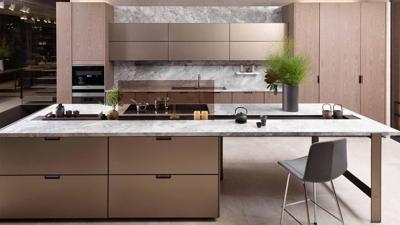

The appliance problem hiding inside expensive kitchens
Spend enough time looking at high-end kitchen projects and a pattern emerges: the more money invested in surfaces and finishes, the more jarring the disconnect when a refrigerator, oven, or dishwasher that wasn't properly integrated ends up dominating the space visually. A flawlessly lacquered cabinet run interrupted by a stainless steel appliance that doesn't quite fit the proportions of the joinery — it's one of the most common ways that otherwise excellent designer kitchens fall short of their potential. The investment is real. The failure is avoidable.
The solution isn't to hide appliances at any cost. It's to plan for them from the very beginning, treating them as architectural elements rather than equipment inserted into whatever space remains after the cabinetry is specified. Ornare's approach to fully integrated luxury kitchen design is built on exactly this premise: the appliance brief and the design brief are the same conversation, held at the same time, with the same people in the room. The kitchen is designed around the appliances, not in spite of them.
Why the kitchen is the renovation Americans value most
The data on kitchen renovation satisfaction is unambiguous. According to the National Association of Realtors' 2025 Remodeling Impact Report, a kitchen upgrade earns a perfect Joy Score of 10 out of 10 — the highest rating in the entire report, tied only with a primary bedroom suite addition. The same report identifies kitchen upgrades as the #1 project with the greatest increase in demand, with 48% of Realtors® reporting a surge in requests over the past two years. Americans invested $603 billion in home remodeling in 2024. The kitchen's share of that investment is not driven by trendiness — it's driven by the direct, daily relationship between a well-designed kitchen and the quality of life of everyone who uses it.
For buyers at the luxury kitchen level, these numbers reflect something they already know intuitively: a kitchen that works well is one of the most consistently satisfying spaces in a home. Getting the appliance integration right is central to that satisfaction — not peripheral to it.
Starting with needs, not with specs
The appliance mix in a luxury kitchen should be driven by the household's specific cooking habits, not by a standard specification list. A family that shops twice a week and stores significant quantities of fresh produce needs different refrigeration than one that shops daily. A serious home cook who bakes frequently needs oven capacity and steam function that a household that mostly reheats doesn't require. Someone who entertains often might need warming drawers, wine storage, and a second dishwasher; someone who lives alone might prioritize a compact, efficient appliance suite that leaves more room for prep and counter space.
Stefan Schattan, CEO of Ornare, is direct about where the project starts: "The appliances are one of the most important parts of the project — you have to really understand what the client needs. Refrigeration, ovens, freezers: every family is different. Some people want to store a lot of food and need two refrigerators. That's where the project starts — with what the client actually needs, not with what looks good in a showroom."
Integration strategies: from panel-ready to fully concealed
The integration of appliances into high-end kitchen design operates on a spectrum. At one end, panel-ready appliances — refrigerators and dishwashers designed to accept custom cabinet-front panels — allow the appliance to disappear almost completely into the cabinetry run. At the other end, built-in column refrigerators and ovens are designed as architectural objects in their own right: precise, minimal, visually compatible with high-quality joinery without requiring concealment.
Between these extremes, the best designer kitchen projects achieve integration through careful spatial planning: appliances positioned where they make ergonomic sense, in proportions that work with the cabinet modules around them, at heights calibrated to the users. A wall oven at counter height eliminates bending when removing heavy dishes. A built-in coffee machine at eye level becomes a design feature rather than an afterthought. These are the decisions that distinguish a kitchen that works from one that merely photographs well.
Ornare's Colette kitchen line is built around exactly this integration philosophy — appliance housings that continue the visual rhythm of the cabinetry, handle profiles consistent across every surface type, finish options that allow the kitchen to read as a unified whole.


(0) comments
We welcome your comments
Log In
Post a comment as Guest
Keep it Clean. Please avoid obscene, vulgar, lewd, racist or sexually-oriented language.
PLEASE TURN OFF YOUR CAPS LOCK.
Don't Threaten. Threats of harming another person will not be tolerated.
Be Truthful. Don't knowingly lie about anyone or anything.
Be Nice. No racism, sexism or any sort of -ism that is degrading to another person.
Be Proactive. Use the 'Report' link on each comment to let us know of abusive posts.
Share with Us. We'd love to hear eyewitness accounts, the history behind an article.