
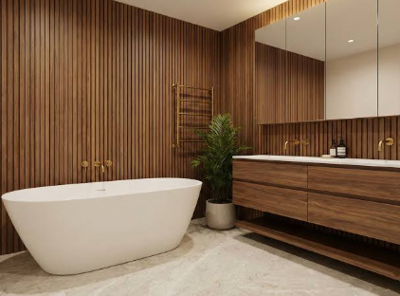

Yes, moisture-resistant wall panels can be used in a bathroom, but it depends where you plan to fit them.
They can be a good choice for walls exposed to steam, condensation and the occasional splash, such as behind a toilet or around a vanity unit. However, moisture-resistant does not mean waterproof. They are two very different things, and moisture-resistant panels should not be used inside showers, wet rooms or anywhere regularly exposed to running water.
What is the difference between moisture-resistant and waterproof panels?
This is the most important thing to understand before choosing wall panels for a bathroom.
Moisture-resistant panels are made to cope better with humid conditions than standard wall panels. They are less likely to swell or become damaged when exposed to steam, condensation or small amounts of water.
Waterproof panels, on the other hand, are designed for much wetter areas. When fitted and sealed correctly, they can be used in places that regularly come into direct contact with water, such as shower enclosures and the walls around a bath with an overhead shower.
Moisture-resistant and waterproof are not interchangeable terms. A panel can be suitable for a humid bathroom without being suitable for the inside of a shower.
Always check the product information before fitting any wall panels in a bathroom. The manufacturer should make it clear whether it is moisture-resistant, waterproof or suitable for direct water exposure.
Why use moisture-resistant panels in a bathroom?
Bathrooms are naturally humid spaces. Every hot shower or bath releases moisture into the air, which then settles on walls, windows and other surfaces as condensation.
Standard MDF and untreated timber can absorb this moisture over time. This may cause the material to swell, warp or lose its finish.
Moisture-resistant panels are made to perform better in these conditions. They are a useful choice when you want the look of decorative wall panelling in a room where ordinary materials may struggle.
They still need to be installed and finished properly, though. A moisture-resistant core will not protect the panel if exposed edges, joins or cut sections are repeatedly soaked.
Where can moisture-resistant wall panels be used?
The right location will depend on how much contact the wall has with water.
Behind a toilet
The wall behind a toilet is usually exposed to bathroom humidity, but not regular splashes or running water.
This makes it a good spot for moisture-resistant panelling. Half-height shaker-style panelling can add character without making the room feel too busy.
Around a vanity unit
Moisture-resistant panels may also work around a vanity unit or bathroom sink, provided they are not regularly soaked.
The area directly behind the taps is likely to receive the most splashes, so you may want to use a waterproof splashback or another suitable surface there.
Make sure that any joins and exposed edges are properly sealed.
On a bathroom feature wall
A feature wall away from the bath or shower is another suitable option.
You could install panelling behind a freestanding vanity unit, around shelving or on the wall opposite the bath. This gives you the decorative look of wall panelling while keeping it away from the wettest parts of the room.
In a downstairs toilet
Moisture-resistant wall panels can also work well in a downstairs toilet or cloakroom.
These rooms usually contain a sink but no bath or shower, so they experience less steam and moisture than a main bathroom. Panelling can add detail to a small room that may otherwise feel quite plain.
Where should you avoid using moisture-resistant panels?
Moisture-resistant panels should not be used anywhere that requires a fully waterproof surface, unless the manufacturer specifically says the product is suitable.
This may include:
- Inside a shower enclosure
- Within a wet room
- Directly above a bath with an overhead shower
- Walls exposed to frequent running water
- Areas where water is likely to collect
- Locations where exposed panel edges will regularly get wet
For these areas, you should use waterproof bathroom panels, tiles or a suitable waterproof wall system.
Do not assume that applying bathroom paint or sealant will turn a moisture-resistant panel into a waterproof one. The panel, adhesive, joins and overall installation method must all be suitable for the level of water exposure.
Are bathroom wall panels better than tiles?
It depends on the part of the bathroom you are decorating.
Tiles are a well-established choice for showers and other wet areas. Waterproof bathroom panels can also be used in these spaces when they are fitted according to the manufacturer’s instructions.
Moisture-resistant decorative panels are better suited to the drier parts of the room. Their main purpose is usually to add character, rather than to create a waterproof barrier.
You do not necessarily have to choose one material for the whole bathroom. You could use tiles or waterproof panels around the bath and shower, then add moisture-resistant decorative panelling behind the toilet or around the vanity unit.
This gives you practical protection where it is needed while still allowing you to introduce more detail elsewhere in the room.
What are the benefits of moisture-resistant bathroom panelling?
It adds character
Wall panelling can bring shape and depth to a bathroom that would otherwise have plain painted walls.
Shaker-style panels can work well in a traditional bathroom, while simple vertical panels can suit a more modern space.
It can be affordable
You do not need bespoke joinery to add wall panelling to a bathroom.
A low-cost moisture-resistant wall panelling pack can provide the pieces needed to create the look yourself. This is often more affordable than ordering custom-made timber panels or paying for professional fitting.
It can be suitable for DIYers
A straightforward wall panelling design can be fitted by many confident DIYers.
Using a ready-made pack can make the job easier because the individual pieces are supplied in consistent sizes. You will still need to measure carefully, plan the spacing and make sure everything is level before fixing the panels in place.
It can be repainted
Painted wall panelling gives you the option to change the colour of your bathroom later.
Rather than removing the panels, you may be able to prepare and repaint them using products suitable for the panel material and a humid environment.
Choosing the right wall panels for your bathroom
Before buying bathroom wall panels, check:
- Whether they are moisture-resistant or fully waterproof
- Whether they are suitable for direct contact with water
- Which parts of a bathroom they can be used in
- Whether cut edges need sealing
- Which adhesive is recommended
- Whether they need to be primed and painted
- How the joins should be finished
A moisture-resistant wall panelling pack can be an affordable way to add character to the drier parts of a bathroom. Just make sure you understand what the panels are designed to cope with before fitting them.
So, are moisture-resistant wall panels suitable for bathrooms?
Moisture-resistant wall panels are suitable for many parts of a bathroom, including behind toilets, around vanity units and on feature walls away from direct water.
They are designed to handle humid conditions and occasional splashes better than standard panels. They are not, however, the same as waterproof panels.
For showers, wet rooms and other areas that are regularly soaked, choose a fully waterproof product that is specifically approved for that use. By matching the panel to the right part of the room, you can create a bathroom that looks good and stands up to everyday use.
(0) comments
We welcome your comments
Log In
Post a comment as Guest
Keep it Clean. Please avoid obscene, vulgar, lewd, racist or sexually-oriented language.
PLEASE TURN OFF YOUR CAPS LOCK.
Don't Threaten. Threats of harming another person will not be tolerated.
Be Truthful. Don't knowingly lie about anyone or anything.
Be Nice. No racism, sexism or any sort of -ism that is degrading to another person.
Be Proactive. Use the 'Report' link on each comment to let us know of abusive posts.
Share with Us. We'd love to hear eyewitness accounts, the history behind an article.