
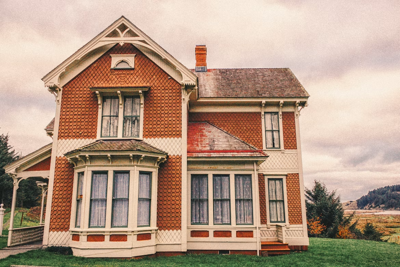

Have you ever gone from one room of an older house to another room and felt a different temperature wash over you?
Old houses have charm that new construction will never mimic. Thick doors, hardwood floors, rooms that were designed with care. They lack an air conditioning system meant for modern living.
Here's the problem:
Homeowners believe the only solution is demolition. Cut open walls. Replace ductwork. Break the bank.
That's almost never necessary.
It's really quite simple: the lion's share of the comfort gap in an older home can be attributed to a short list of fixable items. Airflow, sealing, and equipment that no one has properly maintained for years.
What You'll Pick Up Here:
- Why Older Homes Feel Uncomfortable Today
- Why AC Maintenance Comes Before Demolition
- The Duct Problem Hiding In Your Walls
- Small Upgrades With Outsized Comfort Payoffs
Why Older Homes And Modern Comfort Don't Line Up
Comfort expectations have shifted. Years ago a "comfortable enough" home was one window unit and a fan blowing on the couch. Today everyone wants every room within a degree of the thermostat 24/7.
Older homes were never designed for that. And older homes make up a lot of our housing stock. Owner-occupied housing in the United States now has a median age of 42 years, up from just 31 years in 2005.
They were designed around a different idea of comfort:
- High ceilings and cross-breezes instead of ducted air
- Closed-off rooms rather than open floor plans
- Thin or missing wall insulation
- Cooling added decades later, as an afterthought
That last one kills. Cooling was just added onto a building without any forethought.
Why AC Maintenance Comes Before Demolition
Understand the capability of the existing system before anyone gets a sledgehammer.
Why? A poorly maintained air conditioner in an older house looks like a house that "needs" updating. Poor airflow on the second floor. Dead spot in back bedroom. Increasing bills each summer. These are maintenance issues, not architectural issues.
A thorough AC maintenance visit involves way more than changing a filter. It includes cleaning coils, checking refrigerant levels, assessing blower performance, taking static pressure readings and inspecting ductwork. Scheduling five-star AC & HVAC services for a comprehensive inspection costs only pennies compared to a replacement, and it may correct the issue completely. Routine AC maintenance can also ensure a system operates close to its rated efficiency rather than slowly losing power year after year.
More than most realise. 19% of all residential electricity use goes towards air conditioning, according to the EIA. Operating at 70% of optimal, your system is losing you money every hour it is on.
Measure first. Demolish later — if ever.
The Duct Problem Hiding In Your Walls
Want to know the single biggest reason old homes cool unevenly?
The ducts.
Retrofit duct systems found in older homes were typically shoehorned wherever space allowed. Existing chimney chases. Closet corners. Crawls spaces. Often return air paths were completely eliminated because there was no logical place to route them.
Leaks. It's more than most people realize. According to ENERGY STAR, 20 to 30 percent of the air traveling through your duct system is lost due to leaks, holes and poorly connected duct joints in the average home.
Let that sink in. Nearly one-third of the conditioned air you're paying for never makes it to a living space. It dumps into an attic or crawl space.
The fix isn't a renovation. It's sealing:
- Mastic sealant on every joint and seam
- Insulating any duct that runs through unconditioned space
- Adding return air paths to closed-off rooms
- Repairing crushed, kinked or disconnected flex runs
Duct sealing can be a dirty job, but almost every duct can be reached in an attic, basement or crawl space. You shouldn't have to cut into plaster walls or tear out ceilings for proper duct sealing.
Small Upgrades With Outsized Comfort Payoffs
With a healthy system and tight ducts, just a few minor upgrades seal away most of the remainder. None of them even involve altering the structure of your home.
Zoning And Smart Controls
Few older homes cool uniformly. Warm air moves differently upstairs than down. Zoning dampers with smart thermostat and remote sensors allow each zone to maintain it's own setpoint. Say goodbye to the "freezing living room, boiling bedroom" dilemma permanently.
Targeted Air Sealing
Attic hatches, can lights, rim joists and old plumbing penetrations drip drip drip every day. One day of caulk and foam in the attic usually comforts the home better than a multi-thousand dollar window replacement.
Ductless Mini-Splits For Problem Rooms
Additions, sunrooms and converted attics rarely have adequate ventilation. One head can serve those areas without running any ductwork.
Attic Insulation Top-Ups
Blowing insulation over what's already there is quick, inexpensive and totally non-disruptive. It also reduces AC load, thus prolonging equipment life, silently.
Set Realistic Expectations Room By Room
Here's something that gets ignored...
Not all rooms will ever balance ideally in an older house. 83% of pre-1950 homes have air conditioning vs. 93% of post-2010 homes according to EIA data - and if your house is that old, it almost certainly had AC added onto the original design.
Aim for good, not identical.
A realistic target for an older home looks like this:
- Main living areas within one degree of setpoint
- Bedrooms within two to three degrees
- No room more than five degrees off
Hit that, and the house feels modern even though it clearly isn't.
Bringing It All Together
Living in an older home and expecting modern comforts aren't mutually exclusive. It simply requires proper planning.
Begin with what you have. Get equipment appropriately maintained and tuned before declaring it complete. Duct seal, duct losses are where the big dollar savings are lurking. Follow up with zoning, air sealing and insulation where they will have the greatest impact.
Air conditioning is no longer a luxury afforded by 88% of American households. Comfort is a given these days — even in an old house without central air.
Quick recap:
- Service and test the existing AC first
- Seal and insulate the ductwork
- Add zoning and smart controls
- Air seal the attic and top up insulation
- Use mini-splits for the rooms that can't be reached
None of that requires gutting. You just have to do it in the proper sequence.

(0) comments
We welcome your comments
Log In
Post a comment as Guest
Keep it Clean. Please avoid obscene, vulgar, lewd, racist or sexually-oriented language.
PLEASE TURN OFF YOUR CAPS LOCK.
Don't Threaten. Threats of harming another person will not be tolerated.
Be Truthful. Don't knowingly lie about anyone or anything.
Be Nice. No racism, sexism or any sort of -ism that is degrading to another person.
Be Proactive. Use the 'Report' link on each comment to let us know of abusive posts.
Share with Us. We'd love to hear eyewitness accounts, the history behind an article.