
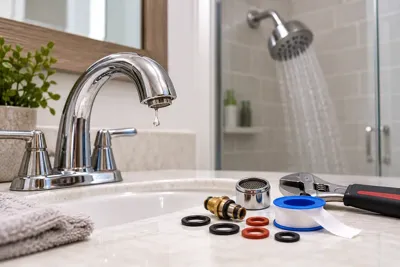

A slow drip has an irritating talent for making itself heard from across the house. More importantly, it is often a small warning that a seal, cartridge, connection or other plumbing component has reached the end of its useful life.
Fortunately, not every leaking faucet or shower calls for an immediate plumbing appointment. Many common fixture leaks can be traced to relatively inexpensive parts, and a few well-chosen products can make diagnosing and repairing the problem considerably easier. The key is figuring out where the water is coming from before reaching for the toolbox.
Start by Finding the Source of the Leak
A faucet dripping from its spout is different from water appearing around the base of the fixture, just as a showerhead that drips after use is different from water escaping behind a shower wall. Before replacing anything, dry the fixture thoroughly and watch where the moisture first appears.
The EPA WaterSense program recommends routinely checking household plumbing for leaks. The agency notes that worn fixtures, corrosion, installation problems and irregular water pressure can all contribute to water loss. If the problem is isolated to a faucet or shower fixture rather than concealed plumbing, one of the following products may provide a relatively straightforward solution.
1. A Faucet Repair Kit for Worn Internal Parts
When water continues dripping from the spout after the handle has been completely shut off, the culprit is often inside the faucet. Seats, springs, cartridges, washers and seals wear over time and may no longer create a watertight closure.
A model-specific repair kit can be far more sensible than replacing an otherwise attractive fixture. For example, the DANCO Repair Kit for Delta and Peerless Faucets contains replacement components intended to restore the seal in compatible faucets. The important word is compatible. Faucet cartridges and internal hardware are not universal, so identify the manufacturer and preferably the model number before buying replacement parts.
2. Replacement O-Rings for Leaks Around the Base
If the faucet works normally but water appears around the base of the spout whenever it is running, an aging O-ring may be responsible. These small rubber seals sit between moving plumbing components and can flatten, crack or deteriorate after years of use.
An assortment such as the DANCO O-Ring Assortment can be useful to keep with basic household repair supplies. However, size matters. An O-ring that looks almost correct may still leak, so compare the old seal carefully with its replacement rather than forcing the nearest available size into place.
3. A Replacement Cartridge for a Persistent Drip
Modern single-handle faucets and shower controls frequently rely on cartridges rather than traditional washers. When the cartridge becomes worn or mineral deposits interfere with its internal seals, symptoms can include dripping, difficulty shutting the water off completely, inconsistent temperature control or water leaking around the handle.
Replacing the cartridge can often restore the fixture without replacing the entire faucet or shower valve. Some repair kits are made specifically for particular brands and faucet families. This is another repair where taking a photograph of the existing cartridge—or bringing the removed part to a plumbing supplier—can prevent purchasing an almost-identical component that does not actually fit.
4. Plumber's Tape for the Right Threaded Connection
Thread-seal tape, commonly called plumber's tape or PTFE tape, belongs in nearly every household tool kit. Wrapped correctly around compatible threaded plumbing connections, it helps create a reliable seal and can be useful when installing certain showerheads and threaded fittings.
What it cannot do is repair every drip. Wrapping tape around the outside of a leaking faucet or covering a failed seal is not a repair. If water is escaping from a cartridge, O-ring, compression fitting or damaged pipe, the defective component still needs to be addressed. Think of thread-seal tape as a product for the correct threaded connection rather than an all-purpose cure for water leaks.
5. A Leak Detector for Water You Cannot Easily See
The most concerning leak is often not the faucet you can hear dripping but the one quietly putting water where it does not belong. Small electronic moisture sensors placed beneath sinks, near vanities or beside other plumbing fixtures can provide an early warning before a slow leak damages cabinetry or flooring.
More sophisticated systems can monitor water flow through the home and identify unusual consumption patterns. EPA WaterSense notes that moisture-sensing devices can detect water at specific leak-prone locations, while whole-home flow-monitoring systems can identify irregular water use and, depending on the system, may even work with an automatic shutoff valve.
When a Leaky Shower Needs More Than a DIY Repair
There is an important distinction between a leaking shower fixture and a leaking shower. A dripping showerhead or worn valve cartridge may be a manageable repair. Water appearing outside the enclosure, beneath the shower pan, through a ceiling below the bathroom or inside the wall deserves considerably more attention.
Those symptoms can point to damaged waterproofing, drain connections, supply plumbing or a failed shower pan rather than a replaceable faucet component. Repeated caulking is not a substitute for finding the source. If water is reaching drywall, flooring, framing or another room, shutting off the affected supply and calling a qualified plumber or appropriate waterproofing professional is the safer approach.
Know When Repairing Makes Sense
A quality faucet does not need to be discarded simply because one inexpensive internal component has worn out. Replacing an O-ring, cartridge, washer or spring can extend the life of a fixture and eliminate unnecessary water waste. It is one of those home repairs where a few dollars in the right part can occasionally save hundreds in replacement costs.
But plumbing rewards accurate diagnosis rather than improvisation. If the source cannot be identified, the shutoff valve itself is leaking, there is visible corrosion, water pressure behaves abnormally or moisture keeps returning after a repair, professional help becomes the sensible investment. The goal is not simply to silence the drip. It is to make certain the water is staying exactly where the plumbing system was designed to keep it.




(0) comments
We welcome your comments
Log In
Post a comment as Guest
Keep it Clean. Please avoid obscene, vulgar, lewd, racist or sexually-oriented language.
PLEASE TURN OFF YOUR CAPS LOCK.
Don't Threaten. Threats of harming another person will not be tolerated.
Be Truthful. Don't knowingly lie about anyone or anything.
Be Nice. No racism, sexism or any sort of -ism that is degrading to another person.
Be Proactive. Use the 'Report' link on each comment to let us know of abusive posts.
Share with Us. We'd love to hear eyewitness accounts, the history behind an article.